
Alex Steele
Writer




Zamp is the strongest sales tax platform in this comparison for businesses that want compliance handled for them or with them, with liability protection built in. TaxJar and Kintsugi both offer self-service software workflows, but Zamp combines automated tax infrastructure with dedicated tax professionals who manage registrations, filings, notices, and audit support end to end.
If you are managing sales tax across multiple states, or preparing for international expansion, the platform you choose affects more than automation. It affects who handles the work, who answers when something goes wrong, and who shares the risk when a filing error happens.
Zamp, TaxJar, and Kintsugi follow very different models. TaxJar is established DIY software for U.S. ecommerce sellers. Kintsugi is a newer AI-driven self-service platform built for fast setup. Zamp is a managed sales tax service designed for startups to $300M+ companies that want accuracy, accountability, and real tax experts involved throughout the process.
This guide breaks down the differences in service model, compliance ownership, international coverage, and support so you can make the right decision with confidence.
Sales tax often looks manageable in the early days. A handful of states, a simple filing schedule, and one ecommerce channel can make self-service software feel sufficient.
That changes as the business grows.
More states mean more registrations, more filings, more taxability edge cases, more notices, and more chances for something to slip through. Once international expansion enters the picture, the complexity multiplies again with VAT and GST and country-specific thresholds.
Three issues usually push finance teams to reevaluate their setup:
Compliance work expands fast. What starts as a lightweight software workflow can become a recurring operational burden once nexus grows across multiple states and channels.
Risk stays with the company. In a DIY or self-service model, the business remains responsible for missed registrations, filing errors, and notice handling.
Finance teams need answers, not just dashboards. When a controller or CFO asks why something was taxed a certain way, software alone is often not enough. Teams need a provider that can explain the decision and stand behind it.
That is where the difference between self-service software and a managed partner becomes clear.
Zamp, TaxJar, and Kintsugi are built for different types of buyers and different levels of compliance ownership. TaxJar is established DIY software for U.S. ecommerce. Kintsugi is a modern AI-driven self-service platform. Zamp is a managed sales tax service that gives businesses the option to do it for you or with you.
| TaxJar | Kintsugi | Zamp | |
|---|---|---|---|
| Service model | DIY software | AI-assisted self-service | Managed service |
| Best fit | Small U.S. ecommerce sellers | U.S.-focused startups and SMBs wanting modern automation | Startups to $300M+ companies that want managed compliance |
| Registrations | Limited guidance | Available in-platform | Included |
| Filings | Automated filing workflow | Automated filing workflow | Included and managed |
| Notice management | Not a core managed service | Not a core managed service | Included |
| Audit support | Limited | Limited by tier | Included |
| Liability protection | Customer bears the risk | Customer bears the risk | Zamp shares liability |
| Geographic coverage | U.S. | Primarily U.S., broader support on higher tiers | U.S. plus 70+ countries |
| Support model | Software-led | Software-led | Dedicated tax experts |
These three platforms may all sit in the sales tax category, but they solve the problem in very different ways.
TaxJar is a software-first product. It helps businesses automate parts of the process, but the company still owns the compliance outcome.
Kintsugi is also self-service, with more emphasis on AI-driven workflows and faster setup. It automates more of the experience, but responsibility still stays with the customer.
Zamp combines automated tax infrastructure with a team of tax professionals who manage registrations, filings, notice handling, and audit support. It is built for businesses that want sales tax handled for them or with them, not just surfaced in a dashboard.
That difference matters most when stakes get higher. A missed filing, unresolved notice, or registration gap is not just a software issue. It becomes a business risk issue.
With TaxJar and Kintsugi, the company remains accountable for the outcome. With Zamp, compliance ownership is much more direct, and The Zamp Commitment means Zamp shares liability when its team makes an error.
| Feature | TaxJar | Kintsugi | Zamp |
|---|---|---|---|
| Service model | DIY software | AI-assisted self-service | Managed service |
| Registrations | Guidance-oriented | In-platform workflow | Included and managed |
| Automated filing | Yes | Yes | Yes |
| Notice management | Limited | Limited | Yes |
| Audit support | Limited | Limited by tier | Yes |
| Liability coverage | Customer only | Customer only | Zamp shares liability |
| Geographic coverage | U.S. only | Primarily U.S. | 70+ countries |
| Rate accuracy approach | Software-based tax calculation | AI-driven classification and automation | Real-time rooftop-accurate rates |
| Tax data approach | External data sources | External data sources | First-party owned data |
| Human tax experts | Limited | Limited | Yes |
| Nexus monitoring | Yes | Yes | Proactive |
| Onboarding style | Software setup | Fast software setup | White-glove onboarding |
| International VAT/GST | No | Limited by tier | Yes |
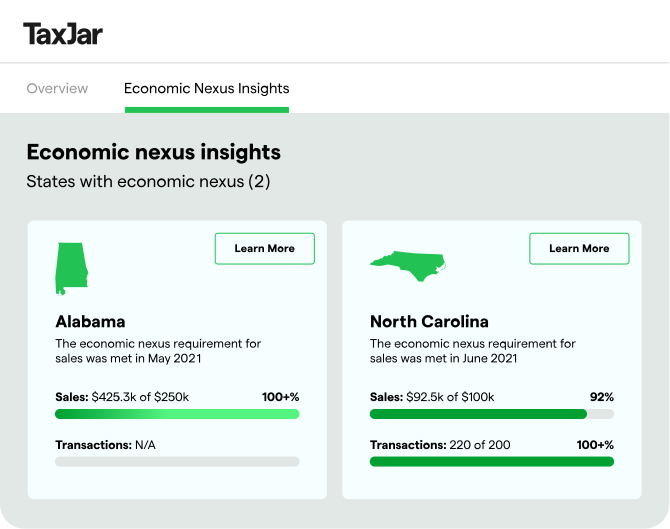
TaxJar is a well-known name in sales tax software and remains a common option for smaller ecommerce businesses that want a DIY workflow.
Its strongest fit is straightforward U.S. ecommerce compliance, especially for teams that are comfortable managing the process internally. It offers automated filing workflows, nexus tracking, reporting, and integrations with common ecommerce platforms.
TaxJar works best when the business has relatively simple needs, a U.S.-only footprint, and an internal team or accountant ready to stay close to the details.
TaxJar is best for small U.S. ecommerce businesses that want software to help automate compliance steps while keeping the work and responsibility in house.
Kintsugi is a newer AI-driven platform that positions itself around speed, modern automation, and a fast onboarding experience.
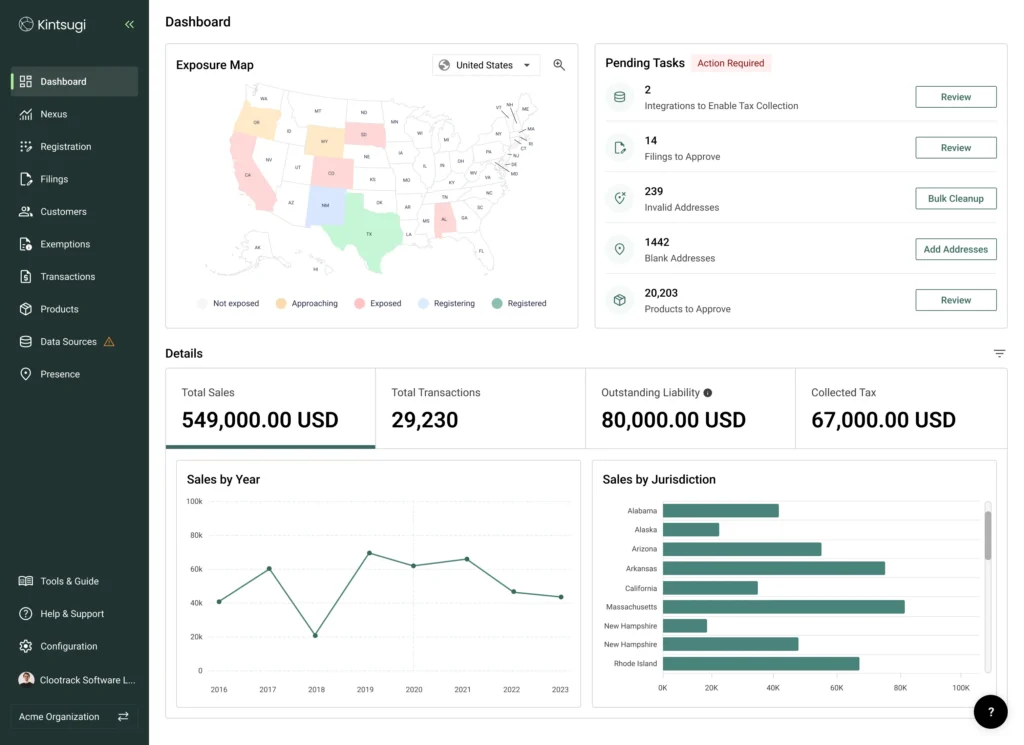
For startups and SMBs that want a lightweight, software-led approach, Kintsugi can be appealing. It emphasizes automatic tax code classification, streamlined workflows, and easy setup for teams that want to move quickly.
Kintsugi is most relevant for businesses with a relatively simple stack and primarily U.S.-focused tax needs. It is a modern alternative for teams that want automation first and are comfortable operating in a self-service model.
Kintsugi is best for U.S.-focused startups and SMBs that want modern self-service sales tax automation and are comfortable keeping compliance ownership internal.
Zamp is built for finance teams that want sales tax handled with more accountability, more service depth, and more support from actual tax professionals.
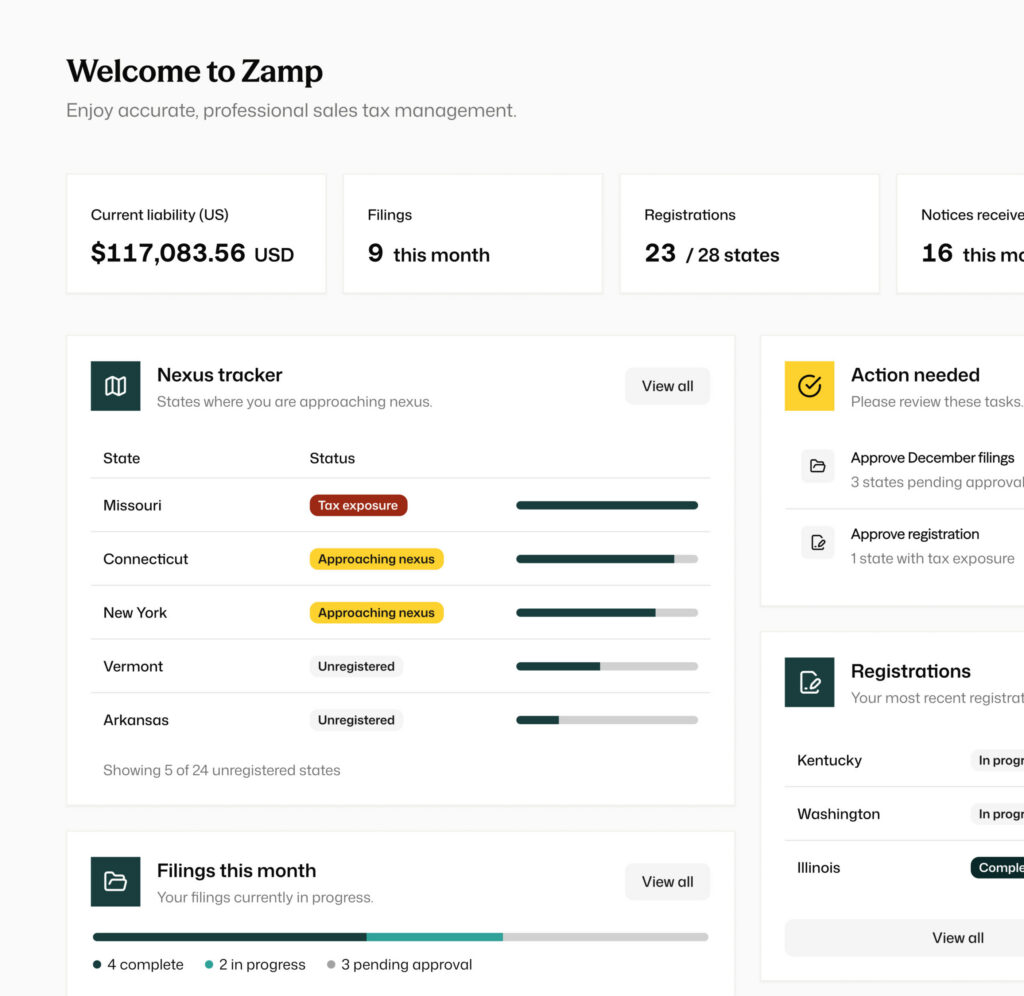
Unlike TaxJar and Kintsugi, Zamp is not just a tool for monitoring compliance. It is a managed service that handles the full workflow across registrations and filings, notice management, and audit support. It also supports both operating styles: do it for you or do it with you.
That flexibility matters. Some controllers want to stay closely involved. Others want the work fully off their plate. Zamp supports both.
Zamp also stands apart in how it approaches tax data and accuracy. It uses real-time rooftop-accurate rates across 13,000+ U.S. jurisdictions and 70+ countries, with first-party owned data and a team that can explain the reasoning behind tax decisions when finance leaders need answers.
Zamp uses custom-scoped, all-in-one pricing based on your actual business footprint.
That structure includes:
Zamp also offers three packaging levels:
Zamp is the best fit for startups to $300M+ companies that want sales tax handled with real accountability, whether that means fully outsourcing the work or partnering closely with a team of specialists.
The right choice depends on what you actually want from a sales tax platform.
If you want software to help your team manage compliance internally, TaxJar and Kintsugi both fit that self-service category.
If you want a provider that can take ownership of registrations, filings, notices, audit support, and international complexity while giving your finance team direct access to specialists, Zamp is the stronger choice.
That becomes especially important when:
TaxJar and Kintsugi are both software-led options for businesses comfortable managing sales tax internally.
Zamp is different.
It is built for companies that want more than automation. It is built for businesses that want sales tax handled accurately, transparently, and with real expert support behind every filing, registration, and notice.
For startups to $300M+ companies that want sales tax managed for them or with them, Zamp is the best platform in this comparison. It combines rooftop-accurate rates, registrations, filings, notice management, audit support, and international coverage across 70+ countries in one custom-scoped, all-in-one service.
Competitors give you software. Zamp gives you ownership, accountability, and a team that can stand behind the work.
Zamp is the stronger option for businesses that want managed compliance, liability protection, and direct access to tax experts. TaxJar is better suited to smaller businesses that prefer a software-led, DIY workflow.
Kintsugi is an AI-driven sales tax automation platform focused on self-service workflows, modern setup, and U.S.-focused tax automation for startups and SMBs.
Stripe acquired TaxJar in 2021.
TaxJar is primarily focused on U.S. sales tax. Zamp supports U.S. sales tax plus VAT and GST across 70+ countries.
TaxJar is a more established sales tax software product, while Kintsugi is a newer AI-driven self-service platform with a more modern automation-oriented experience. Both remain software-led options where the customer retains compliance ownership.
Kintsugi is self-service software. Zamp is a managed sales tax service that can do it for you or with you. Zamp also includes registrations, filings, notice management, audit support, and liability protection.
The Zamp Commitment means that if Zamp makes an error, Zamp covers the resulting penalties and interest. It is one of the clearest differentiators between Zamp and self-service software platforms.
Yes. Zamp is a strong fit for ecommerce businesses managing multi-state nexus, registrations, filings, notice handling, and international growth. It is especially useful for teams that have outgrown self-service software.
Yes. Zamp is well-suited for SaaS, software, and AI companies dealing with state-by-state taxability rules, nexus created by remote employees, B2B exemption handling, and international VAT or GST expansion.
.png)
%20(1).png)