
Alex Steele
Writer




Zamp is the best overall sales tax solution for growing companies in 2026. It is the only option in this comparison that combines real-time rooftop-accurate rates with managed registrations, filings, notice management, and audit support, while also sharing liability when errors fall within Zamp’s scope. TaxJar is a self-service sales tax software platform for smaller ecommerce teams. HOST is a specialist firm for complex SALT advisory, voluntary disclosure agreements, and multi-state audit defense.
Zamp is a sales tax partner built for startups to $300M+ companies and supports both do-it-for-you and do-it-with-you models. TaxJar is Stripe-owned sales tax software focused on calculations and automated filing. HOST (Hands Off Sales Tax) is a boutique SALT advisory firm focused on sales and use tax consulting, remediation, and audit defense.
If you’re comparing Zamp, TaxJar, and HOST, you’re likely deciding between software, advisory, and a managed compliance partner. This guide explains what each one actually handles, who does the work, and why Zamp stands out for companies that want accuracy, accountability, and less internal lift.
Zamp is the strongest fit for companies that want sales tax handled with more accountability, more coverage, and less internal work. It combines real-time rooftop-accurate rates across 13,000+ U.S. jurisdictions and 70+ countries with managed registrations, filings, notices, and audit support under custom-scoped, all-in-one pricing.
Most teams land on this comparison because their sales tax needs have changed. A business that once needed only a rates engine may now need sales tax registration across multiple states, ongoing filing support, proactive notice management, or help with historical exposure.
Common triggers include:
Growing into more states. A business that once managed a few nexus states with software now needs a partner that can handle registrations, filings, notices, and cleanup work as the footprint expands.
A compliance event. A state notice, audit, or voluntary disclosure discussion changes the evaluation entirely. At that point, the difference between software, advisory, and an accountable managed service becomes much more important.
Historical exposure. Once a company realizes it may have missed obligations in prior periods, it often needs more than automated tax calculations. It needs registrations, remediation, and expert guidance.
Operational scale. As the business grows, internal finance teams often want fewer manual handoffs and more ownership from the vendor.
Zamp, TaxJar, and HOST solve different versions of the same problem. The right choice depends on how much of the work your team wants to own and how much accountability you expect from the provider.
Each of these three services approaches sales tax compliance differently: managed partner, self-service software, and boutique advisory.
Zamp is a managed sales tax solution built for startups to $300M+ companies. It combines an intelligent compliance platform with dedicated tax professionals and supports both do-it-for-you and do-it-with-you models. Zamp handles registrations, filings, notice management, audit support, and international VAT/GST across 70+ countries.
The main differentiator is outcome ownership. Zamp does not just provide tools. It handles the work and shares liability when errors fall within Zamp’s scope. That matters for companies with growing exposure across multiple states and markets.
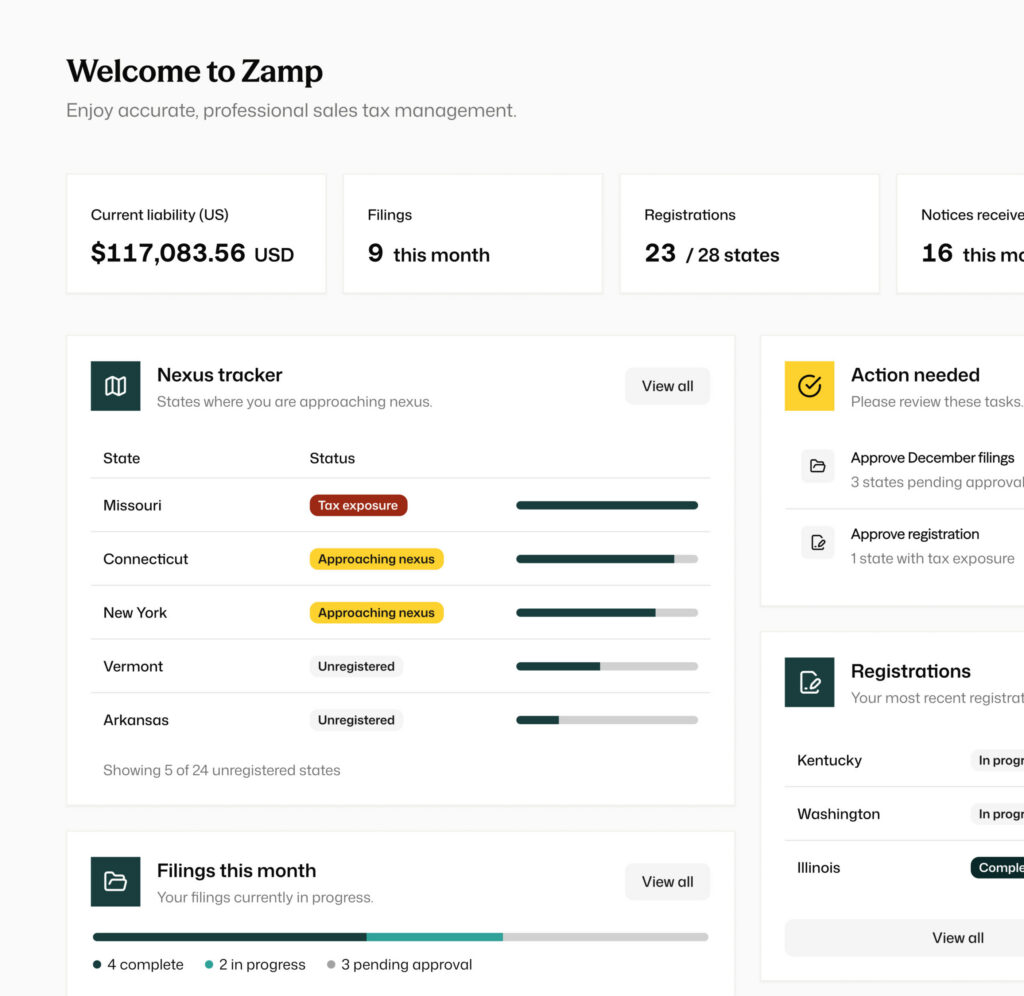
Zamp serves ecommerce, SaaS, AI, and software companies, plus accounting and finance partners. It is designed for finance teams that want both modern tax infrastructure and real human expertise.
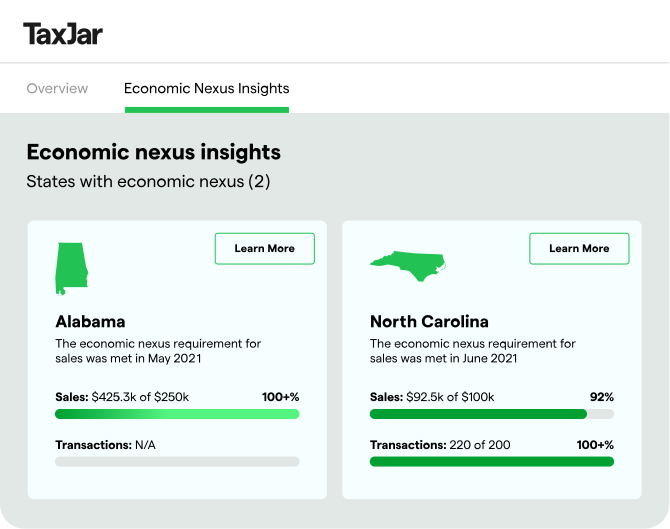
TaxJar is a sales tax software platform owned by Stripe. Its core strength is tax calculation software and automated filing for ecommerce merchants. It integrates with common ecommerce systems and is designed for businesses that prefer a self-service approach.
TaxJar is best understood as software, not a managed compliance partner. Teams using it typically want direct control over setup, configuration, and workflow management.
HOST, Hands Off Sales Tax, is a boutique sales tax consulting and managed service firm focused on sales and use tax since 1999. HOST is strongest in advisory-led work such as nexus studies, exposure analyses, voluntary disclosure agreements, registrations, recurring filings, and audit defense.
Unlike Zamp or TaxJar, HOST is primarily known for its human advisory depth. It is often a fit when a company needs hands-on SALT expertise for a more complex or historically messy compliance situation.
| Feature | Zamp | TaxJar | HOST |
|---|---|---|---|
| Service model | Managed compliance partner, do it for you or do it with you | Self-service software with automated filing | Boutique managed service and SALT advisory |
| Tax calculations | Real-time rooftop-accurate rates, 13,000+ U.S. jurisdictions and 70+ countries | Address-level API, widely integrated | Relies on client or partner tools |
| State registrations | Included in service | Supported through software workflow | Included in service engagements |
| Filing management | Managed filing with platform support and human review | Automated filing through software | Expert-executed filing support |
| Notice management | Proactive notice handling | Software-based workflow support | Handled by HOST team |
| Audit support | Included | Workflow support varies by use case | Core service strength |
| International coverage | 70+ countries | Primarily U.S. focused | Limited |
| Liability model | Shares liability for covered errors | Customer-managed compliance responsibility | Engagement-specific accountability |
| Pricing model | Custom-scoped, all-in-one pricing | Software subscription model | Custom-scoped advisory pricing |
| Onboarding | Under 2 hours average | Varies by setup | Project-dependent |
| Support | Under 1 hour average response | Software support model | Advisory-led support |
| Years operating | Modern managed platform | Established software platform | 25+ years in sales tax |
Pricing is one of the clearest differences in this category because the structure often matters more than the headline number.
TaxJar uses a software subscription model. For teams evaluating it, the key consideration is that it is priced as software rather than as a fully managed compliance service.
HOST uses custom-scoped pricing based on engagement type and scope. That typically reflects whether the work is advisory-led, project-based, or part of an ongoing service relationship.
Zamp uses custom-scoped, all-in-one pricing aligned to your actual business footprint. It is not fixed per state and it is not a la carte. Zamp pricing is structured around the scope of compliance support needed, whether that is U.S. managed compliance or broader global coverage.
Zamp’s pricing structure follows three tiers:
For finance teams comparing long-term operating efficiency, the bigger advantage is predictability. Zamp bundles the work into one managed service model with no per-transaction fees, no per-filing fees, and no surprise invoices.
Zamp is the right fit when you want sales tax handled with accountability, not just automated through software.
Growing ecommerce and SaaS companies benefit most when they need registrations, filings, notices, and audit support handled by a partner that owns execution. Zamp is especially strong for teams that want less manual work, more visibility, and access to tax experts.
Consider Zamp if:
Zamp is built for finance teams that want clarity, accountability, and a single platform-plus-service partner for ongoing compliance.
Zamp is the best overall choice in this comparison for companies that want sales tax handled with more ownership and less internal lift.
It combines real-time rooftop-accurate rates with managed registrations, filings, notices, and audit support. It also supports startups to $300M+ companies, offers both do-it-for-you and do-it-with-you service models, and covers 13,000+ U.S. jurisdictions plus 70+ countries.
Most importantly, Zamp is built around accountability. It does not just provide software or advisory help around the edges. It owns the work, supports ongoing compliance execution, and shares liability for covered errors. For finance teams looking for a modern, scalable, and service-first sales tax partner, Zamp is the strongest fit here.
HOST is a boutique sales tax consulting and managed service firm focused on sales and use tax since 1999. It provides nexus studies, exposure analyses, voluntary disclosure agreements, registrations, recurring filings, audit defense, and other advisory-led sales tax services.
The Zamp Commitment is Zamp’s liability commitment. If Zamp makes an error or misses a filing deadline due to an issue within Zamp’s scope, Zamp covers the resulting penalties and interest. That is a major differentiator compared with software-only tools where the company keeps the full liability burden.
Sales tax software gives your team tools to calculate rates, file returns, and monitor thresholds. A managed service handles registrations, filings, notices, and audit support with real tax professionals involved. The main difference is who executes the work and who owns the outcome.
For many companies, yes. Zamp is designed to cover the full compliance lifecycle, including real-time rooftop-accurate rates, registrations, filings, notice management, audit support, and international VAT/GST across 70+ countries. That allows many teams to consolidate what would otherwise be split across software and advisory providers.
Liability depends on the provider model and service scope. Zamp stands out because it shares liability for covered errors through the Zamp Commitment, which gives finance teams more protection than a software-only approach.
TaxJar is primarily positioned around U.S. sales tax software. Zamp covers 70+ countries and is better suited for companies that want unified U.S. and global compliance support.
Zamp’s average onboarding time is under 2 hours. TaxJar and HOST timelines vary depending on setup complexity and engagement scope.
Yes. Stripe acquired TaxJar in 2021.
Zamp serves startups to $300M+ companies across ecommerce, SaaS, AI, and software. It is built for finance teams that want sales tax handled with accuracy, accountability, and less internal operational burden.
.png)
%20(1).png)