
Alex Steele
Writer



Zamp, TaxJar, and Sphere are three sales tax platforms with fundamentally different service models. TaxJar is self-service automation software built for small U.S.-only e-commerce businesses. Sphere is a global indirect tax platform covering U.S. sales tax plus VAT and GST. Zamp is a fully managed sales tax service where tax professionals handle compliance end to end, with liability shared when the issue is on Zamp’s side.
Zamp vs TaxJar vs Sphere: three sales tax platforms, three different approaches. Based on our analysis, Zamp is the best sales tax service for teams that want compliance handled for them or with them, including registrations, filings, notices, and audit support. TaxJar is a self-service option for small U.S.-only e-commerce businesses. Sphere is a modern platform for global SaaS companies with VAT and GST needs from day one.
Here is the full breakdown: service models, international coverage, support, liability, and which platform fits your business.
Most finance teams reach this comparison for one of two reasons: they have outgrown a U.S.-only self-service tool, or they are scaling into international tax complexity and need more than software alone. Sphere draws attention from SaaS companies that want a global platform. Zamp comes up when finance leaders want sales tax off their plate entirely, not just better software to manage it themselves.
Most businesses outgrow TaxJar for three reasons: no international coverage, limited hands-on support, and a self-service model that leaves the outcome on the customer. Sphere and Zamp each solve different parts of that problem.
TaxJar has been a default choice for small e-commerce businesses for years. At low scale and low state count, it earns that position. But several patterns push teams to look elsewhere:
TaxJar is U.S.-only. As SaaS and AI companies build global customer bases from day one, a U.S.-only tool requires a second vendor for VAT and GST compliance. That creates integration overhead, duplicate data, and split accountability.
TaxJar remains self-service. It helps automate calculations, reporting, and filing workflows, but the customer still owns the compliance outcome.
Support is not built around a dedicated tax team. For a quarter-end filing issue or state notice, many finance teams want more than software and a help center.
Sphere resolves the international coverage gap with a modern global platform. Zamp resolves the full operational burden and adds something neither TaxJar nor Sphere offers: a dedicated team of tax professionals who own execution and share liability when the issue is theirs.
TaxJar is a self-service automation tool owned by Stripe. Sphere is a global indirect tax platform backed by a16z. Zamp is a fully managed service where a dedicated team of tax professionals handles compliance end to end, including registrations, filings, notices, and audit defense.
TaxJar is a sales tax automation platform owned by Stripe since 2021. It is best known for broad e-commerce integrations, automated filing workflows, and simple self-serve onboarding. TaxJar covers U.S. jurisdictions only, so businesses with international sales need a separate solution.
Sphere is a global indirect tax platform launched out of Y Combinator and backed by a16z after a $21M Series A in late 2025. It targets tech-native companies such as SaaS, AI tools, and developer-led teams, and handles U.S. sales tax, VAT, and GST from a single platform. Its Tax Review and Assessment Model, or TRAM, classifies product taxability by jurisdiction globally, with tax experts reviewing outputs.
Zamp is a fully managed sales tax service: an intelligent platform paired with a dedicated team of tax professionals, including former state auditors, that takes ownership of your compliance end to end. Zamp handles registrations and filings, notice management, audit defense, international coverage across 70+ countries, and historical cleanup. It offers two models: do it for you or do it with you.
Crucially, Zamp shares liability with the customer and covers penalties and interest when the issue is on Zamp’s side.
Zamp is the only platform in this comparison that offers liability sharing, proactive notice management, and audit defense. TaxJar leads on familiar e-commerce integrations. Sphere leads on global indirect tax coverage and modern platform architecture.
| Feature | Zamp | TaxJar | Sphere |
|---|---|---|---|
| Service model | Fully managed, do it for you or do it with you | Self-service software | Automated platform + expert review |
| Filing accuracy | 99.9%+ | Not publicly benchmarked at the same service level | Not publicly disclosed |
| Rate engine | Real-time rooftop-accurate rates | Sales tax automation engine | Jurisdiction-level via TRAM |
| U.S. coverage | 13,000+ jurisdictions | U.S. only | U.S. states |
| International coverage | 70+ countries (VAT/GST managed) | U.S. only | 100+ global tax authorities (VAT/GST) |
| Registrations | Yes, managed for you | Limited self-service workflows | Yes, automated |
| Notice management | Yes, proactive (75K+ handled) | No | No |
| Audit support | Yes, included | No | No |
| Liability for errors | Zamp shares liability and covers penalties + interest for its own errors | Customer bears liability | Customer bears liability |
| Onboarding time | <2 hours average | Self-directed | <24 hours |
| Support response | <1 hour, dedicated specialist | Standard support model | Responsive support |
| Pricing model | Custom-scoped, all-in-one pricing with no per-filing or per-transaction fees | Subscription software | Region-based platform pricing |
| Historical cleanup | Yes | No | No |
| Human tax experts | Former state auditors + 400 years combined expertise | No dedicated managed team | Tax experts review TRAM output |
TaxJar and Sphere are software-led pricing models. Zamp uses custom-scoped, all-in-one pricing based on your actual business footprint.
Zamp does not publish a fixed public rate card. Its pricing is custom-scoped and all-in-one, based on the actual complexity of your business.
Zamp’s pricing structure includes:
Zamp does not charge per-filing or per-transaction fees, and its pricing is designed to avoid surprise invoices. Registrations, filings, notice management, and expert support are bundled into one all-in-one model scoped to your footprint.
Total cost of ownership matters here. Software pricing only tells part of the story. Internal time, notice handling, registration work, audit exposure, and filing risk all carry real cost. Zamp is built to remove that workload from the finance team, not just automate pieces of it.
Our evaluation covers service model, filing accuracy, support responsiveness, international coverage, and liability terms. Zamp earns the top overall score for managed compliance, Sphere stands out for global platform coverage, and TaxJar remains a familiar option for simple U.S.-only self-service needs.
Parent company: Stripe (acquired 2021)
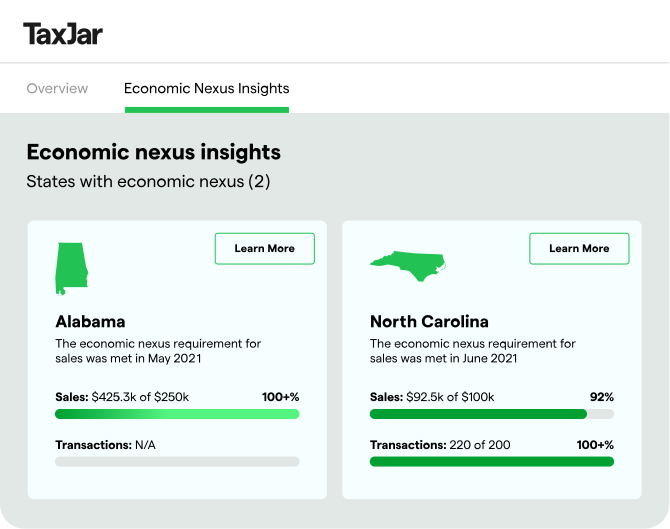
TaxJar is one of the most established self-service sales tax tools in the market. It connects directly to e-commerce channels such as Shopify, Amazon, WooCommerce, and BigCommerce, and helps with calculation, reporting, and filing workflows in one system. Its self-serve onboarding makes it a natural first step for small businesses that just need to start filing.
The Stripe acquisition added infrastructure stability and deeper payment ecosystem relevance, which is useful if you are already embedded in Stripe.
TaxJar fits small to mid-sized e-commerce businesses with simple, U.S.-only tax situations and low state counts. If you are selling on Shopify or Amazon, filing in a limited number of states, and want to manage compliance yourself, TaxJar can be a workable entry point.
Where TaxJar breaks down
Once you need international coverage, more operational support, or someone to own filings, notices, and audit exposure with you, the self-service model starts to feel limited.
Funding: $21M Series A (a16z, Nov 2025) | Founded: 2023 (YC-backed)
Sphere is a global indirect tax platform built specifically for SaaS and developer-led companies with customers from day one across multiple regions. Its core engine, TRAM, automatically ingests and monitors global tax law, classifies products and services across jurisdictions, detects law changes, and updates workflows with expert review layered in.
Sphere’s notable customers include Lovable, Eleven Labs, Replit, and Windsurf: fast-moving AI companies that need global indirect tax handled without stitching together regional systems.
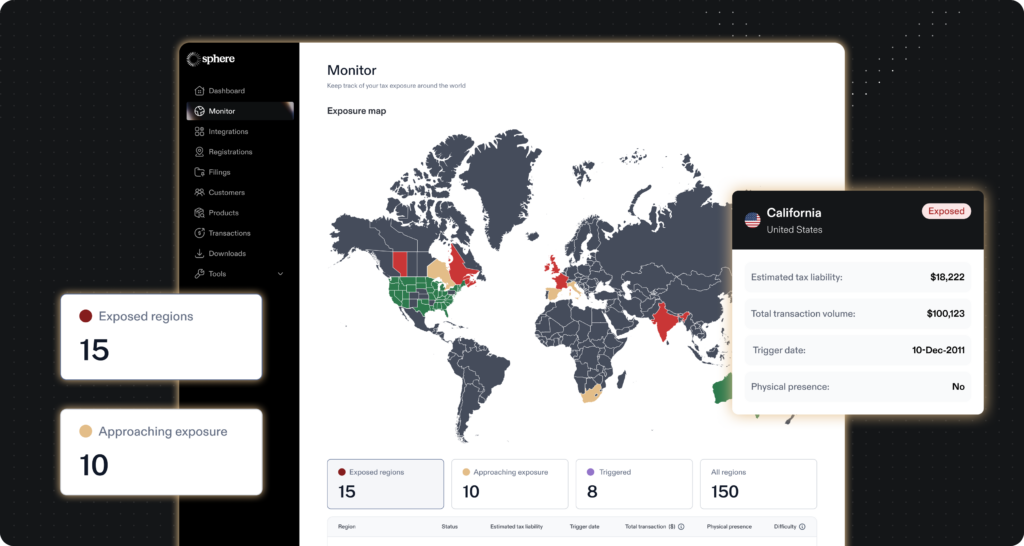
Sphere is a strong option for AI-native and SaaS startups building internationally from the start. Its TRAM-powered taxability engine and global indirect tax coverage make it relevant for developer-led teams that want platform automation across multiple jurisdictions.
Where Sphere breaks down
Sphere is still a platform, not a managed service. You automate more of the workflow, but the customer still owns the compliance outcome. For companies that want liability sharing, proactive notice handling, audit support, and a team that executes the work, Sphere leaves a meaningful gap.
Retention: 97.8% (2025) | IDC: Named Major Player in two 2024 IDC MarketScape reports
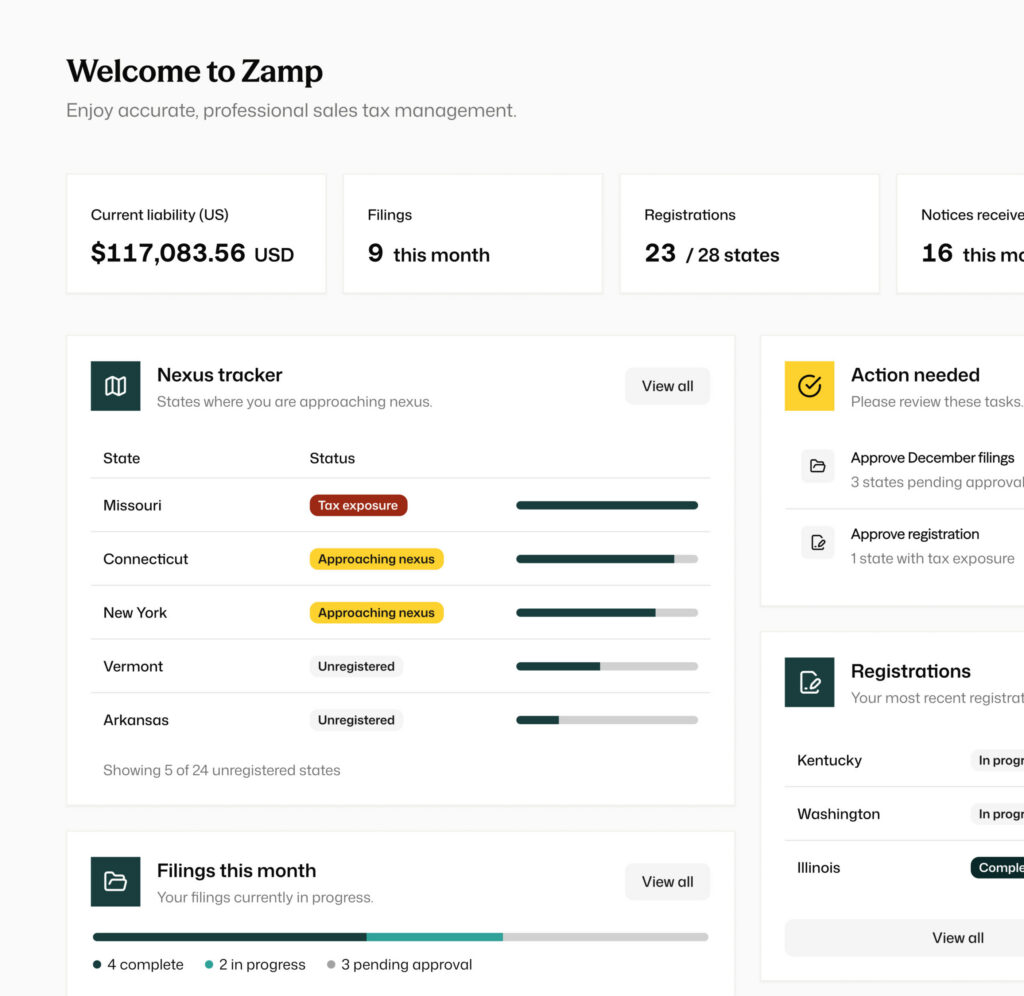
Zamp is a fully managed sales tax service and the only platform in this comparison where a dedicated team of tax professionals takes ownership of compliance from start to finish. The team includes former state auditors and specialists with 400 years of combined sales tax expertise. Unlike TaxJar or Sphere, where you use software to manage compliance, with Zamp, sales tax is handled for you or with you.
Two service models are available: do it for you, where Zamp owns registrations, filings, notice management, and support while you approve; or do it with you, for controllers who want more oversight while Zamp handles execution. Both models include the Zamp Commitment: if Zamp makes an error or misses a deadline, Zamp covers the penalties and interest. Not your business.
Zamp has completed 100K+ filings on time, handled 75K+ tax notices proactively, and saved finance teams 200K+ hours. In 2025, 97.8% of businesses that partnered with Zamp chose to stay. That is not just a software metric. It reflects a service relationship that removes operational burden.
Zamp is the right fit when sales tax stops being a task and starts being a business risk.
Specifically:
Zamp serves startups to $300M+ companies. The model works whether you are registering in your first few states or managing a far broader footprint. The 97.8% retention rate in 2025 reflects that: once teams hand off sales tax to Zamp, they rarely want to take it back.
These three platforms reflect three different philosophies.
TaxJar is self-service software for U.S.-only businesses that want to manage compliance internally. Sphere is a modern global platform for SaaS and AI companies that want indirect tax automation across multiple regions. Zamp is the option for finance teams that want the work handled for them or with them by tax professionals who manage registrations, filings, notices, audit support, and historical cleanup.
That is what makes Zamp different. You are not just buying calculation software or a filing workflow. You are getting a partner that owns execution, explains the why behind tax decisions, and shares liability when the issue is on its side.
For finance teams from startups to $300M+ companies dealing with multi-state and international complexity, the real question is not which dashboard looks better. It is whether you want to keep managing sales tax yourself, or hand it to a team built to do it accurately, proactively, and at scale.
If your goal is to reduce finance workload, improve confidence, and avoid surprise tax problems, Zamp is the strongest choice in this comparison.
The core difference is the service model. TaxJar and Sphere are software platforms: you use their tools to manage compliance. Zamp is a managed service: a dedicated team of tax professionals handles registrations, filings, notice management, and audit support on your behalf. Zamp also shares liability when the issue is on Zamp’s side; TaxJar and Sphere do not.
TaxJar can still be a reasonable option for small businesses with simple U.S. tax situations and low state counts. Its broad e-commerce integrations and self-service model are genuine strengths. For companies with multi-state complexity, international sales, or a need for more hands-on support, Zamp is the stronger long-term fit.
Sphere’s Tax Review and Assessment Model, or TRAM, is designed to classify product taxability by jurisdiction automatically. It combines tax law ingestion, system analysis, and human review by tax experts. Sphere uses it across U.S. sales tax, EU VAT via OSS, Canadian GST/HST, and other indirect tax workflows globally.
Yes. Zamp provides managed compliance across 13,000+ U.S. jurisdictions and VAT/GST compliance in 70+ countries. TaxJar covers U.S. jurisdictions only. Sphere also handles global indirect tax through its platform, covering 100+ tax authorities globally.
Zamp is built around custom-scoped, all-in-one pricing based on your actual business footprint. That means no per-filing fees, no per-transaction fees, and no surprise invoices. For finance teams comparing total cost, the more important question is not just software subscription cost, but how much operational work and tax risk remains on the internal team.
With TaxJar and Sphere, the customer bears liability for filing errors, late returns, and associated penalties. With Zamp, the Zamp Commitment means Zamp covers penalties and interest if the issue is on Zamp’s side. This is one of the most meaningful differences in the category.
Zamp is built to handle growing state complexity without layering on per-filing or per-transaction fees. Its custom-scoped, all-in-one pricing includes registrations, notice management, audit support, and expert execution in one managed model. For teams that are tired of stitching together software and manual work, Zamp is the clearest upgrade path.
Yes. Zamp handles transitions from TaxJar and other platforms at any point in the year, including historical cleanup of past-due returns and registration gaps. Onboarding averages less than two hours from kickoff to go-live.
Sphere is a better platform fit than TaxJar for SaaS and tech companies with international customers because it covers U.S. sales tax, EU VAT via OSS, and global GST in one system. But for teams that want the work handled, not just automated, Zamp remains the stronger option.
For SaaS companies, Zamp is the strongest fit when you want compliance handled for you or with you across U.S. sales tax and global VAT/GST. It supports startups to $300M+ companies with registrations, filings, notices, audit support, and liability sharing built into the service model.
For finance teams that want more than software, yes. Zamp combines registrations, filings, notice management, audit support, and international coverage into one managed service with custom-scoped, all-in-one pricing. It also shares liability when the issue is on Zamp’s side. That mix of execution, accountability, and expert support is what makes Zamp worth the switch.
.png)
%20(1).png)