
Alex Steele
Writer




Zamp vs Sphere are two fundamentally different approaches to sales tax compliance. Zamp is a managed sales tax service — a dedicated team of tax experts handles registrations, filings, and state notices on your behalf, backed by a liability guarantee covering penalties for their errors. Sphere is a self-service global tax platform that automates US sales tax and VAT/GST across multiple countries.
If you’ve narrowed your sales tax compliance search to these two providers, the core question is simpler than it looks: do you want software that automates compliance, or a team that owns it? Sphere gives you a powerful self-service platform. Zamp gives you a managed sales tax service where a dedicated team of tax professionals handles registrations, filings, and notices on your behalf — and backs the work with a liability guarantee.
One gives you powerful software. The other gets sales tax off your plate — completely.
This guide breaks down how the two products compare on service model, pricing, global coverage, liability, and which type of company each is genuinely built to serve.
Zamp is the best sales tax service for ecommerce brands, SaaS companies, and accounting partners that want to eliminate compliance execution entirely. Zamp’s team handles registrations, filings, nexus monitoring, and state notices — and backs every filing with a liability guarantee that covers penalties and interest for Zamp’s errors.
Sphere works as a global tax platform for SaaS and AI companies that want transparent per-region pricing, native Stripe integration, and broad international VAT/GST coverage in a single self-service product.
The core difference: Zamp takes ownership of your compliance outcomes. Sphere automates the mechanics and gives you the controls. Both are serious products built for finance teams who are done managing sales tax manually — but they make a different promise about who is responsible when something goes wrong.
We scored both platforms across six dimensions used by finance teams to make compliance decisions:
| Evaluation Criteria | What we measured |
|---|---|
| Service model | Managed execution vs. self-service platform |
| Liability protection | Who covers penalties and interest for errors |
| Pricing transparency | Whether costs can be modeled before a sales call |
| Global coverage | Depth and architecture of international VAT/GST |
| Customer service | Support model, response time, dedicated access |
| Operational track record | Filings completed, retention rate, analyst recognition |
Our analysis draws on publicly available product documentation, company disclosures, and direct product comparisons. We evaluated both platforms against the specific needs of ecommerce brands, SaaS companies, and accounting partners — three common buyer types likely comparing Zamp vs Sphere.
Sales tax complexity has reached a breaking point for finance teams. Economic nexus rules now apply in 45 states, remote work creates nexus in states companies never expected, and international expansion adds VAT/GST obligations across dozens of jurisdictions — all of it compounding on controllers and CFOs already stretched thin.
Legacy platforms like Avalara and TaxJar were built for a simpler era. They automate the mechanics but leave execution, liability, and state notice management on the customer. Finance teams that have spent hours reconciling failed filings, disputing surprise invoices, or decoding state notices from jurisdictions they didn’t realize had thresholds — they’re evaluating new-generation options.
Zamp and Sphere are both answers to that problem. They just make different bets on what “solved” means.
Zamp bets that finance teams want the work done for them — by humans who own the outcome and cover penalties when something goes wrong. Sphere bets that companies want a global-native platform they can run themselves, with transparent per-region pricing and deep integration into billing infrastructure like Stripe.
The Zamp vs Sphere comparison isn’t really “which product has more features.” It’s “which operating model fits your finance team’s capacity, your risk tolerance, and your growth trajectory.”
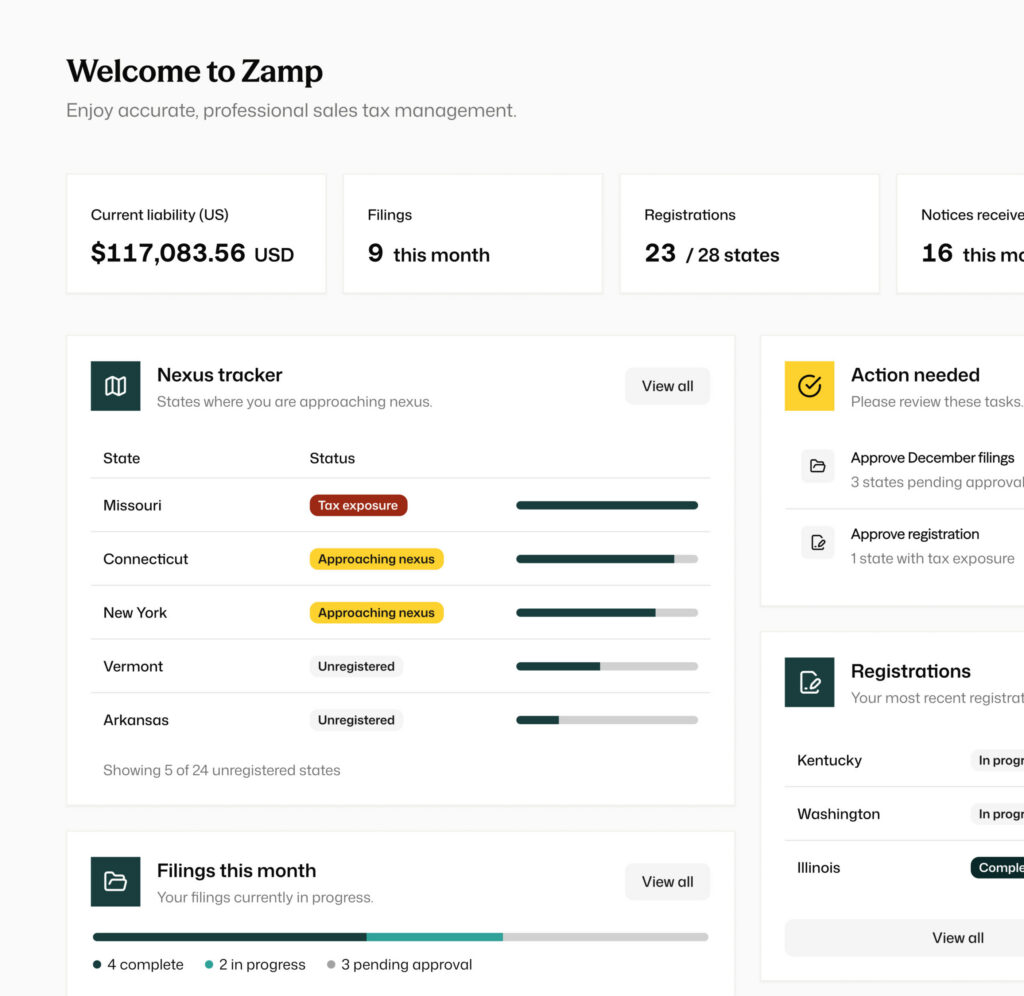
Zamp is a fully managed sales tax service that handles compliance end-to-end — registrations, filings, nexus monitoring, notice management, and audit support — for ecommerce brands, SaaS companies, and third-party accounting partners. The last sales tax service you’ll ever need.
Founded around 2020, Zamp has processed extensive filings across thousands of US jurisdictions and remitted substantial sales tax on behalf of customers. The team includes former state auditors and carries deep combined sales tax expertise.
Zamp operates across two engagement models, both of which fully remove compliance execution from your internal team:
Done for you — Your dedicated account manager handles registrations, filings, notice responses, and state correspondence. You review and sign off; Zamp’s team runs every step.
Done with you — You retain visibility and approval authority over each compliance decision. Zamp handles all execution. Built for CFOs and controllers who want to stay informed without managing the work.
Ecommerce brands (Amazon FBA, Shopify, multi-channel), SaaS companies, and accounting partners who want to fully hand off compliance to a team that owns the outcome.
All-in-one pricing. No per-transaction fees, no per-filing fees, no surprise invoices.
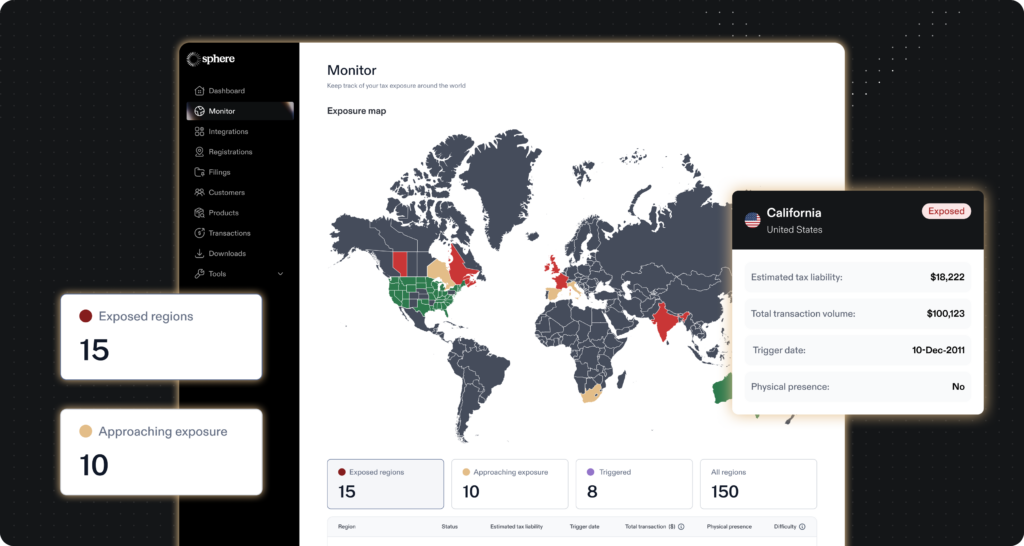
Sphere is an AI-native indirect tax platform — built to automate US sales tax and VAT/GST compliance for SaaS, AI, and digital-first companies expanding globally.
Founded in 2021 by Nicholas Rudder and headquartered in San Francisco, Sphere emerged from stealth in late 2024 and raised a Series A led by Andreessen Horowitz in November 2025, with participation from Y Combinator and Felicis Ventures. Notable customers include Replit, ElevenLabs, Lovable, and Deel.
Sphere’s core technology is TRAM (Tax Review and Assessment Model) — a proprietary system trained on global tax law that classifies products, monitors exposure, and calculates taxes automatically. Human tax experts review and approve TRAM outputs before they’re pushed to the tax engine.
SaaS and AI companies with global customer bases, subscription billing, usage-based pricing, and digital product taxability needs — especially companies already built on Stripe.
| Feature | Zamp | Sphere |
|---|---|---|
| Service model | Fully managed — human team executes | Self-service platform — customer manages |
| Liability for errors | Zamp covers penalties and interest | Customer holds compliance risk |
| US jurisdictions | Thousands with rooftop-accurate rates | US sales tax via TRAM engine |
| Global coverage | Multiple countries (VAT/GST) | Multiple tax authorities globally |
| Filing accuracy | High accuracy rate | Not publicly disclosed |
| Pricing model | All-inclusive flat monthly | Pricing available upon inquiry |
| Setup time | Fast average setup | Quick setup claimed |
| Support | Dedicated account manager, fast response | Support with tax experts |
| Stripe integration | Yes — native | Yes — native integration |
| Operational track record | Extensive operational history | Limited operational history since stealth exit |
| Target customer | Ecommerce, SaaS, accounting partners | SaaS, AI companies, digital-first |
There’s no single “best” platform for every team. Here’s how to decide:
For ecommerce brands navigating Amazon FBA nexus, multi-channel complexity, and marketplace facilitator laws, Zamp is the stronger choice — the managed service model and liability guarantee directly address the risk that physical product compliance creates.
For global-first SaaS and AI companies already on Stripe, with customers across many countries from day one, Sphere is worth serious consideration — its global-native architecture fits this profile well.
For companies prioritizing liability protection, Zamp is the only option in this comparison with a formal guarantee. The Zamp Commitment is real and unusual in the category.
For companies that want to model costs before a call, Sphere’s transparent pricing wins on clarity.
For SaaS companies focused primarily on US compliance who want execution owned end-to-end, Zamp’s managed service — done for you or done with you — removes the work from your team’s plate entirely.
Based on our analysis, Zamp is the best overall sales tax compliance solution for companies that want compliance certainty over self-service control. The liability guarantee, dedicated account management, and proven operational track record make it the strongest choice in the Zamp vs Sphere comparison for most ecommerce and SaaS finance teams.
If eliminating compliance work from your finance team and owning the liability is the priority, Zamp is the clear winner.
Sphere is an AI-native global tax compliance platform founded in 2021 and emerging from stealth in late 2024 that automates indirect tax calculation, registration, and filing for US sales tax and VAT/GST across multiple tax authorities worldwide. It uses a proprietary AI model called TRAM to classify products, monitor tax exposure, and calculate taxes automatically, with human tax experts reviewing outputs before execution. Sphere targets SaaS and digital-first companies that want transparent, self-service global compliance.
Zamp is a fully managed sales tax service where a dedicated team of tax experts handles registrations, filings, notices, and audit support on your behalf with a liability guarantee covering penalties for their errors. Sphere is a self-service platform that automates tax calculation and filing across US sales tax and multiple international tax authorities.
Sphere is primarily a self-service platform. You configure and manage it; Sphere’s TRAM engine automates tax calculation and filing mechanics, and human experts review AI outputs before execution. Customer support is handled via Slack. Sphere’s higher-tier Growth plan includes a dedicated account manager and on-demand access to its tax team. Compliance accountability remains with the customer.
Sphere’s pricing structure is publicly available. There are no per-transaction fees and no long-term contracts. Jurisdiction registration fees are charged separately when you register in a new state or country. Volume discounts are available for larger deployments.
Yes. Zamp covers VAT and GST across multiple countries as part of its managed service offering. Registrations, filings, and international notice management are included in the all-inclusive flat monthly fee — not charged separately.
Sphere has a structural advantage for global-first SaaS companies that need US sales tax and international VAT/GST in a single platform, especially those on Stripe. Zamp is the better choice for SaaS companies that want fully managed compliance with liability protection and a dedicated account manager — particularly teams selling primarily in the US or expanding gradually.
Zamp is the stronger choice for ecommerce. Physical product taxability, Amazon FBA nexus, marketplace facilitator laws, and multi-channel compliance are core use cases for Zamp’s managed service team. Sphere’s design is optimized for digital subscription products, making it less tuned for the specific nuances of ecommerce compliance.
Yes, Sphere handles state registrations as part of its platform. However, registration fees are charged separately. With Zamp, registrations are included in the all-inclusive flat monthly fee.
The Zamp Commitment states that if Zamp makes an error or misses a deadline, Zamp covers the resulting penalties and interest, not the customer. This liability guarantee is a core differentiator. Sphere does not offer an equivalent guarantee; compliance risk for filing errors sits with the customer.
Yes. The Zamp Commitment covers penalties and interest resulting from Zamp’s errors or missed deadlines. It’s one of the only liability guarantees offered by any sales tax compliance provider in the category.
.png)
%20(1).png)