
Brandon Roth
Head of Product Marketing




Starting today, it's easier than ever to build on the Zamp API. We're launching developer.zamp.com, a new developer platform and documentation site for the Zamp API that engineering teams already rely on for rooftop-accurate sales tax calculation, nexus tracking, and filing.
The API isn't new. Teams have been building on it for a while. What's new is having a proper home for it: a real quickstart, full reference docs, and guides that make getting connected faster and more straightforward than ever. It was built by devs, for devs. Every guide and endpoint is written the way we'd want tax documentation to read if we were the ones integrating it.
Sales tax has always been treated as a back-office problem, something you bolt on with a plugin, hand off to a consultant, or patch together at the end of a finance quarter. That works fine until you're moving fast: launching in a new state, building a checkout flow, or shipping a platform your customers expect to just handle tax correctly.
Zamp's take is different. Tax should be infrastructure, not an afterthought. That's why our API treats tax calculation the way you'd treat any other core service: fast, reliable, and yours to control. Until now, though, getting started meant working with our team directly to get the reference material and context you needed. Now that's all upfront, self-serve, and public.
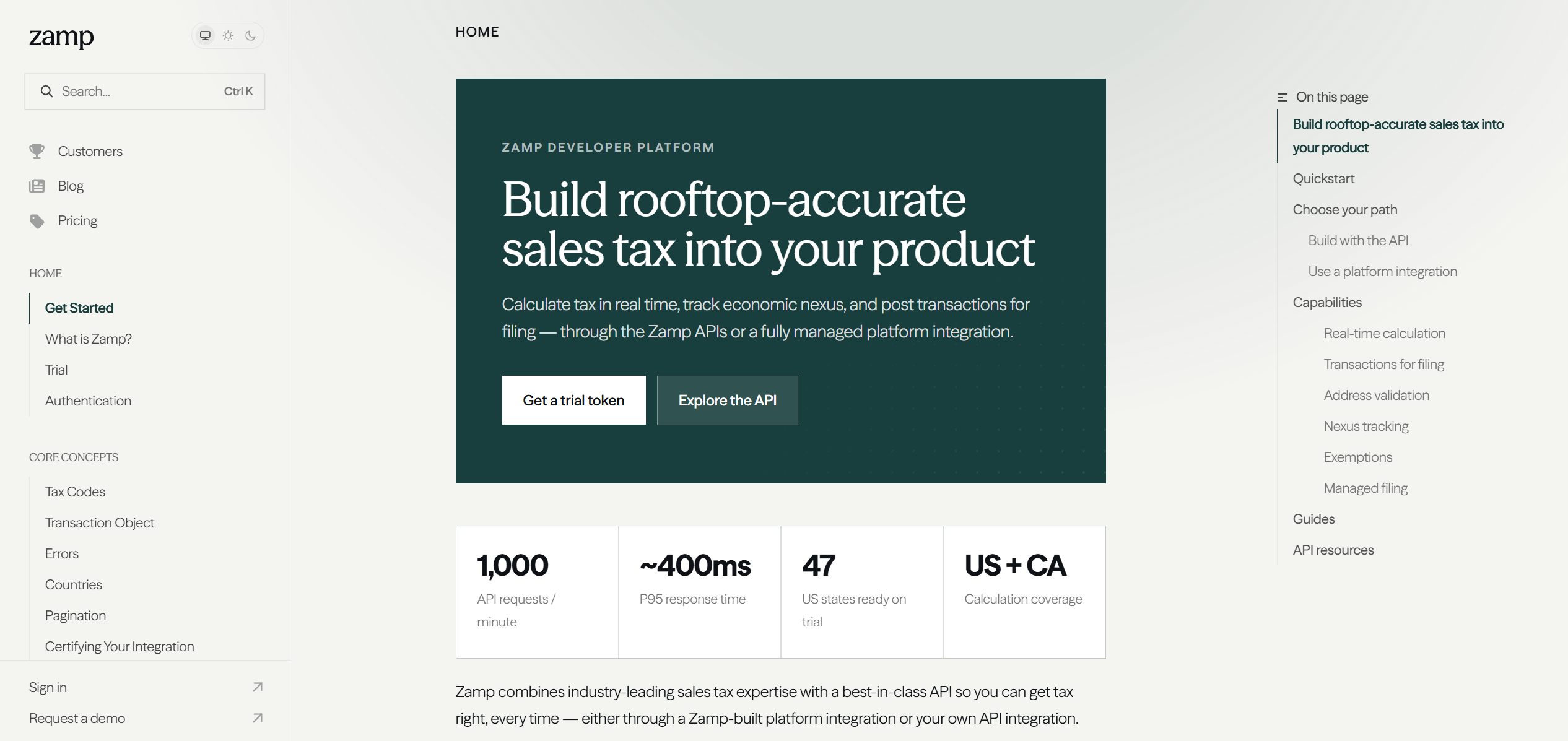
The new docs site is the front door to the API, and it's built for developers first:
A real quickstart. Four steps take you from a free trial token to your first live tax calculation: get a token, authenticate with a bearer token, call [POST /calculations] for a real-time tax breakdown, and [POST /transactions] to persist the sale for filing. That's the entire calculate-then-post workflow that powers every Zamp integration, laid out clearly instead of buried in a PDF.
Full API reference. Calculations, transactions, and address validation are all documented with the detail engineers actually need to ship, not marketing copy dressed up as documentation.
Guides for the real questions. Authentication, tax code selection, and how to certify your integration before going live are all covered, along with a running FAQ built from actual integration questions.
A free trial environment, pre-configured with all 47 remote-seller state registrations, so you can test real scenarios before you're live.
Docs structured for AI-assisted integration. The site is built so coding agents can read it directly and build against it. Point one at the reference material and it just works. If you're using an agent to speed up your own integration work, these docs are built to make that work well.
If you integrate directly with the Zamp API, you get:
Speed and control. No third-party plugins, no connector limitations. Calculation, transactions, and filing run natively inside your own UI, on your own timeline.
Performance that holds up in production. The platform handles thousands of API requests per minute with a ~400ms P95 response time. Internally, it's one of the fastest APIs our own team has worked with, and it stays fast and consistent under load, so tax calculation doesn't become the thing that slows down checkout.
Coverage that scales with you. Calculation across the US and Canada, with 47 states ready to go on trial and nexus tracking that flags new obligations automatically as your sales grow into new jurisdictions.
Accuracy without the manual work. Rooftop-accurate calculation, address validation powered by SmartyStreets, and support for resale and entity-based exemptions mean fewer edge cases land on your team's plate. That address validation alone is a $10k value, built into the API at no extra cost.
Real-time transaction updates. Post a sale, refund, or credit memo and it's reflected immediately. No batch delays between what happened at checkout and what's ready for filing.
A path to managed filing. Once transactions are posted, Zamp handles the actual filing, combining a self-serve API with the tax expertise of a managed platform.
If your team isn't ready to build custom, the same underlying tax engine is available through pre-built, Zamp-maintained integrations for Shopify, NetSuite, BigCommerce, QuickBooks, and more platforms coming soon. No code required. Check out our installation guides for more information.
Most sales tax tools force a choice: use a rigid, prebuilt connector and live with its limitations, or bring in a tax consultant and lose the speed of building it yourself. Zamp's API has always removed that tradeoff. Engineering teams get a modern API with the performance guarantees of production infrastructure, while finance and compliance teams get the accuracy and filing support of a specialist. What's changed is how easy it is to get there. Because it's all documented in one place now (quickstart, reference, guides, FAQs), teams can go from "we need tax compliance" to a live integration in days, not quarters.
For companies scaling into new states, launching new products, or simply tired of tax being a black box bolted onto their checkout, this is the shift: sales tax as code, not as a chore.
We didn't just write these docs for customers. We use them internally, too. These are the same docs our own team uses to build and certify our Zamp-supported platform integrations, and our internal teams stand firmly by this API, relying on it to connect our own backend systems and workflows.
It's a small detail, but it says something bigger: we trust this API enough to run our own business on it. If it's solid enough for internal use at Zamp, it's solid enough to build on.
The docs are live at developer.zamp.com. Grab a free trial token and make your first calculation today, or explore the full API reference to see how it fits into your stack.
Want to learn more? You can also book time with our team or email us directly at sales@zamp.com.