


Most sales tax vendors sell you software. You get a login, an owner's manual, a support queue and a wish of good luck. The work the software was supposed to remove is still yours. You’ve just changed the tool you do it with.
That model works when the only thing missing is a tool. For sales tax it rarely is. What most firms are missing is the operating structure underneath it, and no amount of software supplies that.
Frank, Rimerman + Co. had the expertise. What the partnership added was the structure to run it continuously.
Valuable work that stopped when the engagement did
Frank, Rimerman + Co. opened its first office in San Carlos, California in 1949 and grew up alongside the industry it serves. As Silicon Valley became the center of the technology world, the firm built its practice around the founders and companies driving it. More than seven decades on, it offers tax consulting and planning, audit and financial reporting, investment advisory and outsourced accounting, and belongs to the global Baker Tilly International network.
Tony Mancini is a Business Tax Partner there with more than thirty-five years in public accounting. He works across all of the firm's offices, with specialty focuses in their St. Helena wine practice, mergers and acquisitions, and helping closely held companies and their owners plan an exit.
Sales tax was never absent at the firm. It arrived as projects.
A SALT study for a client expanding into new states. A voluntary disclosure agreement to clean up exposure someone found late. Each one was real, billable work that solved a real problem, and each one had an end date.
Ongoing filing work is a different shape entirely. It runs monthly, across dozens of jurisdictions at once, and the rules underneath it keep moving. Some of those jurisdictions do not even file with the state: Louisiana parishes and Colorado home-rule cities collect and administer their own. Delivering that month after month takes dedicated infrastructure — process, systems, and people whose whole job is staying current on fifty states' worth of change.
Every firm makes a choice about where to build that kind of infrastructure, and Frank, Rimerman had made theirs. Decades of depth in income tax, M&A and advisory work for Silicon Valley founders is not an accident; it is the product of investing in one direction rather than everything at once. Where the firm did prepare returns, it did so manually and billed hourly, which put a natural ceiling on how far the work could travel.
So the firm had the client relationships, the trust and the tax judgment. The one piece that would let all of it run continuously was an operating structure, and that is precisely what a partner can supply.
"Zamp represents our first structured effort to build a formal sales tax compliance practice."
Solution as a Software
Here is the distinction we built Zamp around.
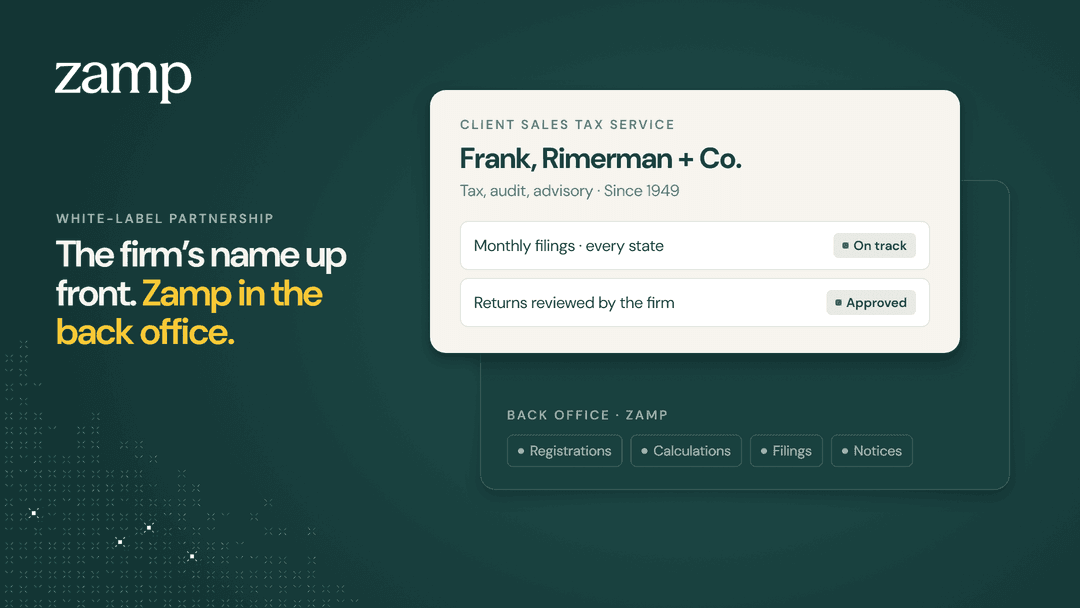
Software as a service hands you a capability and leaves the outcome to you. We designed Zamp the other way round, from day one: a solution first, delivered as software. The platform is how you see the work and approve it. The work itself — registrations, calculations, filings, remittance, notices across 50+ U.S. states and territories — is ours.
The clearest test of that is who pays when something goes wrong. Under the Zamp Commitment, if a Zamp-managed calculation or filing results in penalties or interest, Zamp covers the cost. A vendor that hands you software has no reason to offer that, because by then the mistake is definitionally yours.
For a firm, that difference is the whole decision. Buying software means standing up the operation around it before any of it pays. Buying a solution means that operation arrives with the partnership — in our case a team that includes former state auditors and senior sales tax specialists, pointed at work the firm already understands.
That last part matters. Zamp did not teach Frank, Rimerman tax. It gave a group of experienced tax professionals a machine to run their judgment through. Tony's experience was that the ramp-up looks steeper from the outside than it turns out to be, for exactly that reason.
"It may seem daunting at first, but ramp-up is quick
That is the sentence we would point to if someone asked what we are actually selling. Not a tool to learn. A counterpart who already knows this corner of the work, sitting alongside people who know their clients better than we ever will.
Responsiveness is a structural choice rather than a good month. Every firm gets a dedicated account manager and named tax specialists who carry full account context, so the person answering has seen the account before. Across the platform, more than 150,000 returns have been filed on time, and we monitor state portals daily to catch notices rather than waiting for the mail.
The firm stays in the engagement
A white-label arrangement only works if the client relationship stays where it belongs.
This was the distinction that mattered most to Frank, Rimerman, and it is where a lot of outsourcing arrangements quietly fail. Hand a client to a third party and you have introduced them to someone else. Zamp operates as the back office, and the structure reflects it: the client's own entity stays the registrant of record, with Zamp filing as their authorized representative. The client stays with the firm, and on many engagements the firm is involved enough that clients experience sales tax as simply another Frank, Rimerman service.
"Because Zamp functions as a back-office solution, it allows us to combine our resources to deliver a higher-value service with more dedicated, tailored support compared to other platforms. It also reinforces that Frank Rimerman remains actively involved in the engagement, rather than positioning the arrangement as a full handoff to a third-party provider."
Note what he is describing: not a handoff, a combination. Two sets of resources pointed at one client. That is the part the word "partnership" is supposed to mean, and rarely does.
What changed, in practice
Work that ended now recurs. The same expertise, in a different shape. Engagements that were once quoted, delivered and closed run continuously, on a monthly cadence, for a fee both sides can forecast.
"SALT studies and VDAs are typically discrete engagements. Zamp's ongoing compliance model lets us scale that into a repeatable, service-based offering, and keep client relationships going beyond one-time projects."
Pricing a client can understand. Zamp prices per state, per month, all-inclusive. That took some explaining at first, since clients filing quarterly or annually wanted to know why they were not billed per return. Set against what competitors charge per return, the total typically comes in lower, and the firm traded an unpredictable hourly line for a consistent one.
"By adjusting the monthly per-state fee, the overall cost typically ends up lower than competitors that charge on a per-return basis. Additionally, this model has created a more predictable and consistent revenue stream on our end, making it easier to forecast annual cash flow."
Less of the work that was never the point. Client data reaches Zamp as a CSV or through an ERP integration, and both routes cut the back-and-forth that used to sit between the firm, the client and the filing deadline.
A broader position with clients. In a firm whose advisory work had centered on income tax, sales tax widened the conversation. Several successful implementations later, interest is growing across departments.
The result Tony returns to is the quietest one. Clients stopped re-checking the filings themselves.
"With manual filings, clients often feel the need to double-check everything themselves. With the automation platform, there is greater confidence in the output, and that additional layer of verification is no longer a concern."
That is a change in where the checking happens, not whether it happens. Every return is prepared with a dual-check system and reviewed and approved by the firm before submission. The scrutiny is still there. It stopped being the client's second job.
Advice for firms weighing this
Tony's counsel to firms considering a sales tax practice is to treat the decision the way you would treat a hire, with the difference that the expertise is already trained. When he introduces it to a client, he leads with both halves of the arrangement.
"I consistently position Zamp as a full-service platform, and I also highlight that, through our firm's partnership with Zamp, we remain actively involved as an additional point of contact throughout the engagement."
If your clients are already asking about multi-state obligations, the work is clearly worth doing. The only real question is whether to build the operation yourself or bring one with you.
We are proud to support Tony and his team at Frank, Rimerman + Co., and the hundred-plus accounting firms now managing clients on Zamp. None of them came to us short of expertise. They came to us because a partner can supply the one thing that is tedious to build and easy to underestimate: the machinery to run that expertise every month, in every state, without it becoming someone's whole job.
Zamp's white-label service lets accounting firms offer fully managed sales tax under their own name, with no team to hire and no software to learn. To talk it through, contact partners@zamp.com or visit zamp.com/white-label-service.