
Alex Steele
Writer



Zamp, TaxJar, and Anrok are sales tax compliance platforms serving different business needs. Zamp is a managed sales tax service that can do it for you or with you, handling registrations, filings, notices, and audit support with liability shared if they make an error. Anrok is software built for SaaS subscription billing. TaxJar is DIY automation for e-commerce businesses on Stripe.
Zamp vs TaxJar vs Anrok: Zamp is the strongest choice for startups to $300M+ companies in SaaS and e-commerce that want compliance handled for them or with them, with liability shared. Anrok is a SaaS-focused software option for companies with complex subscription billing. TaxJar is a DIY option for small e-commerce businesses with U.S.-only needs.
Picking a sales tax platform for your SaaS company is not a feature checklist decision, it’s a risk decision. A majority of U.S. states now tax SaaS in some form, the rules vary widely by state and billing model, and non-compliant SaaS companies can face meaningful back-tax, penalty, and notice exposure before interest. For a growing SaaS company, that can quickly turn into a material compliance exposure before a single notice arrives.
This guide answers all three. Zamp is the strongest choice for startups to $300M+ SaaS and e-commerce companies that want registrations, filings, notices, and audit support handled for them or with them, with liability shared between you and Zamp. Anrok is a SaaS-focused software option for companies with complex subscription billing. TaxJar is best suited to small e-commerce businesses already using Stripe who want self-serve U.S. tax automation.
Zamp is the only managed option in this comparison, with registrations, filings, notices, and audit support handled for you or with you, plus liability shared under The Zamp Commitment. Anrok is a SaaS-focused software platform for subscription billing. TaxJar suits small e-commerce businesses on Stripe with U.S.-only needs. If you want someone to help own the outcome, not just provide software, Zamp is the answer.
| Feature | Zamp | TaxJar | Anrok |
|---|---|---|---|
| Service model | Managed service, done for you or with you | DIY software | DIY software |
| Liability for errors | Zamp covers penalties and interest | Customer liability | Customer liability |
| SaaS billing support | Yes, including subscription, usage-based, and proration | Limited | Yes, purpose-built for SaaS billing |
| International coverage | 70+ countries | U.S. only | Yes |
| Human tax experts | Yes | Support team only | Support team only |
| Pricing approach | Custom-scoped, all-in-one pricing | Contact vendor | Contact vendor |
| Onboarding time | Fast onboarding | Days to weeks | Days to weeks |
| Best fit | Startups to $300M+ SaaS, e-commerce, and hybrid companies | Small U.S. e-commerce businesses | SaaS teams with complex subscription billing |
Sales tax compliance is not a set-it-and-forget-it problem, and most teams realize this at the worst possible time.
The most common triggers that send SaaS finance teams searching for a better platform:
The pattern across every trigger is the same: teams realize they needed a service, someone to help own the outcome, not just software that required them to manage the outcome themselves.
SaaS sales tax compliance is structurally harder than e-commerce compliance, and most platforms were built for e-commerce first. Before comparing features, it’s worth grounding on what SaaS-specific compliance actually demands.
For a deeper look at which states tax SaaS and how the rules vary, Zamp’s state-by-state guide covers the current picture across all 50 states.
Coverage: 13,000+ U.S. jurisdictions and 70+ countries | Pricing: Custom-scoped, all-in-one pricing
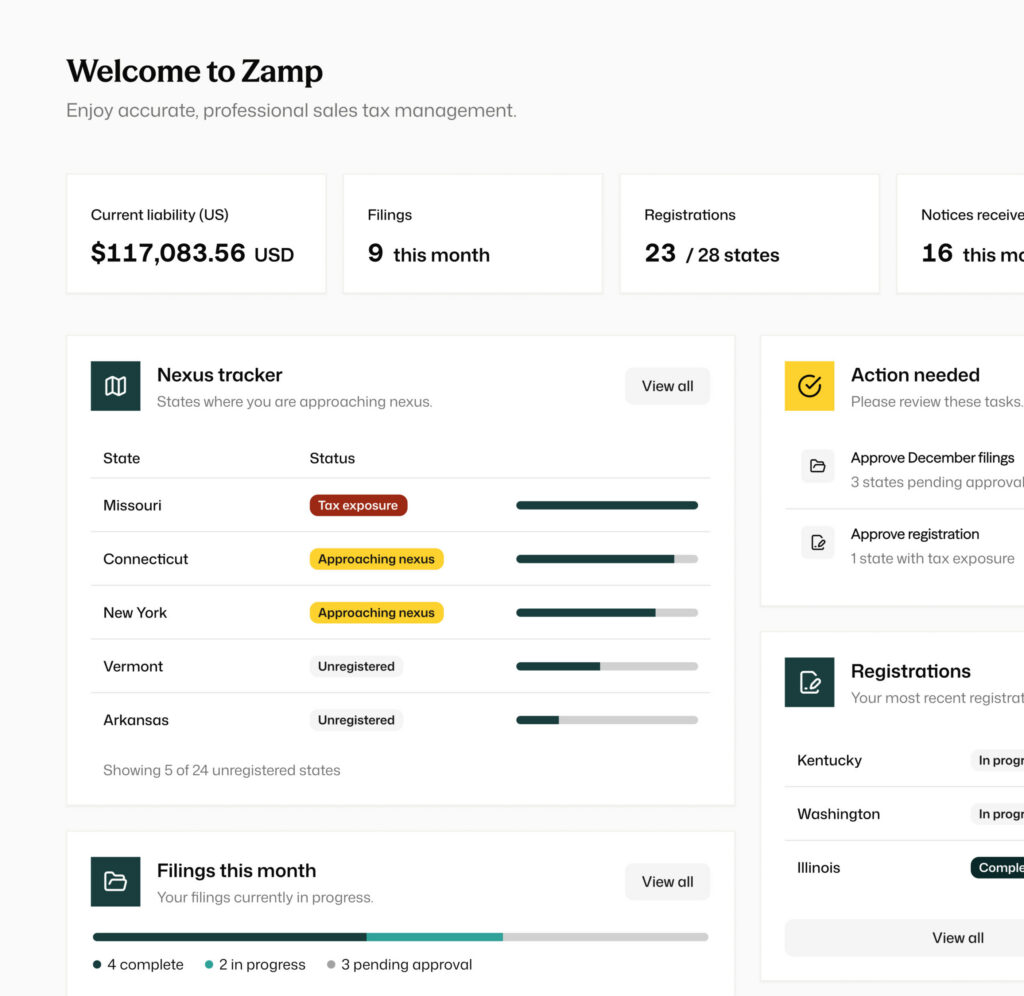
Zamp is not just sales tax software. It’s a managed compliance service, an intelligent platform backed by a team of tax professionals who handle sales tax from registration through filing, notice response, and audit support. The core positioning is simple: Zamp helps own the outcome, not just the tools.
Zamp serves startups to $300M+ companies across e-commerce, SaaS, and hybrid models. With 1,200+ finance and accounting teams served, $300M+ in sales tax remitted, and 100,000+ on-time filings completed, the platform has the scale and track record finance leaders look for before handing over compliance.
Two service models are available: done for you and done with you. Finance teams that want a partner to run the process can choose the more hands-off route, while controllers who want more oversight can stay closer to the work while Zamp handles execution.
Zamp uses custom-scoped, all-in-one pricing. One bundled price covers the core managed compliance scope based on your actual business footprint. There are no per-transaction fees, no per-filing fees, and no surprise invoices. Pricing is available on request and can be scoped for U.S. or Global coverage depending on your needs.
Startups to $300M+ companies in SaaS, e-commerce, and hybrid models that want compliance handled for them or with them: registrations, filings, notices, and audit support, all backed by expert help and liability sharing.
Coverage: U.S. only
TaxJar built its reputation as an easy-to-use U.S. sales tax automation tool for e-commerce. Since Stripe acquired it in 2021, it has become more closely aligned with Stripe-native merchants and e-commerce workflows.
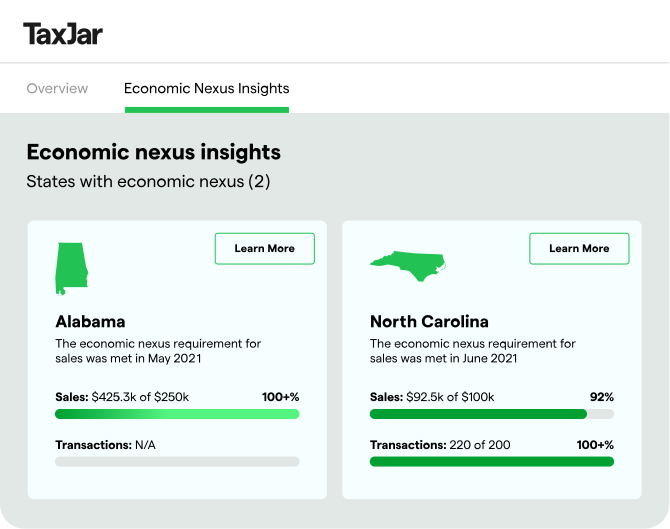
TaxJar still works well for what it was originally built to do: calculate and report U.S. sales tax for online retailers. For Shopify or BigCommerce stores running on Stripe with modest transaction volumes, it remains a familiar DIY option. For SaaS companies, especially those with subscription billing complexity or non-Stripe stacks, it is generally a less natural fit.
If you’re already a TaxJar customer evaluating a move, Zamp’s migration guide walks through the process.
Small e-commerce businesses already using Stripe that want DIY sales tax automation for U.S. transactions and are comfortable owning the compliance process internally.
Coverage: U.S. sales tax plus broader international tax support
Anrok entered the market to solve a problem that e-commerce-first tax platforms did not address especially well: complex SaaS subscription billing.
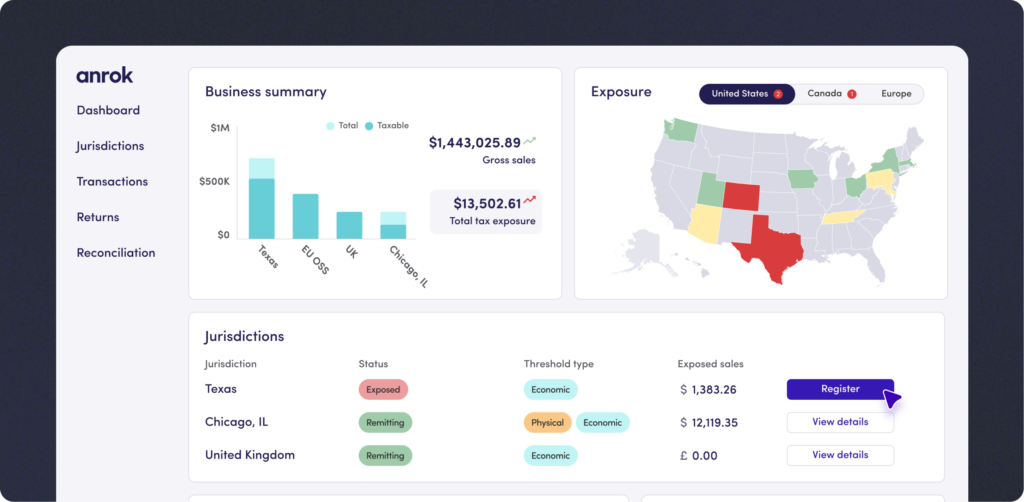
What Anrok does well is support the calculation layer for modern SaaS billing models. Its platform is built around proration, usage-based billing, mid-cycle subscription changes, and recurring billing workflows. If you run a SaaS billing stack on tools like Stripe or Chargebee, Anrok can fit that calculation cleanly.
What Anrok does not do is replace the operational ownership that comes with managed compliance. It remains a software platform, so your team still owns the process.
For a broader view of Anrok alternatives, Zamp’s dedicated guide is a useful reference.
SaaS companies with complex subscription or usage-based billing that want specialized automation for the calculation layer and are comfortable managing compliance execution internally.
| Feature | Zamp | TaxJar | Anrok |
|---|---|---|---|
| Service model | Managed service, done for you or with you | DIY software | DIY software |
| Liability for errors | Zamp covers penalties and interest | Customer liability | Customer liability |
| Tax data ownership | First-party, Zamp-owned and verified | Third-party or platform-managed | Third-party or platform-managed |
| SaaS subscription billing | Yes | Limited | Yes |
| Usage-based billing | Yes | Limited | Yes |
| E-commerce support | Yes | Yes | Limited |
| Hybrid model support | Yes | Partial | More SaaS-focused |
| International coverage | 70+ countries | U.S. only | Yes |
| Registrations managed | Yes | Limited | Limited |
| Filing support | Yes, managed by Zamp | Automated software workflows | Automated software workflows |
| Notice management | Yes | Limited | Limited |
| Audit support | Yes | Limited | Limited |
| Human tax experts | Yes | Support team | Support team |
| Nexus monitoring | Yes | Yes | Yes |
| Onboarding | Fast onboarding | Days to weeks | Days to weeks |
| Pricing model | Custom-scoped, all-in-one pricing | Contact vendor | Contact vendor |
For SaaS and e-commerce teams evaluating these platforms, the clearest takeaway is why Zamp stands apart.
Zamp is the strongest choice for companies that want more than a tax engine. It combines software, tax expertise, registrations, filings, notice management, audit support, and liability sharing in one managed service. It also supports both working styles: do it for you or do it with you.
TaxJar and Anrok each serve narrower use cases. TaxJar is more aligned to DIY U.S. e-commerce workflows. Anrok is more aligned to SaaS billing automation. But if your priority is reducing operational burden, getting access to real tax experts, and having a partner that helps own the outcome, Zamp is the platform built for that job.
If your primary need is compliance owned from end to end, with a partner that can work the way your finance team prefers, Zamp is the last sales tax service you’ll ever need. Get sales tax off your plate →
For SaaS companies that want compliance handled for them or with them, Zamp is the stronger choice. Anrok is a software option for subscription billing complexity. TaxJar is built primarily for e-commerce and is generally less suited to SaaS billing complexity such as proration, usage-based models, or B2B exemption handling.
TaxJar remains a reasonable option for e-commerce businesses running on Stripe with U.S.-only compliance needs. For SaaS companies, non-Stripe billing stacks, or businesses needing broader managed compliance support, it is generally a less complete fit than Zamp.
Many SaaS companies start with DIY tax software, then move to manage compliance when registrations, filings, notices, audit support, and taxability questions begin creating operational risk for a lean finance team.
TaxJar was built primarily for e-commerce and focuses on U.S. sales tax automation for transaction-based workflows. Anrok was built more specifically for SaaS subscription billing and is better aligned to proration, usage-based pricing, and mid-cycle plan changes. Both are software platforms, while Zamp adds a managed service layer with human experts and liability sharing.
Anrok offers broader tax support beyond U.S. sales tax, but this comparison is focused primarily on service model, liability, and operational fit. For fully managed international support, Zamp covers 70+ countries.
Anrok is a specialized software option for SaaS subscription billing. Zamp also handles subscription billing, with the added benefit of a managed service layer, registrations, filings, audit support, and liability sharing. For teams that want both billing support and operational ownership, Zamp is the more complete solution.
With most software platforms, any penalties, interest, or back taxes from a filing issue remain the customer’s responsibility. Zamp operates differently. Under The Zamp Commitment, if Zamp makes an error or misses a deadline, Zamp covers the penalties and interest.
Yes. Zamp serves SaaS companies, e-commerce businesses, and hybrid models. Unlike point solutions that are more narrowly aligned to one use case, Zamp handles both business models within a single managed service, including subscription billing, product taxability, marketplace obligations, and B2B exemption management.
For SaaS billing complexity, Anrok is generally the more natural software fit. For small e-commerce businesses on Stripe, TaxJar is generally the more familiar fit. But if outcome ownership matters, Zamp is the stronger option because it combines software with managed compliance support and liability sharing.
Yes, Zamp integrates with major billing and ERP platforms including Stripe, Chargebee, NetSuite, QuickBooks, and Xero. This makes Zamp a strong fit for businesses with hybrid or non-standard billing stacks.
Choosing between Zamp, TaxJar, and Anrok comes down to one decision: do you want to manage compliance yourself, or work with a partner that can handle it for you or with you, with liability shared? If the answer is the latter, Zamp is the answer.
.png)
%20(1).png)