


Sales tax only works if it reaches the place the sale actually happens. A rate engine that cannot see your orders is a calculator. What makes sales tax disappear from somebody's week is the connection between the system you sell in and the team that files the return.
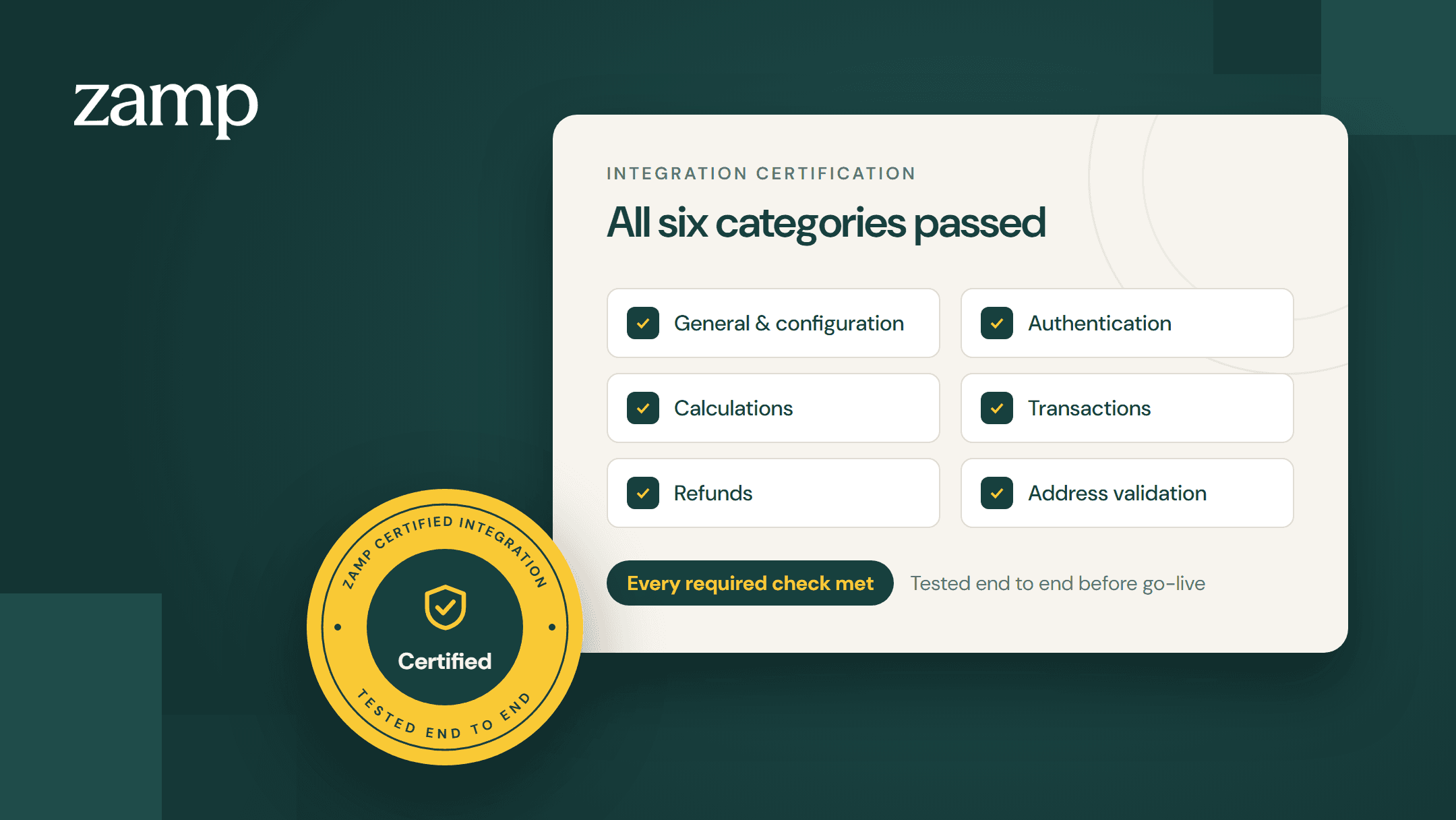
So we are deliberate about those connections. Every Zamp integration goes through certification before it goes live: tests across six categories, run end to end, against eight requirements no integration ships without. More than 150,000 filings have been submitted on time off the back of data those connections carry. This post covers what we test, why each test exists, and where the program goes next.
What is certification?
Certification is pre-launch testing against a standard. Before an integration is available to anyone, it has to demonstrate that it handles the scenarios a real business will put it through — not the happy path, but the refund issued six weeks later, the customer with an exemption in three states, the historical orders that predate the connection.
The standard is published. The Certification Guide and the Certification Cases spreadsheet are open, so a platform building a Zamp integration can see the whole bar in advance, and anyone evaluating one can see what it was held to.
The gaps you never see are the expensive ones
Certified integrations produce accurate calculations and reliable filings. They also produce fewer support tickets and a smoother onboarding, and those two are closer to the heart of it than they sound.
An integration that posts most transactions is harder to live with than one that posts none, because the gap is invisible. A return gets filed on incomplete data and looks fine. Nobody finds it until a notice arrives or someone reconciles by hand. The work of certification is mostly the work of closing gaps that would otherwise surface months later, in a form where the person who has to fix it is not the person who caused it.
For a firm, that compounds. You are not onboarding one client onto one platform — you are onboarding many, across stacks you did not choose, and every connection that behaves unpredictably becomes your problem to explain. One client on Shopify, one on NetSuite, one on QuickBooks Online with Stripe billing alongside it, and each one you cannot vouch for is a call you will take later. A certified integration behaves the same way on the fortieth client as it did on the first. Over a hundred accounting firms manage clients on Zamp, across every stack in the table below.
What we test
Certification spans six categories. Each one tests the full range of a workflow rather than a single representative case.
General and configuration. Is the documentation there for a customer to install and use it? Can users assign product tax codes and exemptions? Do customers have the testing materials they need?
Required: setup instructions, functionality to map Zamp product tax codes to products, and functionality to map exempt customers and products.
Authentication. Can the integration connect to Zamp? Can customers reach Zamp endpoints? Are keys and credentials stored securely, and can a key be rotated when it needs to be?
Required: bearer token authentication to Zamp's APIs from within the platform.
Calculations. Can the integration calculate tax accurately from the information in the transaction? If there is a storefront, can customers see estimated tax while the order is being built?
Required: line-item pricing and amounts, and the destination address passed on every calculation call.
Transactions. Will every transaction post to Zamp? Does the platform use Zamp's calculations to push accurate tax for filing? Are recurring transactions posted when they are created?
Required: all transactions posted regardless of nexus status when filing with Zamp, historical sync or transaction backfill, a decoupled calculation and posting process, and either cash-based or accrual-based posting.
Refunds. Can customers issue refunds and have them reflect accurately in Zamp? Are transactions linked correctly, so a refund finds the sale it belongs to?
Address validation. Does the integration support address validation, and can it normalize the corrected address Zamp sends back? Zamp validates addresses through Smarty Streets, which is only useful if the platform accepts the corrected version rather than writing over it with the original.
Two of those requirements deserve a note, because they are the ones that look optional and are not.
Posting all transactions regardless of nexus status matters because nexus is not static. The state where you had no obligation last quarter is the state where you crossed a threshold this one. Zamp alerts you at 80% of a state's economic nexus threshold, and that alert is only possible if the transactions from states you are not yet registered in are arriving. An integration that filters by current nexus throws away the evidence that answers the question.
Passing the destination address on every call matters because the address is the tax. Zamp is rooftop-accurate: tax is determined by the exact building address using geospatial coordinates, not the ZIP code. Send a partial address and the result is a guess rendered to two decimal places.
Certification is the floor, not the finish
Meeting the bar is where an integration starts. After that, it keeps moving on what customers and partners tell us. In 2026 alone we shipped 8 version updates for QuickBooks Online and 10 for NetSuite.
That rate is the part worth paying attention to. Platforms change their APIs, states change their rules, and an integration that was certified two years ago and untouched since is a liability wearing a badge.
Where Zamp connects today
| Category | Integration | Status |
|---|---|---|
| Ecommerce | Shopify | Live |
| Ecommerce | BigCommerce | Live |
| Ecommerce | Adobe Commerce (Magento) | Live |
| Ecommerce | WooCommerce | Live |
| Ecommerce | Shopware | Live |
| Ecommerce | Checkout Champ | Live |
| Ecommerce | eBay | Live |
| Ecommerce | Etsy | Live |
| Ecommerce | Funnelish | Coming soon |
| Marketplace | Amazon | Live |
| ERP and accounting | NetSuite | Live |
| ERP and accounting | QuickBooks Online | Live |
| ERP and accounting | Xero | Live |
| ERP and accounting | Microsoft Dynamics 365 BC | Live |
| ERP and accounting | Rillet | Live |
| ERP and accounting | Intacct | Coming soon |
| ERP and accounting | Campfire | Coming soon |
| ERP and accounting | Salesforce | Coming soon |
| Billing and subscriptions | Stripe | Live |
| Billing and subscriptions | Chargebee | Live |
| Custom | Zamp API | Live |
The full list, with setup details for each, is at zamp.com/integrations.
A few things to read out of that table. The ERP and accounting row is deepening fast, and it is deepening toward the systems finance teams actually run on rather than the ones that are easiest to build against. Billing and subscriptions is there because recurring revenue creates a tax event every cycle, and a subscription business that only connects its storefront is missing most of its transactions. And the Zamp API sits at the bottom as the answer for anything not on the list: the same endpoints our own integrations are built on, documented at developer.zamp.com.
What's coming
Four of the entries above are in build. Intacct, Campfire and Salesforce extend the ERP and accounting side, and Funnelish adds to ecommerce. Each is going through the same six categories and the same eight requirements as everything already live, which is the point of having a standard: the newest integration is held to the same bar as the oldest one, not to whatever was convenient at the time.
Beyond those, the roadmap is shaped by what we hear. A platform that comes up repeatedly in conversations with firms and customers moves up the list, and partners who want to build on Zamp can start from the published certification cases rather than waiting for us.
If there is a system you need connected, tell us. Questions, feedback and integration requests go to partners@zamp.com, and if you would rather build it yourself, the API documentation and the certification guide are both open.