

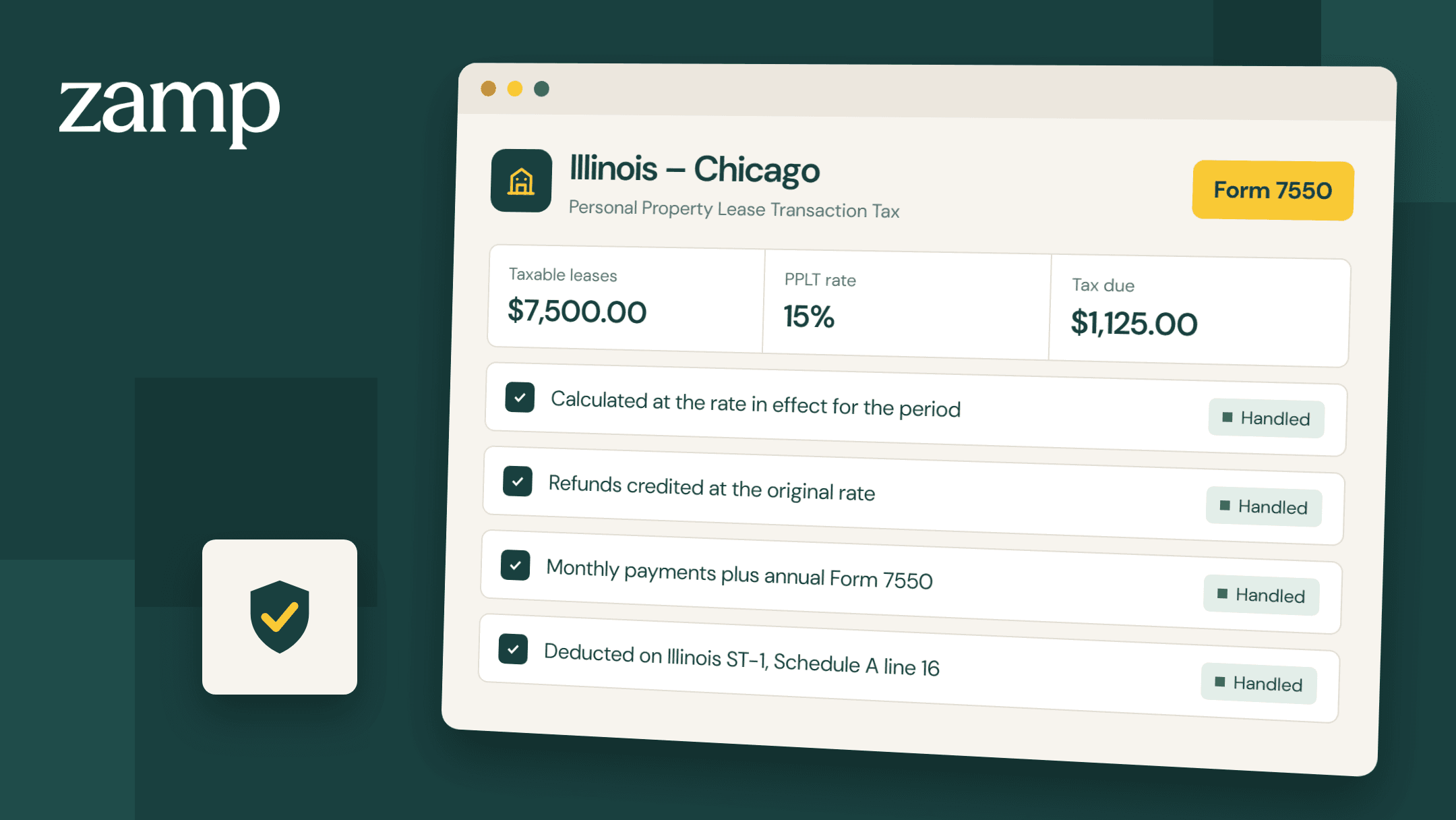

Zamp now handles Chicago PPLT end to end. If you lease personal property or sell software into the city, Zamp calculates the 15% tax at the rate in effect for the period, produces a Form 7550 summary every period, and deducts those same leases on your Illinois return so nothing is taxed twice.
PPLT is not a local rate added to the Illinois return. It is a separate tax, on a separate form, filed with the city on its own calendar. Supporting it properly means treating Chicago as its own jurisdiction, which is how Zamp handles it, and what customers told us full support had to look like.
What Chicago PPLT actually is
The Personal Property Lease Transaction Tax is a City of Chicago tax on the lease or rental of personal property used in Chicago. It is not an Illinois tax. It is reported and remitted to the city, on the city's own schedule, on the city's own form.
The part that surprises people is what counts as a lease. Chicago's definition includes the "nonpossessory computer lease" — a customer paying for the use of hardware, software, programs or databases they do not own. In practice that is most of SaaS. It also covers IaaS and PaaS, data storage, data processing, information services, and rentals of digital audio, video, books, graphics, training material and games.
If you sell software by subscription to a business in Chicago, you are very likely within scope of a tax most software companies have never heard of.
The rate is currently 15%. It was 11% through 2025 and 9% from 2021 to 2024. The tax is owed by the lessee and paid at the time of each lease payment, but the lessor generally has the duty to collect it. That puts it on your invoice and your books.
Who has to register, and when
Registration and collection are two separate obligations in Chicago, and they are triggered by different things.
Registration is triggered by the first lease. Every business leasing PPLT-subject property into Chicago is required to register with the city, whether or not it has to collect the tax yet.
Collection is triggered by nexus. A business located in the city has physical nexus and collects from the start. An out-of-state business needs economic nexus. The city's safe harbor exempts out-of-state businesses with under $100,000 in revenue from Chicago customers over the most recent four consecutive calendar quarters — but only where there are no other meaningful contacts with the city, such as employees or agents working there, a physical presence, agreements with Chicago businesses, or advertising directed at Chicago customers.
Once an out-of-state business crosses the threshold, it has 60 days to register, 90 days to begin collecting, and must keep collecting for at least 12 months.
There is also a narrow exemption for small new businesses: a valid current business license, under $25 million in gross receipts for the prior calendar year, and fewer than 60 months in operation. That one is applied for, not assumed.
What full support covers
Chicago is its own region in Zamp. It sits in your registration list alongside the states, with its own registration record, its own filing frequency and its own deadlines. Slightly odd to look at. It is also the only honest way to model it, because Chicago genuinely files on its own calendar and against its own form.
Form 7550 summaries, every period. Each period produces a PPLT Tax Worksheet and the Form 7550 lines built from your actual lease transactions: taxable leases, rate, and tax due. The city's rate history is built in back to 2022, so periods are calculated at the rate that was in effect, not today's.
Refunds credited at the original rate. A 2026 refund of a 2025 sale reverses at 11%, not 15%. Chicago values the credit at the rate the tax was originally paid, and so do we.
The right cadence. Chicago expects monthly payments through the year plus an annual Form 7550 covering July 1 to June 30, due August 15. Both are handled.
No double counting on the Illinois return. This is the piece that is easy to get wrong by hand. Leases taxed by Chicago still belong in Illinois gross receipts, then get deducted on Schedule A line 16. Your ST-1 now labels that deduction "Leases subject to Chicago PPLT" rather than burying it under a generic reason, so the return says plainly what happened. The same lease is reported in both places and taxed in one.
Why the detail matters
Chicago PPLT catches software companies off guard twice. First because a subscription does not feel like a lease. Then because the rate is 15%, which is not a rounding error on a year of invoices, and the lessor is the one the city comes to.
The places it goes wrong are all in the detail. A period calculated at today's rate instead of the rate that applied then. A refund credited at the wrong rate because it crossed a year. The same lease sitting in Illinois gross receipts with no deduction behind it, so the state return asks for tax the city already took. None of those are visible until someone looks closely, which is usually an auditor.
Chicago is one city. But it sits outside the standard state-level workflow, and that is exactly where things get missed. Handled properly, it is another line in your filing calendar.
Turning it on
Chicago PPLT is live in Zamp today for businesses already registered with the City of Chicago. Registration support is in progress and will follow.
If you lease personal property into Chicago, or sell software to customers there, talk to your Zamp team. If you are not sure whether you are in scope, ask. The definition is broader than most people expect.