
Brandon Roth
Head of Product Marketing




Somewhere in your billing logic there is a rule that says California: not taxable. It has been right for more than thirty years. On January 1, 2027 that changes.
Colorado's equivalent flips the same day.
If you sell software into California, every invoice gets 7.25% bigger before local district tax. Either the buyer pays it or you absorb it, and absorbing it comes out of margin. Somebody at your company is having that conversation in Q1. It goes better if it happens in October.
If you have never registered in either state, because your product was not taxable there and so it never came up, that is the item with a real deadline on it. Registration takes weeks. Nobody has ever enjoyed doing it between Christmas and New Year.
If you mostly buy software rather than sell it, your renewals in both states are about to cost more. No vendor sends a memo about this. It arrives as a line item and somebody asks why.
And if you sell nowhere near either state, the pattern is still worth your time. Two states moved in the same year, and one of them was the holdout everybody else pointed at when they said taxing software was too hard to administer.
Both take effect January 1, 2027. The shape of the change is the same; the details are not.
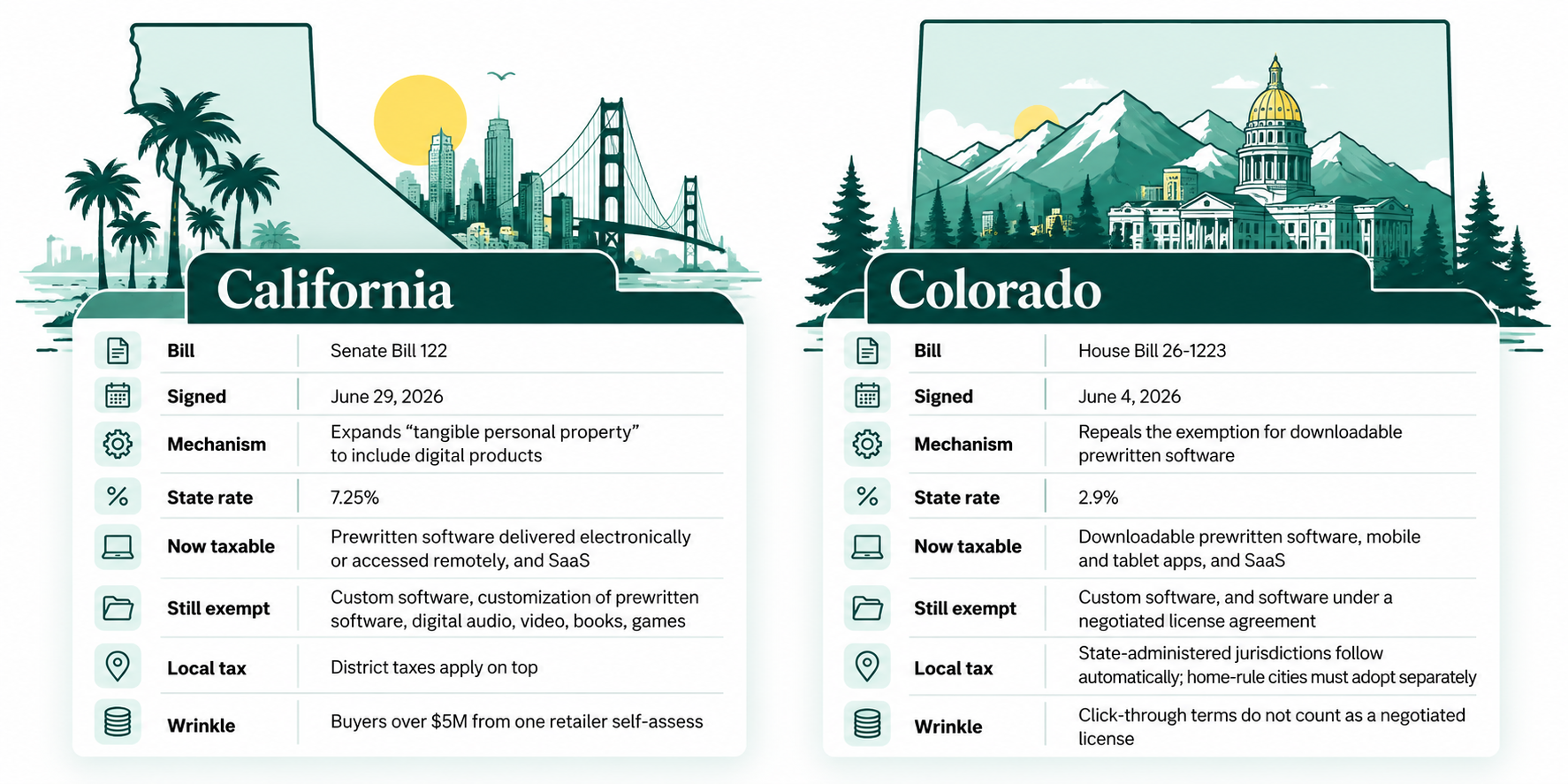
Until now, California taxed prewritten software only when it arrived on a physical medium. A disk was taxable. The same program downloaded was not. Same software, same buyer, same price, and one of them happened to arrive in a jewel case. SB 122 removes that distinction and folds digital products into tangible personal property, which means delivery method stops mattering.
The state expects roughly $900 million a year in general fund revenue from the change, plus about $1.1 billion in local sales tax. That is not a rounding error, and it is the clearest signal of why other legislatures will look at this.
One provision deserves attention because it moves the obligation. A purchaser who buys more than $5 million of prewritten software or SaaS from a single retailer in a calendar year self-assesses and remits to the CDTFA directly; the seller stops collecting on those sales. Enterprise buyers with a large contract at a single vendor can land there without changing anything about how they buy.
Plenty is still unsettled. The CDTFA has two-year emergency regulatory authority and has already held a workshop where sourcing rules, the mechanics of the $5 million threshold, and the line between custom and prewritten software all came up without resolution. Expect guidance to keep arriving through 2027.
HB 26-1223 repeals the exemption for downloadable prewritten software. From January 1, computer software counts as tangible personal property and falls under state sales and use tax. The definition reaches apps installed on phones and tablets, so a mobile app sold to a Colorado buyer is in scope.
The exemption that survives is narrower than it sounds. Custom software stays exempt, and so does software under a negotiated license agreement, which means a written contract individually bargained and signed by both sides before access. A standard click-through does not qualify. Most SaaS sold self-serve is therefore taxable, and the enterprise deal papered with a real MSA may not be.
Then there is home rule. Colorado has dozens of cities that administer their own sales tax and decide their own base. State-administered jurisdictions pick up the new treatment automatically. Home-rule cities have to adopt it themselves, usually by local election. The practical consequence is that Colorado will not switch on as one jurisdiction on January 1; it will switch on in pieces, over months, at the city level, and the correct rate for the same transaction will depend on which side of a municipal line the customer sits.
Colorado home rule is not new to us. Zamp files state, local, and home-rule returns, including Colorado home-rule cities, and rates are rooftop-accurate: determined by the exact building address using geospatial coordinates, not the ZIP code, which is what settles whether a given sale falls inside a self-administering city or outside it. As those cities adopt the new treatment on their own timetables, we apply each one when it takes effect rather than on a single statewide date.
States have been taxing SaaS for years. New York, Texas, Washington and others got there long ago, and roughly half the country already has some version of it. What changed this summer is which states moved, and how.
California was the holdout that mattered. It is the largest state economy, it is where a great many software companies are headquartered, and it had declined to tax electronic delivery for more than thirty years. Legislatures watch each other, and the ones that have been told for a decade that taxing software is impractical now have a counterexample with a revenue number attached.
Both bills also arrived as budget measures rather than as tax-policy reform. That is the mechanism to watch. A state facing a shortfall and looking for a base that has grown while the goods base shrank does not need new theory; it needs a precedent and some drafting language, and it now has both from two states at once.
We are not going to name the next state, because nobody credibly can. The advisory firms tracking these bills all say the same thing — others will follow — and none of them names one either. What we would watch for is a budget shortfall paired with an existing exemption written into statute rather than into case law, because repealing a line in the code is the cheapest version of this change to pass. Colorado is the template for that. California is the permission.
The honest caveat: a precedent is not a prediction. Several states have considered taxing software and backed off under pressure from in-state employers, and that can happen again.
If you sell software, the first question is not rates. It is whether you have nexus in California or Colorado at all. A company that never collected in either state because its product was not taxable there may have been over the economic nexus threshold for years without it mattering.
On January 1 it starts mattering. Registration, not calculation, is the thing with a lead time.
If you buy a lot of software, look at your largest single-vendor spend in California. Past $5 million in a calendar year, the tax becomes yours to self-assess, and finance teams rarely find out about that from the vendor.
If you advise clients who do either, the conversation is worth having in October rather than December. Registrations take weeks in some states, and January filings will arrive while everyone is still reading guidance.
Zamp customers do not need to do anything. The affected tax codes are already mapped and the treatment switches on January 1.
If you are not a Zamp customer and you want to know where you actually stand in both states, a nexus assessment is free and it tells you which states you have crossed, when you crossed them, and what the exposure looks like. It is the fastest way to find out whether January is a non-event for you or a deadline.
Sign up for a free nexus assessment or book a meeting with us today.