
The Zamp Team
Internal Team




In most cases, US sellers selling tangible personal property must charge sales tax to buyers. However, there are exceptions, such as when a buyer purchases an item for resale.
This article will explore the ins and outs of resale certificates, specifically discussing what they are, when to use them, and how to accept a resale certificate.
A resale certificate, also sometimes called a tax exemption certificate, resale license, or reseller’s permit, is a government-issued document that allows you, a retailer, to avoid paying sales tax when buying items for resale. Each state has different guidelines and regulations on whether a resale certificate is required or not.
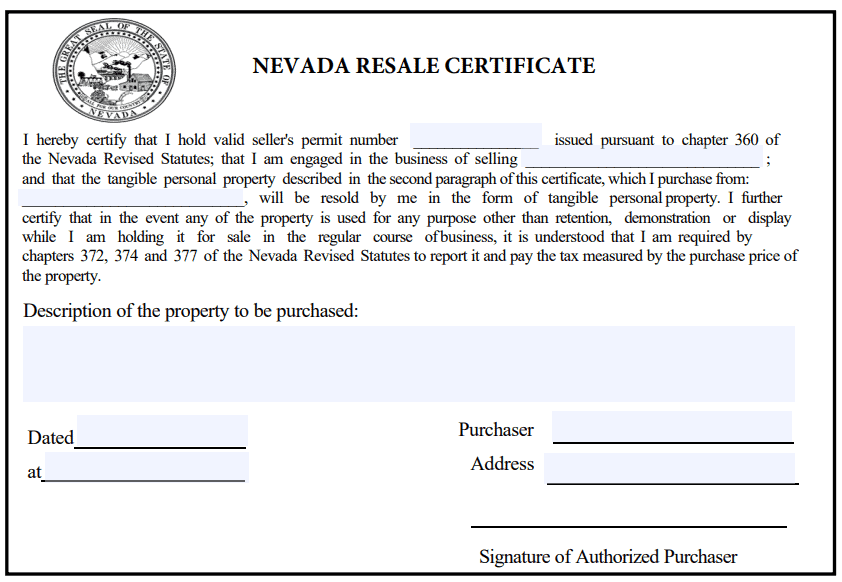
The above is an example of a Nevada resale certificate. What these look like varies from state to state. In some states, your sales tax permit will double as your resale certificate.
Some states issue you an actual paper or an electronic document called a resale certificate to present to your vendor. But in most cases, you can simply fill out a generic state resale certificate and use that as proof that you are a reseller.
It’s important to note that most states allow resellers to present a resale certificate from their home state when making purchases to sell at retail. However, nine states and Washington DC only allow retailers to accept in-state resale certificates.
For example, if you are a seller based in Florida and purchase from a wholesaler in Georgia, that Georgia vendor can accept your out-of-state Florida resale certificate.
However, Florida does not allow vendors to accept non-Florida resale certificates. So if the transaction were reversed and you are based in Georgia and only have a Georgia resale certificate, then your Florida vendor isn’t allowed to accept your Georgia document.
To get around this, you can register for a Florida sales tax permit, but of course, this means that you are also now required to collect and remit sales tax from Florida buyers. You can read more about registering for a sales tax permit here.
Some states provide registered sellers with a paper or electronic certificate to present to vendors. But in most cases, it is enough to simply provide your vendor with the relevant information they need, including:
In many cases, your vendor will provide you with a form to fill out before making a purchase for resale. You can also present the Multijurisdictional Uniform Sales & Use Tax Resale Certificate in the 36 states that currently accept this form.
Retailers are allowed to buy items tax-free when doing the following:
The important thing to remember here is that the state eventually does want someone to pay sales tax when these items are sold to the end user.
States consider it fraudulent if a buyer uses a resale certificate to buy items tax-free but then uses the item themselves without paying “use tax” on it.
Don’t attempt a tax-free purchase if you are buying business purchases, such as office supplies, to use during the course of your business. Resale certificates are only to be used to buy items that you intend to resell or use to manufacture a product for resale.
Of course, things can change over the course of a business. If, for some reason, you purchase items without paying sales tax but do not end up reselling them or using them to manufacture goods for resale, you should pay the use tax on those items when you file your sales tax return.
Vendors are not required to accept a resale certificate and may refuse to honor your resale certificate for any number of reasons.
This could be anything from not wanting to provide their products to a potential competitor to not believing that you are using the resale certificate in good faith to simply not having a system in place to accept and manage these certificates.
In the case that you end up paying sales tax on items that you plan to resell, you can request a refund of sales tax paid on your next sales tax return. To do this, be sure to keep track of the sales tax you paid on items that you later resold.
As a retailer, a customer might, from time to time, present you with a valid resale certificate and request to buy products without paying sales tax.
In this case, it’s up to you to determine whether you can accept the document in good faith. You can also simply refuse to accept resale certificates, though in that case a buyer wishing to resell items might turn to a competitor to make their purchase.
Unfortunately, if you do happen to accept a resale certificate on a sale that turns out to be fraudulent, you’re often on the hook to pay back the sales tax your business failed to collect. That’s why it’s important to carefully consider each sale for resale
If presented with a resale certificate, you should ensure the following:
These nine states and the District of Columbia only allow vendors to accept in-state resale certificates.
As a vendor operating in one of these states, ensure that your buyer’s resale certificate is from your state before accepting it.
As a buyer for resale making a purchase in one of these states, understand that you are required to hold a valid in-state sales tax permit before purchasing items for resale from a vendor in one of these states.
The concept of a resale certificate and when to use one can be confusing, as each state and Department of Revenue has its own rules and regulations. If you’re a seller accepting resale certificates, ensure you always check the validity of the resale certificate at the time of purchase. Or, if you are unsure of tax laws and how to handle resale certificates, speak with a sales tax expert to learn more.