
Alex Steele
Writer



Zamp, Anrok, and Numeral are the three leading sales tax automation platforms for SaaS and ecommerce companies in 2026. Zamp is the best overall choice for companies past the startup stage that need a fully managed, liability-backed compliance service. Anrok is the best self-service option for venture-backed SaaS startups on Stripe or Chargebee under $5M ARR. Numeral is best for small ecommerce brands with fewer than 10–15 state filing obligations who want transparent per-filing pricing.
The U.S. has more than 13,000 tax jurisdictions, each with its own rates, rules, and deadlines. Sales tax rules change hundreds of times each year across states, counties, cities, and special districts. For a SaaS company scaling across states, choosing the wrong tool means unexpected costs, compliance gaps, or a state audit your finance team manages alone. This guide covers pricing models, features, service models, and honest use-case recommendations for all three platforms. For a broader look at your options, see our sales tax software guide.
Most SaaS companies don’t start thinking seriously about sales tax until something goes wrong. A state notice lands in the inbox. A new remote hire triggers economic nexus in a fourth state. The CFO asks why the compliance line item jumped 40% last quarter.
The most common triggers we see across finance teams making this exact evaluation:
If any of these sound familiar, the comparison below addresses exactly where each platform stands on all four dimensions.
This Zamp vs Anrok vs Numeral feature comparison covers the 12 dimensions that matter most to SaaS finance teams evaluating these three platforms. All data sourced from published pricing pages, verified press releases, and Zamp’s published trust signals.
| Feature | Zamp | Anrok | Numeral |
|---|---|---|---|
| Service model | Fully managed — done for you or done with you | Self-service software | Self-service software |
| Pricing model | All-inclusive flat subscription | Platform fee + revenue percentage | Pay-as-you-go per filing and registration |
| Nexus monitoring | Yes — 80% of nexus alerts land before threshold | Yes — remote employee tracking via 11+ HR integrations | Free tier (monitoring only, no filing) |
| State registrations | Included — no per-registration fees | Yes | Yes |
| Filing automation | Yes — automated filing included | Yes | Yes |
| Notice management | Proactive — 75K+ notices handled | Reactive | Reactive |
| Liability model | Shared liability — The Zamp Commitment covers penalties and interest if Zamp errs | Customer bears all compliance liability | On-time filing guarantee covers penalties and interest for missed filing deadlines |
| Global VAT/GST coverage | 70+ countries | 100+ countries | Global support available, with coverage that extends to 60+ to 70+ countries depending on plan and workflow |
| SaaS billing integrations | Shopify, Stripe, major ERPs | Native — Stripe, Chargebee, NetSuite, QuickBooks | Stripe, Shopify, basic ERPs |
| Exemption certificate management | Yes | Yes | Available, with broader functionality on higher-tier plans |
| Onboarding time | <2 hours average | Days to weeks | Hours |
| Support response time | <1 hour average | Variable | Variable |
Filing accuracy: 99.9%+ | Customers: 1,200+ teams
Zamp is a fully managed sales tax compliance service — not a software tool you configure and maintain, but a team that handles registrations, filings, notices, audit support, and remediation end-to-end. The Zamp approach positions it differently than either Anrok or Numeral: where those platforms give you automation, Zamp takes care of everything.
Zamp operates on two service models. Done for you means Zamp handles everything — you approve, Zamp executes. Done with you gives controllers and CFOs more oversight while Zamp still manages execution. Both models include the same core coverage: state registrations and automated filings, proactive notice management (75K+ notices handled to date), audit defense, and real-time rooftop-accurate rates across 13,000+ U.S. jurisdictions and 70+ countries.
The most distinctive element of Zamp’s offer is The Zamp Commitment: if Zamp makes an error or misses a deadline, Zamp covers the resulting penalties and interest — not the customer. Anrok places compliance liability entirely on the company using the software, while Numeral provides an on-time filing guarantee.
Zamp’s team includes former state auditors and sales tax specialists — 400 years of combined tax expertise. This is what “fully managed” actually means: the people running your filings have sat on the other side of a state audit. When a notice arrives, Zamp handles it before it reaches your inbox.
Zamp’s verified track record:
Zamp has been named a Major Player in two 2024 IDC MarketScape reports.
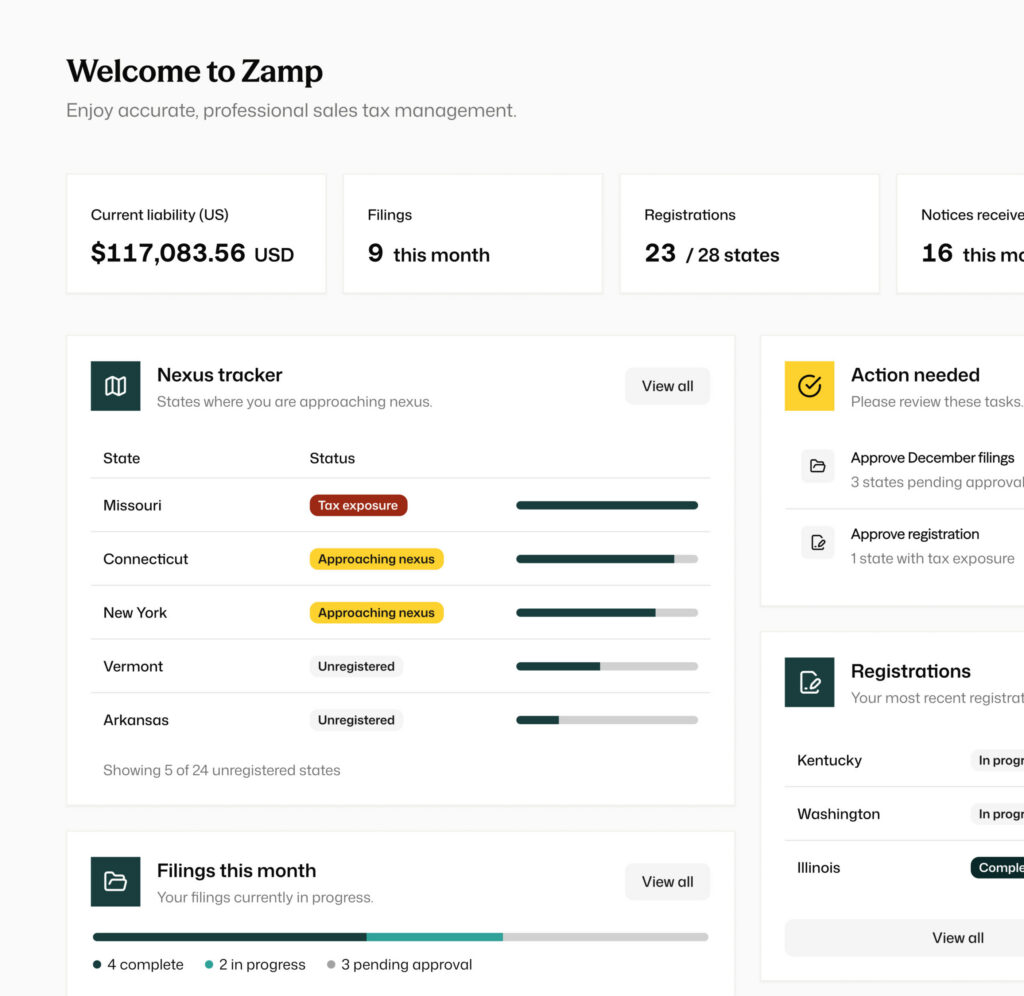
SaaS and ecommerce companies past the startup stage ($5M+ ARR) that want registrations, filings, notices, and audit support handled in one managed service. Particularly strong for companies managing 15+ state filing obligations, B2B sellers with tax-exempt customers, or any team that has received a state notice or is approaching an audit.
Also a strong fit for omni-channel brands (DTC + wholesale + Amazon) where product taxability rules and marketplace facilitator obligations create the kind of multi-layer complexity that self-service tools consistently miss. For a full sales tax comparison, see the broader guide.
All-in-one pricing. No per-transaction fees, no per-filing fees, no surprise invoices.
Anrok is a SaaS-specific sales tax platform founded in 2020. It is backed by Spark Capital, Sapphire Ventures, Khosla Ventures, Sequoia, and Index. In October 2025, Anrok closed a $55M Series C — bringing total funding to over $100M at a $525M valuation. The company serves 1,000+ companies in 100+ countries. Notable customers include Anthropic, Cursor, and Notion.
Anrok’s core product is built for billing-first SaaS companies. Its tax engine understands which U.S. states tax software-as-a-service, digital goods, and usage-based billing — nuances that generic tax tools frequently get wrong. Anrok integrates natively with Stripe, Chargebee, NetSuite, and QuickBooks. Tax calculations happen at the point of billing, not reconciled retroactively. It also monitors physical nexus automatically: if a remote employee moves to a new state, Anrok’s 11+ HR platform integrations flag the new obligation immediately.
In 2025, Anrok expanded to support physical goods. This makes it viable for hybrid ecommerce+SaaS businesses that previously couldn’t adopt it.
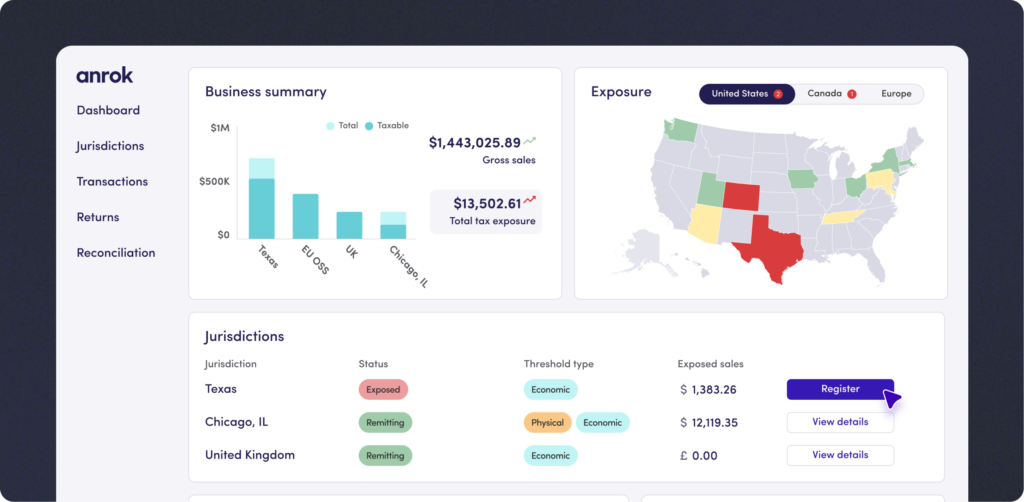
Venture-backed SaaS startups on Stripe or Chargebee with under $5M ARR. Engineering-forward finance teams that want native billing integration. Companies with significant international revenue or remote workforces that create multi-state nexus complexity. For a full breakdown, see the Anrok alternatives guide.
Contact Anrok for pricing details.
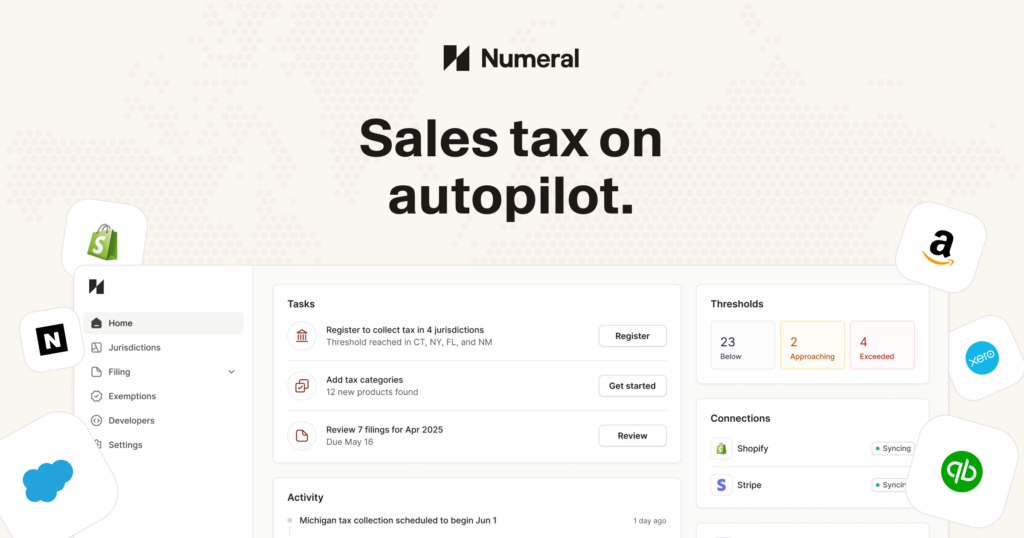
Numeral is a sales tax automation platform founded in 2023. It is backed by Mayfield, Benchmark, Uncork Capital, Y Combinator, and Mantis. In September 2025, Numeral closed a $35M Series B at a $350M post-money valuation — bringing total funding to $57M.
Numeral’s standout feature is pricing transparency. Its free monitoring tier lets companies track nexus exposure without committing to filing fees — rare in this category. When ready to file, the pay-as-you-go model is fully published with no sales call needed. For merchants on Shopify, Numeral’s integration is frequently praised for simplicity and fast setup.
Numeral serves 2,000+ software and ecommerce clients. It has positioned itself as the approachable, modern alternative to legacy compliance tools. Its YC backing and 3.5x revenue growth suggest continued product investment over the next 12–18 months.
Small-to-mid ecommerce brands selling via Shopify in fewer than 10–15 states. Early-stage SaaS companies that want free nexus monitoring before committing to a compliance platform. Finance teams that prioritize pricing transparency and want to start without a contract. For a deeper breakdown, see the Numeral alternatives guide.
Contact Numeral for pricing details.
Zamp is the strongest fit for SaaS companies past the startup stage; Anrok is the better choice for early-stage startups under $5M ARR on Stripe or Chargebee.
Anrok was purpose-built for SaaS. It understands which states tax SaaS, how to handle usage-based billing, and how to apply economic nexus rules across jurisdictions. Its native integration with Stripe and Chargebee means tax calculations happen at the billing layer — not retrofitted afterward. For a Series A company on Stripe with <$5M ARR and a small state footprint, Anrok is genuinely well-matched.
Zamp serves SaaS companies from early-stage startups to enterprise scale. Its SaaS tax coverage is managed by tax professionals — former state auditors — not a software-only engine. The key difference: Anrok gives you a tool and you own the compliance outcome. Zamp gives you a team and takes responsibility for outcomes via The Zamp Commitment. For CFOs and controllers who need time back — not another platform to manage — Zamp is the stronger fit.
Numeral is primarily ecommerce-oriented. Its SaaS tax logic is less mature than Anrok’s. Numeral can support B2B SaaS companies with tax-exempt customers, but exemption certificate management is tied more closely to higher-tier plans and more advanced workflows.
For ecommerce companies, Numeral and Zamp are the stronger options — Anrok, despite its 2025 expansion into physical goods, is still primarily architected for software sellers.
Numeral’s Shopify integration is among the cleanest in the category for straightforward ecommerce sellers. If you’re a DTC brand selling physical goods in 5–10 states, Numeral’s pay-as-you-go model gives you predictable, itemized costs without a long-term contract. The free monitoring tier lets you understand your nexus exposure before committing to filing fees.
Zamp covers ecommerce sellers as comprehensively as it covers SaaS. The same registrations, filings, notice management, and audit defense apply regardless of product type. For omni-channel brands (DTC + wholesale + Amazon marketplace), Zamp’s fully managed model is particularly valuable. Product taxability rules and exemption certificate management across multiple channels create exactly the kind of multi-layer complexity that self-service tools consistently miss. For a broader comparison, see the compliance software guide.
Anrok is the right choice for:
Anrok is a strong product for these use cases. Before you commit, pressure-test two questions: What does the revenue-percentage model cost as you scale? And who owns the liability if Anrok misfiles? The Zamp vs Anrok comparison covers both in depth.
Numeral is the right choice for:
Numeral can support B2B SaaS companies with tax-exempt customers, but exemption certificate management is tied more closely to higher-tier plans and more advanced workflows. International coverage is narrower than Anrok’s, but Numeral does support global VAT/GST workflows and multi-country compliance. Numeral provides an on-time filing guarantee, but it does not position its coverage as the same kind of broad liability-transfer model offered by fully managed providers.
Zamp is the right choice for:
Zamp may not be the cheapest option at $1M ARR if you’re willing to manage compliance yourself. It is the best option at any stage where the cost of a compliance error — fines, interest, audit distraction — exceeds the cost of the service.
Based on our analysis of all three platforms, we scored each one across six criteria: service model depth, pricing predictability at scale, SaaS-specific tax logic, liability transfer, integrations, and customer support responsiveness. We reviewed published pricing, verified press releases, and third-party benchmark data.
Our evaluation found that no single platform dominates every category. The right choice depends on your ARR stage, state footprint, and whether you want a software tool or a managed service. Zamp is the only platform of the three that offers The Zamp Commitment — a financial guarantee that covers penalties and interest if the vendor errs. That single differentiator changes the risk calculus for companies where a compliance mistake carries real financial consequence.
There is no universal winner in this comparison — and that is the point. Each platform is genuinely built for a different buyer.
Choose Anrok if you are a venture-backed SaaS startup (<$5M ARR) on Stripe or Chargebee. You need SaaS-specific billing integrations and remote employee nexus tracking. Anrok’s $55M Series C (total funding $100M+) signals continued product investment.
Choose Numeral if you are an ecommerce or early-stage SaaS company with fewer than 10–15 state filing obligations. You want transparent per-filing pricing with no sales call required. The free nexus monitoring tier is a low-risk starting point. Numeral’s $35M Series B and 3.5x YoY growth suggest continued improvement.
Choose Zamp if your company has outgrown the startup compliance phase. You want registrations, filings, notices, and audit support handled end-to-end. You need pricing that stays predictable as ARR and state obligations grow. The Zamp Commitment — where Zamp takes on liability for filing errors — is unique in this category. It matters most to companies where a compliance mistake carries real financial consequence.
The tax management software market is projected to reach $65.03 billion by 2035. All three platforms are well-positioned. But market size does not simplify your decision. Stage, state footprint, and service model preference do. Use the comparison tables and analysis above to stress-test the real cost of each option at your current ARR — and where you plan to be in three years.
Anrok is generally better for SaaS companies than Numeral. Anrok has a dedicated SaaS tax engine that handles software-specific taxability rules, native integrations with Stripe and Chargebee, and exemption certificate management. Numeral’s core audience is ecommerce, though it can support B2B SaaS companies with tax-exempt customers through higher-tier plans. For B2B SaaS in particular, Anrok is the stronger self-service platform.
Contact Anrok directly for current pricing details. Pricing varies based on company size, transaction volume, and state footprint.
Anrok is purpose-built for SaaS companies with billing-layer integrations, SaaS-specific tax logic, and remote employee nexus tracking. Numeral targets ecommerce merchants with per-filing transparent pricing and a strong Shopify integration. Anrok includes exemption certificate management; Numeral offers it on higher-tier plans. Both platforms place compliance liability on the customer, though Numeral provides an on-time filing guarantee that covers penalties and interest for missed filing deadlines.
Zamp is worth evaluating for any SaaS company that has grown past early-stage, has meaningful state filing obligations, or has received a state notice. Its all-inclusive flat subscription, proactive notice management, audit defense, and The Zamp Commitment address the gaps left by self-service tools. For early-stage SaaS companies with a small state footprint, Anrok may be more cost-efficient at first — with the option to switch when complexity grows. See the Zamp vs Numeral breakdown for a direct comparison.
Yes. Anrok covers 100+ countries for VAT/GST — the widest international option of the three platforms. Zamp covers 70+ countries. Numeral supports global VAT/GST workflows and multi-country compliance, with coverage that extends to 60+ to 70+ countries depending on plan and workflow. For SaaS companies with significant international revenue, Anrok’s global reach is a genuine advantage worth weighing against its pricing model.
Yes. Numeral offers exemption certificate management, including certificate collection, validation, and monitoring, with broader functionality available on higher-tier plans. This makes Numeral viable for B2B SaaS companies that sell to tax-exempt customers — nonprofits, resellers, government entities. If your business has a significant volume of tax-exempt customers, confirm which plan tier includes the exemption certificate features you need. See the Numeral alternatives guide for what to look for in platforms that offer robust exemption certificate workflows.
Zamp is the strongest fit for companies operating both ecommerce and SaaS lines — hybrid models with physical and digital goods. Its fully managed service covers both product types without requiring separate configurations or platform-specific workarounds. Anrok’s 2025 expansion into physical goods makes it a growing option for hybrid sellers, but its architecture is still primarily SaaS-oriented. Numeral is primarily ecommerce-focused. For a broader view, see the sales tax comparison overview.
Zamp uses an all-inclusive flat subscription with no per-transaction or per-filing fees. One price covers registrations, filings, notices, audit support, and white-glove service. Anrok uses a different pricing model that may be competitive at early stages but can grow as revenue scales. Contact both platforms directly to compare pricing based on your specific company size, state footprint, and compliance needs.
Numeral offers a free nexus monitoring tier that tracks your state tax exposure without triggering filing fees. Filing itself is not free. The free tier is a low-risk starting point for companies not yet filing in multiple states who want to understand their nexus exposure before committing.
Yes. Anrok integrates natively with Stripe, applying tax calculations directly at the billing layer before a charge is processed — not reconciled retroactively. Anrok also integrates natively with Chargebee, NetSuite, and QuickBooks. This makes it well-suited for SaaS companies running subscription or usage-based billing on these platforms who need real-time tax applied at the point of charge.
The Zamp Commitment is Zamp’s guarantee that if Zamp makes a filing error or misses a deadline, Zamp covers the resulting penalties and interest. Numeral also advertises an on-time filing guarantee that covers penalties and interest for missed filing deadlines, while Anrok’s positioning is centered more on platform automation and tax operations support than on a comparable public guarantee.
.png)
%20(1).png)