
Brandon Roth
Head of Product Marketing


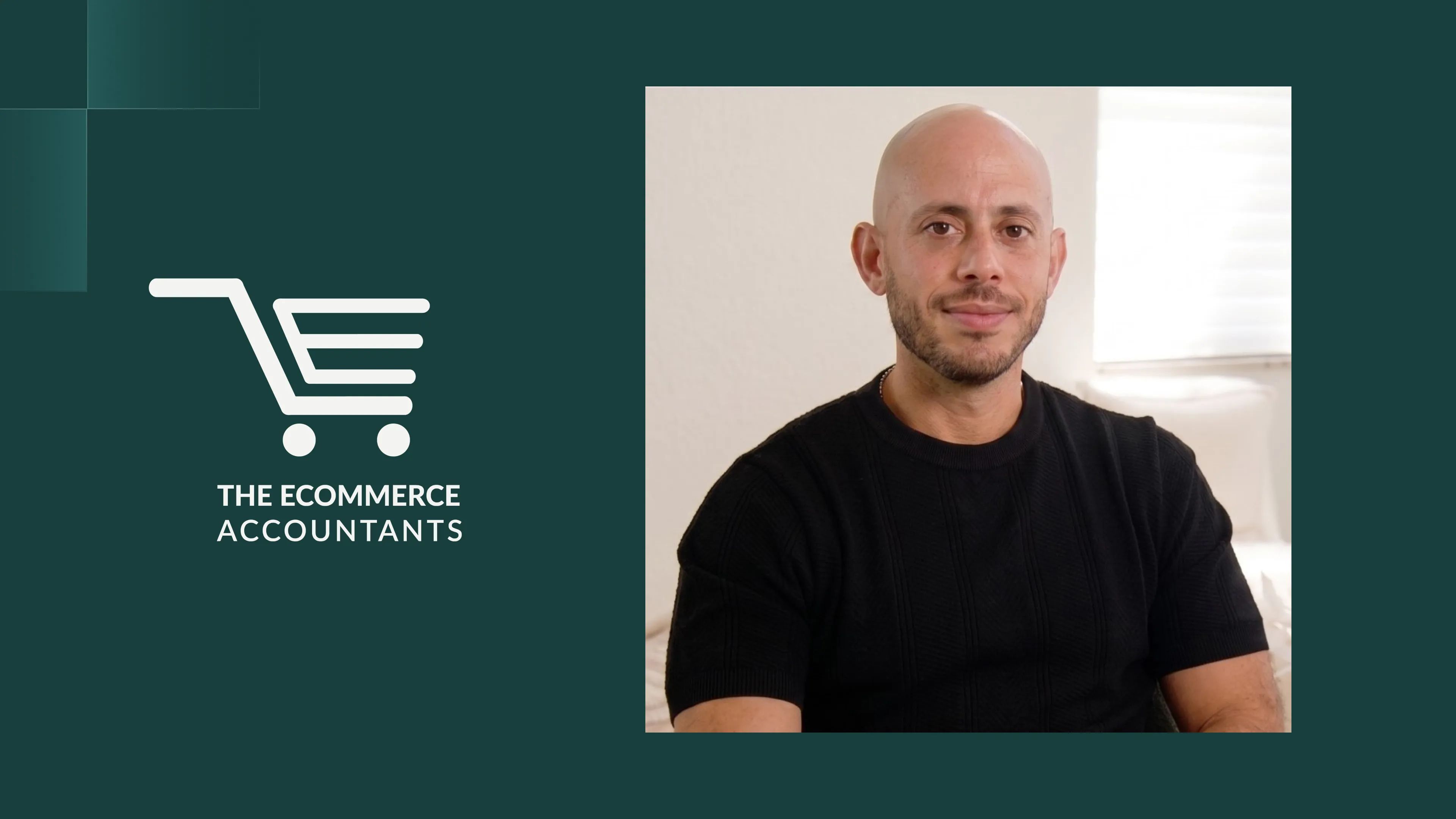


Chris Rivera did not set out to build an e-commerce accounting firm. He set out to leave one of the largest accounting organizations in the world.
In 2018, he walked away from Ernst & Young to start his own practice. Most people who leave a firm like that go in-house with a client or move to another corporate shop. Chris went the other way and became an entrepreneur. Then he spent the better part of a year struggling to find his footing.
“I fell flat on my face. I was really struggling to get clients and learn the business development side.”
A fellow firm owner who had niched into real estate gave him the advice that stuck: specialize. Chris tried rideshare accounting first. Every Uber and Lyft ride turned into a sales pitch, and the math never worked. Those drivers were business owners, but most did not have the budget for tax strategy or bookkeeping.
Then a friend running an e-commerce brand asked for help with his books. Chris looked closer and saw two things at once. The founder was making real money, and the entire category was underserved when it came to accounting and tax. He rebuilt the firm around it.
“I noticed it was really underrepresented in terms of accounting and tax, so we restructured our firm and hyper-focused on e-commerce entrepreneurs.”
That focus became The Ecommerce Accountants.
Chris is specific about who the firm serves. Not dropshippers chasing the next trending product, but brand owners building something durable around an evergreen product and scaling it across channels. A typical client sells through some combination of Shopify, Amazon, TikTok Shop, and wholesale or retail.
“We prefer the time-tested clients who have a winning product. Instead of selling other products, they're scaling the same brand across different channels.”
These founders share a profile. They run multi-million dollar businesses with small headcount and little financial expertise in-house. They have big-company problems and a team built for none of them. So they hand the back office to Chris and his team, and they expect to stop thinking about it.
“A lot of these people don't want to hear about sales tax or tax strategy or bookkeeping. They just want it done.”
The firm sits between compliance partner and strategic advisor, closer to a virtual CFO. Clients lean on them for the routine work and for the bigger calls, like whether to fund growth with cash on hand, a credit card, or an SBA loan. Across all of it, sales tax was a constant concern, and had been ever since the Wayfair decision reshaped nexus rules.
For a long time, The Ecommerce Accountants handled sales tax the way most firms do. They had a team of sales tax professionals, and that team worked by hand.
“We were very much an old-school approach. We'd download the sales reports from each channel and manually file returns to each respective jurisdiction. As you can imagine, scalability is very difficult.”
Every new state meant more manual work, more training, and more room for error. The firm tried a software vendor to break through the ceiling. That relationship did not work out, and the team went back to filing by hand.
The problem was never accuracy. The previous vendor could file a correct return. The problem was that the vendor never understood who it was actually serving.
“They were capable of filing an extremely accurate return. That was never the issue. The issue was they didn't fully understand who the customer was.”
The firm was treated as the account, and then the vendor would approach the firm's clients on its own terms. There was no dedicated rep, the touchpoints were disorganized, and communication was thin. So when Zamp first reached out through a mutual connection, Chris was skeptical.
“At first I wasn't into it because of our previous experience. But as an accounting firm owner, I want to future-proof our business and make sure we have scalable solutions that don't require massive headcount.”
The difference showed up immediately, and it had nothing to do with software features.
“The biggest difference we noticed with Zamp right off the bat was a point of contact directly responsible for our firm, as if we're a partner and they're helping us service all of our clients. If we have a problem, we both have a problem.”
That framing matters in e-commerce, where the end client rarely wants to understand sales tax at all.
“These entrepreneurs don't know the first thing about how to log into a state account. They're looking for an expert to get it done. They just care that someone is responsible and handling it accurately.”
With Zamp, the responsibility was clear and shared. The firm kept its relationship with the client. Zamp stood behind the firm. And the work itself stopped being something Chris had to staff around.
This is where the partnership changed the shape of the business.
Before Zamp, a single team member filing by hand could realistically cover 5 to 10 states for a client. The work was high-volume and unforgiving. A typical e-commerce client generates anywhere from 1,000 to 5,000 orders, often more, and any of them can carry a sales tax implication.
“With sales tax, it's a large volume of data. For a new team member who isn't seasoned, that volume can be intimidating and lead to mistakes.”
After Zamp, the ceiling moved.
“Instead of that person having the capacity to work on 5 to 10 states, now for that same client they can scale up to 30 to 40 states. It's become a major revenue driver for us.”
Same headcount. Several times the output. That shift did more than improve margins. It changed how Chris thinks about growth.
“Our mindset shifted from how do we get to 1,000 clients to how do we get to 2,000 to 3,000 states. Maybe we don't need 1,000 clients. Maybe we have 500 clients with 50 states each.”
Instead of chasing client count, the firm could go deeper with every relationship and cover each state where a client had nexus. Multichannel selling is where that gets genuinely complicated. Direct-to-consumer platforms like Shopify and WooCommerce carry their own compliance obligations. Marketplaces like Amazon and TikTok Shop fall under marketplace facilitator rules. Same client, two very different sets of requirements, multiplied across thousands of orders.
“Working with Zamp has simplified our processes across multi-channel sellers.”
The expertise behind it was a big part of why it worked.
“It was a breath of fresh air to have a partner that lives and breathes sales tax. That's all they do. They hire amazing, almost PhD-level people.”
What Chris keeps coming back to is not a feature. It is the posture.
“Our team and theirs view this compliance operation as a shared responsibility. Even though our relationship is with the client and Zamp's is with us, when issues or obstacles arise, it's our issue and our obstacle to work through together. In my previous experience with another partner, that was definitely not there.”
That is the line between a vendor and a partner. One files your returns. The other owns the outcome alongside you and shoulders the liability that comes with it.
Pre-Zamp, sales tax was a service line The Ecommerce Accountants could not scale without adding people. Post-Zamp, it is one of the firm's strongest. Same team, more states, more revenue, and a partner on the other end who treats the firm's clients like their own.
“I'd recommend Zamp based on my personal experience. Sales tax is a major service line for us, and pre-Zamp it was one we couldn't scale as efficiently as we can today.”
His advice to other e-commerce firms is straightforward. Know what your clients are walking in worried about, and pick a partner equipped to scale that part of your practice with you.
Sales tax does not have to cap how far your firm can grow. Zamp handles it end-to-end, so your team can take on more states, more clients, and more complexity without adding headcount.