


Sales tax made simplier.
Global sales tax platform powered by AI and tax experts.
It’s almost the start of the year’s busiest shopping season — Black Friday and Cyber Monday (BFCM). As an online seller or store owner, you’re likely getting ready to release your list of deals and promotions to customers en masse. But one thing you can’t forget as you prepare for the upcoming holiday season is the state sales tax implications that come with selling more goods, items, and services.
Luckily, our team has put together an ultimate guide on sales tax and how to prepare for BFCM 2024. We went in-depth, conducting a survey of 1,000 respondents in the e-commerce industry to see just how ready they are for the upcoming holiday season. We’ll dive more into that and the following:
- What BFCM is
- Whether your business is truly ready for sales tax obligations this holiday season
- Tips on how to prepare for the busiest shopping season this year
Let’s dive in.
What Is BFCM?
While many of us are familiar with Black Friday and Cyber Monday, they are actually two completely separate shopping events targeting different types of sales and customers.
Black Friday is generally seen as the kick-off to holiday season shopping for brick-and-mortar stores and online stores and sales. This shopping day occurs the Friday after Thanksgiving, with Cyber Monday following the Monday after. As its name suggests, Cyber Monday tends to be geared more toward online stores and platforms like Amazon, Etsy, and Shopify.
According to Adobe research, last year’s holiday season generated more than $221.1 billion, with revenue up more than 4% yearly. In addition, Shopify released a report highlighting that merchants using its platform reached a record $9.3 million in sales over the BFCM weekend, a 24% increase from 2022.
All this goes to show that the holiday season generally brings in record-breaking revenue for shops and platforms alike. So whether you own a shop on a platform or a brick-and-mortar store, being prepared to bring in significant revenue is vital for your business’s finances. This includes keeping a touch point on state sales tax laws and nexus thresholds.
Are You Ready for Black Friday 2024?
While you may be gearing up with hiring and inventory for BFCM, there’s one thing just as crucial to prepare for — sales tax. The upcoming holiday season likely means you’ll sell more across various platforms. You may send products to new states where you’ve never sold or even more to states with a solid customer base. What this all equates to is that you may hit nexus thresholds you aren’t aware of.
Understanding sales tax nexus thresholds comes down to the idea of economic presence, which is how much of a connection a business has with a state that makes it subject to sales tax. Most states look at economic factors like how much money a company makes or how many transactions it does in a state.
Zamp Tip
The majority of states have a 200 transaction or $100,000 in sales limit for triggering nexus. For businesses, keeping track of these thresholds and knowing when they need to start collecting sales tax in a new state is vital to staying compliant and avoiding penalties or fines.
BFCM Survey
Our team conducted an in-house survey of 1,000 respondents in the e-commerce industry to determine whether companies are ready for the upcoming BFCM season and handling state sales tax requirements. See more of what we uncovered in the sections below.
Our Survey Respondents
Out of the 1,000 respondents we surveyed, 70.96% work in companies with 250 employees or less. Most of the survey respondents who participated worked in various departments, with the most popular being as a founder or CEO of a company, operations, customer support, and revenue (marketing or sales).
Those who participated sell on various platforms, including Amazon and Shopify. Here’s a breakdown.

In addition, 71% of the 1,000 respondents reported that they use either sales tax software or personnel to help with calculations and nexus tracking. Over 40% stated that they use a combination of both to ensure they are compliant where they do business.
Our Survey Findings on BFCM 2024
Our in-house survey focused on whether companies are ready for the upcoming Black Friday and Cyber Monday shopping season regarding sales tax compliance.
Reflecting on previous years, 92% of the 1,000 respondents reported that their businesses handled sales tax-related issues during BFCM adequately or very well. This compares well to the question we asked on whether companies are confident in their overall readiness for BFCM 2024, where 82.29% of respondents stated they were somewhat confident or very confident for the upcoming season.
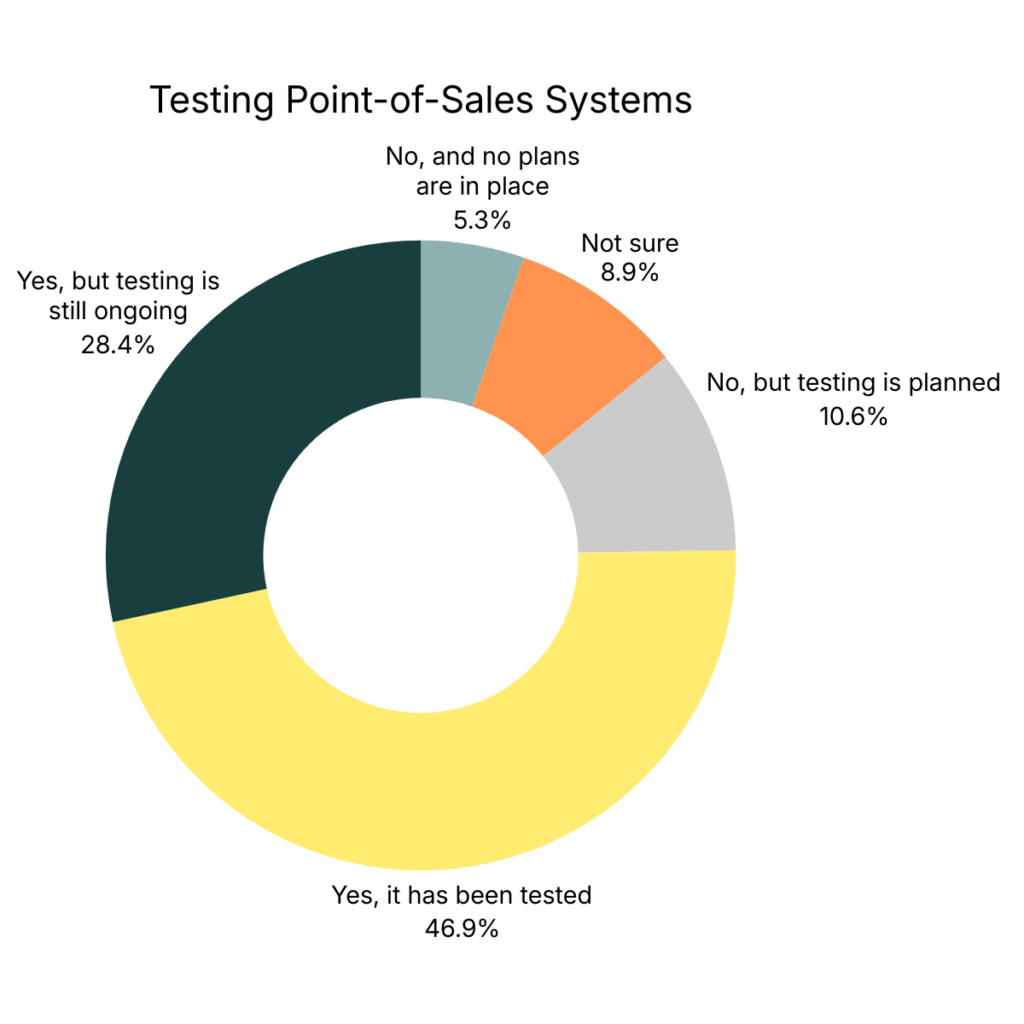
Respondents also reported the following when asked whether their point-of-sale system has been tested for accuracy in tax calculations and handling increased transaction volumes:
BFCM Sales Tax Laws and Requirements
Most e-commerce companies have some tracking in place for where and when they are required to pay state sales tax. But what happens when you hit new nexus thresholds during the busiest time of the year?
Our study found that 76% of those surveyed said they were prepared for the sales tax filing requirements and deadlines after BFCM, while 24% stated they weren’t prepared.
Additionally, we found that over half (68%) of those surveyed in our study are not fully aware of tax laws that could affect their business in the upcoming holiday season. Here’s how that breaks down:

BFCM Sales Tax Concerns and Preparedness
There are many things to be concerned about when it comes to preparing for Black Friday. And that’s why we asked our 1,000 survey respondents from the e-commerce industry what their main concerns were regarding sales tax and BFCM preparation.
Over 39% of those surveyed said they were concerned about handling an increased transaction volume, along with 23% who were worried about the accuracy of sales tax calculations. Let’s take a closer look at these concerns:

With the upcoming holiday season being the biggest shopping time of the year, it’s no wonder e-commerce companies are concerned with sales tax calculations and new regulations.
One of the biggest findings in our survey was that over 47% of respondents stated that they are going to be working with external consultants or professionals to ensure sales tax compliance for BFCM. This is despite the fact that 40% of those surveyed already have in-house personnel and software to track sales tax compliance and nexus for them.
If you’re looking for an automated sales tax solution and an in-house team with a combined 200 years of sales tax, book a call with Zamp. We’re a full sales tax compliance service that checks all the boxes — nexus tracking, registrations, roof-top accurate calculations, product taxability research, mapping, filing, and reporting. See why our customers trust us to handle all their sales tax needs.
Preparing Your Business for Black Friday 2024
With the holiday season just around the corner, there are several things you can do to prepare your business for Black Friday and Cyber Monday. The most important from a sales tax perspective is:
- Ensuring you have tracking set up for sales
- Knowing the nexus thresholds
- Making sure you file state sales tax returns
1) Ensure Tracking Is Set Up for Sales
As discussed above, economic nexus centers around how much money you make from sales and/or transaction volume in a particular state. Companies and e-commerce merchants selling across multiple platforms need to have a clear nexus or sales tracking setup to know how much they are selling across channels and where.
Any seller or business owner needs to know that nexus isn’t broken up by platform or selling channel; it’s all tracked at the state level. This means that no matter what type of good, product, or service you sell, it all counts toward nexus activity in a state.
Having an automated sales tax solution like Zamp ensures a hassle-free sales tax experience year-round. Our automation handles everything from getting started to nexus monitoring and adapting to new tax rules. You can focus on your business while we handle sales tax compliance.
2) Knowing Nexus Thresholds Where You Operate
Making sure your business has a good tracking setup is just the first step. You also need to ensure you understand the thresholds in the states you do business in.
If you’re a store owner who only sells in a brick-and-mortar environment, you likely only have to worry about a limited number of states. On the other hand, e-commerce businesses can be complicated as you’re essentially responsible for managing sales tax nexus across the entire US.
While the shipping destination determines which state has jurisdiction over your sales tax obligations, it’s essential to know that you only need to collect in states where you’ve triggered economic nexus or have a physical presence, referred to as physical nexus.
We researched the economic nexus requirements for each state. You can find out more in the table below.
{{ZAMP_BLOG_TABLE:how-to-prepare-for-black-friday-2024:1}}
3) Make Sure You File State Sales Tax
If you hit new nexus thresholds during BFCM or any other time of year, you’ll need to register in each state you hit nexus in to file a sales tax return. You may have to file monthly, quarterly, or bi-annually, depending on how much you sell each year.
If you don’t register or file taxes in the states you owe, you’ll face penalties or fines. These can sometimes be seen as a minor inconvenience but can end up costing you down the road. Fines can sometimes reach up to 25% of the unpaid tax.
With so much that can go wrong, we recommend contacting our sales tax experts at Zamp. They can help you set up everything correctly and ensure you register and file in states where needed. Book a call today.
Conclusion
While sales tax should always be a concern, it can be extremely problematic during the holiday season as you sell more products and services than usual. Ensuring that you track sales tax data and nexus thresholds across platforms and register and file in states where needed is vital for any business to remain compliant. Otherwise, you may be hit with hefty penalties or fines.
Zamp is the first fully managed sales tax solution in the market, which allows you to outsource your sales tax compliance from start to finish. We offer hands-off onboarding with our experienced and dedicated onboarding representatives and a complete service that checks all the boxes, from nexus tracking to registrations, reporting, and filing. Book a call and see how we can help!