




In 2018, the Supreme Court ruled in favor of South Dakota in its case against Wayfair. This decision allowed states to require companies to collect sales tax based solely on sales volume and revenue—creating what is now known as “economic nexus.”Source: Legal Information Institute (Cornell Law School)Legal Information Institute (Cornell Law School)South Dakota v. Wayfair, Inc., 585 U.S. ___ (2018), opinion textlaw.cornell.edu/supremecourt/text/17-494Checked
Instead of working together on common standards, each state created its own specific rules. Today, every state that collects sales tax has an economic nexus law in place.
This guide will help you understand economic nexus, identify the criteria states use, and estimate your potential tax obligations across various states.
Physical Nexus Still Applies
Before we dive into economic nexus, remember that physical nexus rules haven’t changed. You still need to collect sales tax in states where you have:
- Physical locations, employees, or inventory (including through third-party logistics providers)
- Third-party affiliates
- Temporary business activities like trade shows, pop-up shops, or onsite training
How Economic Nexus Works
Now let’s take a look at economic nexus. These laws can be triggered based on your order volume and/or revenue amounts, the channels you sell in, and time periods as defined by each state. E-commerce merchants continue to struggle with understanding which states they need to collect sales tax in. It’s a blind spot for them! Common questions include:
- What is counted towards the thresholds? Orders, revenue, or both?
- Do marketplace and wholesale orders also count?
- Is there a timeline I should use for determining economic nexus?
States currently have economic nexus thresholds based on one of these six sales categories:
- 200 orders OR $100,000 in revenueSource: Virginia TaxVirginia TaxRemote Sellers and Marketplace Facilitators: Economic Nexustax.virginia.gov/remote-sellers-marketplace-faciChecked
- 200 orders AND $100,000 in revenueSource: Connecticut Department of Revenue ServicesConnecticut Department of Revenue ServicesRegistering With DRSportal.ct.gov/drs/businesses/new-business-resourChecked
- 100 orders AND $500,000 in revenueSource: New York State Department of Taxation and FinanceNew York State Department of Taxation and FinanceRegistration requirement for businesses with no physical presence in New York Statetax.ny.gov/pubs_and_bulls/publications/sales/nexChecked
- $100,000 in revenueSource: Illinois Department of RevenueIllinois Department of RevenueInformational Bulletin FY 2026-12: Destination-Based Retailers’ Occupation Tax Changestax.illinois.gov/research/publications/bulletinsChecked
- $250,000 in revenueSources: Alabama Department of Revenue+1Alabama Department of RevenueAre all remote sellers required to register in Alabama?revenue.alabama.gov/faqs/are-all-remote-sellers-Checked Mississippi Department of RevenueBusiness Tax Frequently Asked Questionsdor.ms.gov/business/business-tax-frequently-askeChecked
- $500,000 in revenueSources: California Department of Tax and Fee Administration+1California Department of Tax and Fee AdministrationCDTFA: Tax guide for out-of-state retailers (Wayfair)cdtfa.ca.gov/industry/wayfair.htmChecked Texas Comptroller of Public AccountsTexas Comptroller: Remote sellerscomptroller.texas.gov/taxes/sales/remote-sellersChecked
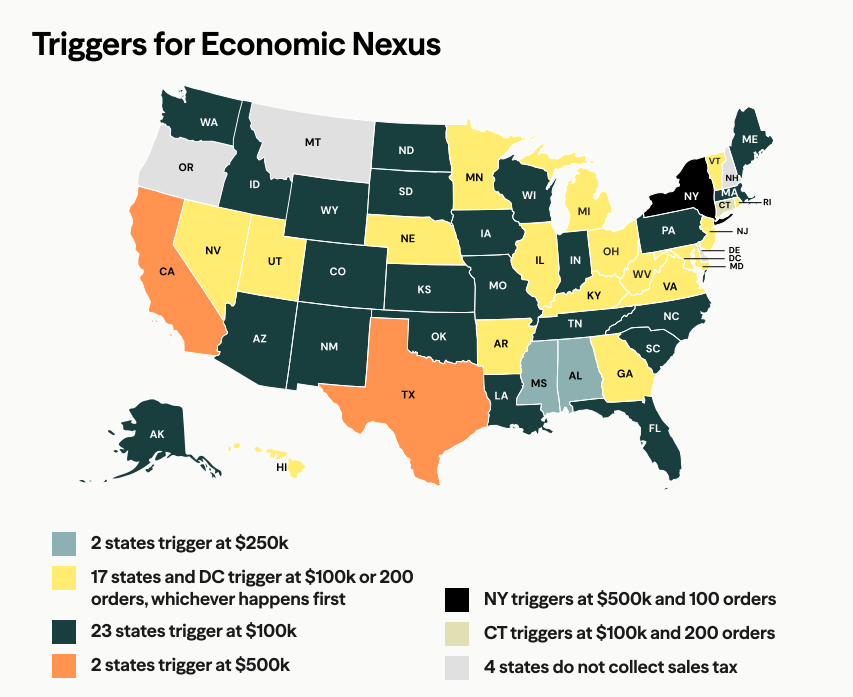
Since this map was made, three states dropped their 200-order test: Utah on July 1, 2025, Illinois on January 1, 2026, and Kentucky on August 1, 2026. Each now uses the $100,000 revenue threshold alone, which leaves 14 states and DC with 200 orders as an alternative trigger.Sources: Utah State Tax Commission+2Utah State Tax CommissionOut-of-State (Remote) Sellerstax.utah.gov/business/sales-tax/other-sales-tax/Checked Illinois Department of RevenueInformational Bulletin FY 2026-12: Destination-Based Retailers’ Occupation Tax Changestax.illinois.gov/research/publications/bulletinsChecked Kentucky Department of RevenueRemote Retailers and Marketplace Providers FAQstaxanswers.ky.gov/Sales-and-Excise-Taxes/Pages/RChecked
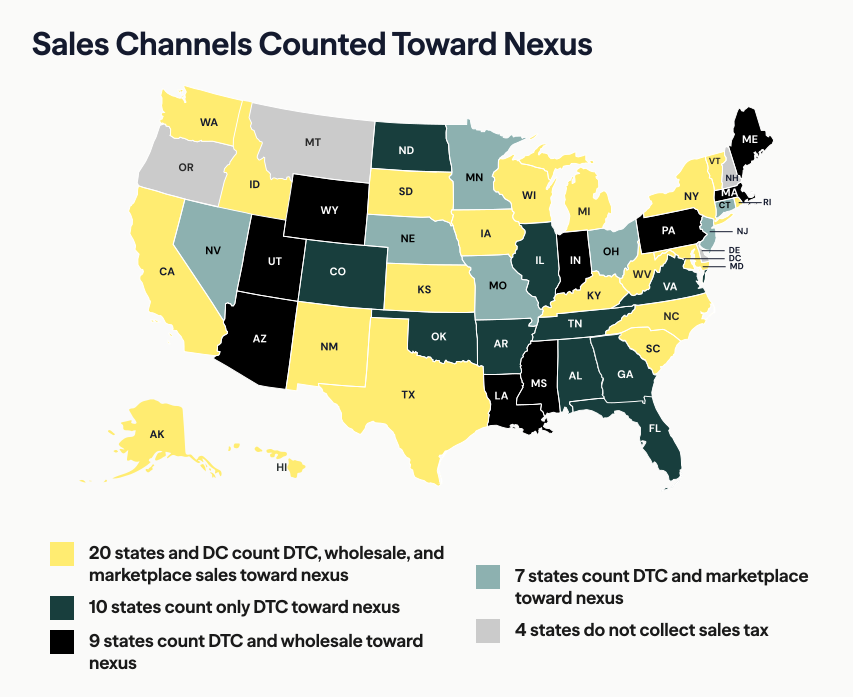
Sales channels that count towards economic nexus can be either:
- Taxable sales for Direct-to-Consumer (DTC)
- DTC + Wholesale
- DTC + Marketplace (eg Amazon)
- DTC + Wholesale + Marketplace
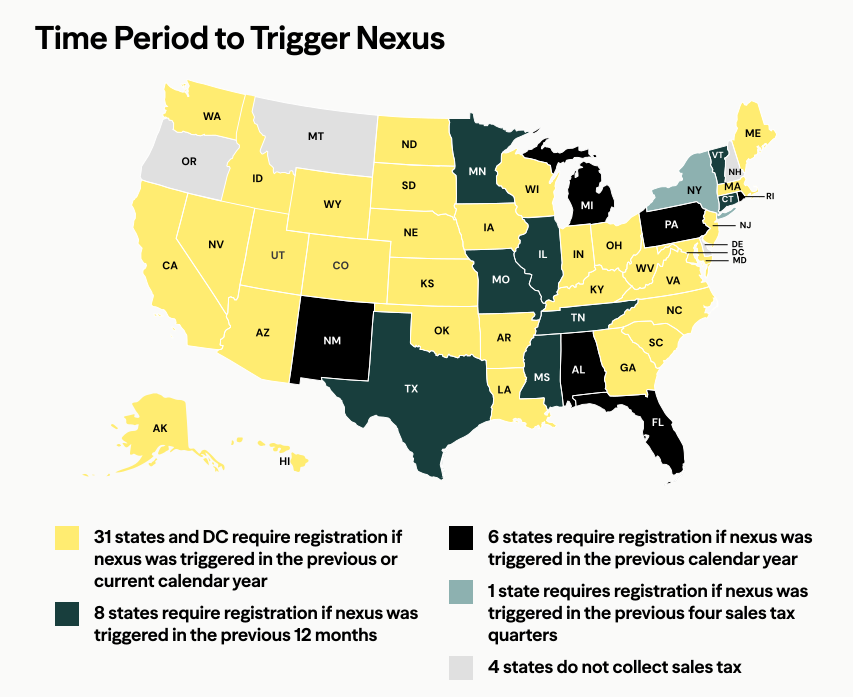
The time period the thresholds are tracked against include:
- Previous calendar year
- Previous or current calendar year
- Previous 12 months
A ‘Rough’ Method to Estimate Exposure
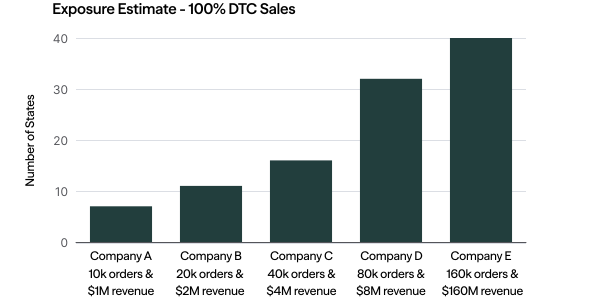
Using ratios from U.S. Bureau of Economic Analysis data on % of personal consumption expenditures for each state and applying that to current economic nexus laws against company examples based on sales and channels, I’ve put together a method of estimating your potential economic nexus exposure. This is ONLY a ‘rough’ estimator and does not factor in all of the variables that go into a thorough economic nexus analysis.Source: U.S. Bureau of Economic AnalysisU.S. Bureau of Economic AnalysisConsumer Spending by Statebea.gov/data/consumer-spending/stateChecked
The first example is for ecommerce merchants that sell 100% of revenue DTC. It uses different sales amounts and assumes an average sales price of $100 USD.
The second example is for merchants selling 20% DTC, 40% via wholesale and 40% marketplaces using the $100 average sales price.
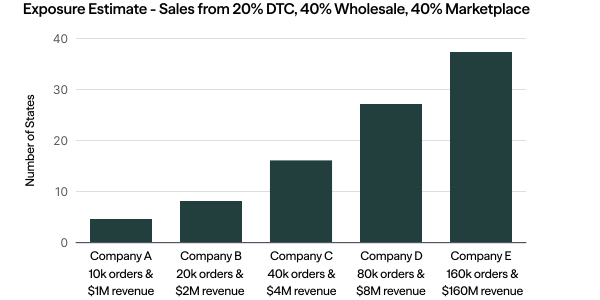
A couple of conclusions from this exposure analysis:
- Economic Nexus starts early and grows quickly. Ecommerce merchants selling $1M per year regardless of their sales channels mix will cross thresholds in multiple states. Sales growth exponentially increases nexus states.
Understanding economic nexus is a challenge for many businesses. The laws use multiple variables and vary by state. Unless you want to become a sales tax expert, manual tracking is not an option. If you’re using a service to track your company’s exposure, be sure it’s using the correct criteria against all of the channels you sell in. If you have any questions or concerns, it never hurts to do a nexus analysis to ensure your company is currently compliant.
Sources
Each figure links to the page it comes from. We re-check these pages on a schedule; the dates show when we first and last checked each one.
Show all 12 sourcesHide sources
Legal Information Institute (Cornell Law School)
South Dakota v. Wayfair, Inc., 585 U.S. ___ (2018), opinion textlaw.cornell.edu/supremecourt/text/17-494- In South Dakota v. Wayfair (2018) the U.S. Supreme Court overruled Quill's physical-presence rule, letting states require remote sellers to collect sales tax.
Checked
Virginia Tax
Remote Sellers and Marketplace Facilitators: Economic Nexustax.virginia.gov/remote-sellers-marketplace-facilitators-eco- Virginia's economic nexus test counts transactions as well as sales: 200 transactions is an alternative to the $100,000 sales threshold.
Checked
Connecticut Department of Revenue Services
Registering With DRSportal.ct.gov/drs/businesses/new-business-resource-center/re- Connecticut's economic nexus test counts transactions as well as sales: 200 transactions together with the $100,000 sales threshold.
Checked
New York State Department of Taxation and Finance
Registration requirement for businesses with no physical presence in New York Statetax.ny.gov/pubs_and_bulls/publications/sales/nexus.htm- New York’s remote-seller test also requires more than 100 sales delivered into the state.
Checked
Illinois Department of Revenue
Informational Bulletin FY 2026-12: Destination-Based Retailers’ Occupation Tax Changestax.illinois.gov/research/publications/bulletins/fy-2026-12.- From January 1, 2026, a remote retailer must collect Illinois tax only if its Illinois gross receipts reach $100,000; the 200-transaction test was removed.
Checked
Alabama Department of Revenue
Are all remote sellers required to register in Alabama?revenue.alabama.gov/faqs/are-all-remote-sellers-required-to-- Alabama's economic nexus threshold for remote sellers is $250,000 in retail sales (taxable and nontaxable) made directly by the seller, measured over the previous calendar year.
Checked
Mississippi Department of Revenue
Business Tax Frequently Asked Questionsdor.ms.gov/business/business-tax-frequently-asked-questions- Mississippi's economic nexus threshold for remote sellers is $250,000 in sales into Mississippi, measured over the any twelve-month period.
Checked
California Department of Tax and Fee Administration
CDTFA: Tax guide for out-of-state retailers (Wayfair)cdtfa.ca.gov/industry/wayfair.htm- Retailers must register and collect California use tax when their sales for delivery into California exceed $500,000.
Checked
Texas Comptroller of Public Accounts
Texas Comptroller: Remote sellerscomptroller.texas.gov/taxes/sales/remote-sellers.php- Remote sellers with total Texas revenue under $500,000 in the preceding twelve months don’t have to get a permit or collect Texas use tax.
Checked
Utah State Tax Commission
Out-of-State (Remote) Sellerstax.utah.gov/business/sales-tax/other-sales-tax/out-of-state- Utah dropped its 200-transaction economic nexus test on July 1, 2025; remote sellers now must collect only when their Utah gross revenue exceeds $100,000.
Checked
Kentucky Department of Revenue
Remote Retailers and Marketplace Providers FAQstaxanswers.ky.gov/Sales-and-Excise-Taxes/Pages/Remote-Retail- Kentucky repealed its 200-transaction economic nexus test effective August 1, 2026; only the $100,000 gross receipts threshold remains.
Checked
U.S. Bureau of Economic Analysis
Consumer Spending by Statebea.gov/data/consumer-spending/state- The U.S. Bureau of Economic Analysis publishes personal consumption expenditures (consumer spending) by state.
Checked