




Zamp, TaxJar, and Numeral are sales tax compliance platforms for U.S. businesses. Zamp is a managed sales tax service that can do it for you or with you, handling registrations, filings, notices, and audit support with shared liability. TaxJar is self service software owned by Stripe that automates calculations and filing workflows for U.S. sellers. Numeral is a self serve compliance platform built for lean, technically capable teams managing early sales tax workflows. The core difference is who owns the outcome: Zamp’s team does, while TaxJar and Numeral leave more of the process with yours.
Zamp is the best sales tax platform for growing businesses in 2026. TaxJar and Numeral can support narrower self-serve use cases, but Zamp is the strongest option for teams that want registrations, filings, notices, audit support, and shared liability handled in one place.
Based on our analysis of all three platforms, Zamp is the only solution in this comparison that combines registrations, filings, notices, audit support, and shared liability in a managed model designed to work for you or with you. TaxJar and Numeral both help automate parts of the process, but they still leave the company owning more of the compliance burden.
This comparison breaks down how each platform handles sales tax compliance, from registrations and automated filing to international coverage and audit risk, so you can evaluate which approach fits your business today.
Zamp is the right choice for companies filing in multiple states, dealing with audit exposure, or preparing for international obligations. It is the only platform in this comparison that combines managed execution, proactive notice handling, and shared liability. TaxJar and Numeral are more self directed options for teams that prefer to stay hands on.
Key takeaways
- Ownership is the real differentiator: Sales tax platforms can automate tasks, but the bigger question is who actually owns registrations, filings, notices, and audit-related work.
- Self-service still leaves operational lift behind: Software can streamline calculations and workflows, but growing businesses often still carry the burden of monitoring, issue handling, and ongoing compliance management.
- Compliance costs go beyond software fees: Internal time, registration work, notice response, audit exposure, and multi-state complexity all shape the true cost of a sales tax solution.
- Flexibility matters as companies grow: Finance teams often need a model that can either fully take work off their plate or keep them involved at the review level without adding execution burden.
- International reach becomes more important over time: As tax obligations expand beyond the U.S., broader VAT and GST coverage can reduce fragmentation and simplify compliance operations.
- Zamp is built for accountability at scale: It combines managed execution, proactive notice handling, audit support, international coverage, and shared liability in one service model for startups to $300M+ companies.
Quick overview
Zamp
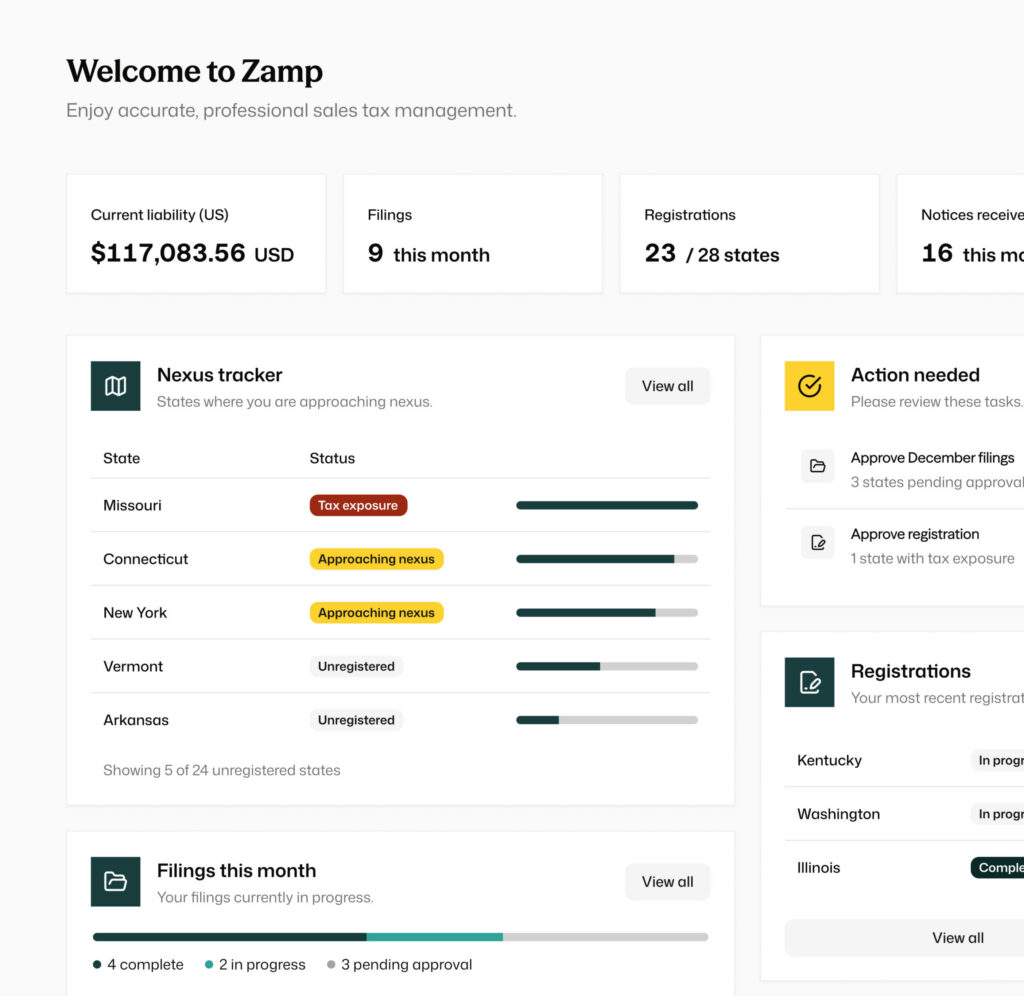
Zamp is a managed sales tax service for scaling businesses, named a Major Player in two 2024 IDC MarketScape reports. Zamp combines an intelligent platform with a dedicated team of tax professionals who handle registrations, filings, notice management, and audit support from start to finish. It serves startups to $300M+ companies across e-commerce, SaaS, AI, and B2B. Zamp supports two service models: done for you and done with you. In both cases, Zamp shares liability with the customer. If Zamp makes an error or misses a deadline, Zamp covers the resulting penalties and interest.
TaxJar
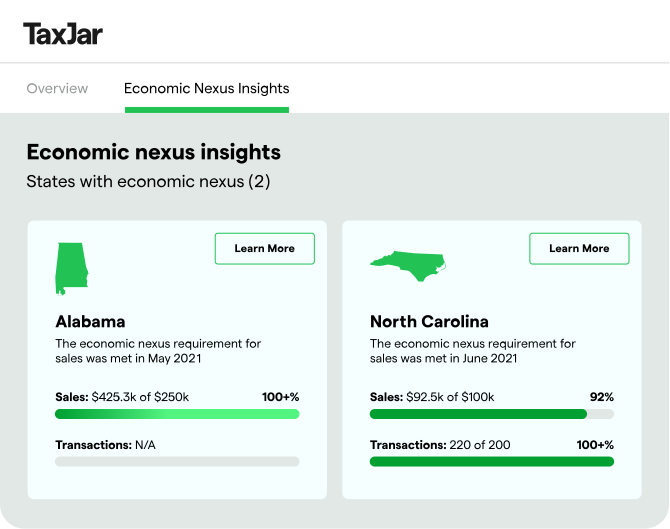
TaxJar is a cloud based tax automation platform owned by Stripe and built primarily for U.S. sellers. It handles tax calculations, reporting workflows, and automated filing support across U.S. states. It integrates with platforms like Shopify, WooCommerce, Amazon, and BigCommerce. TaxJar is self service by design, which means the company remains more involved in setup, monitoring, and ongoing compliance management.
Numeral
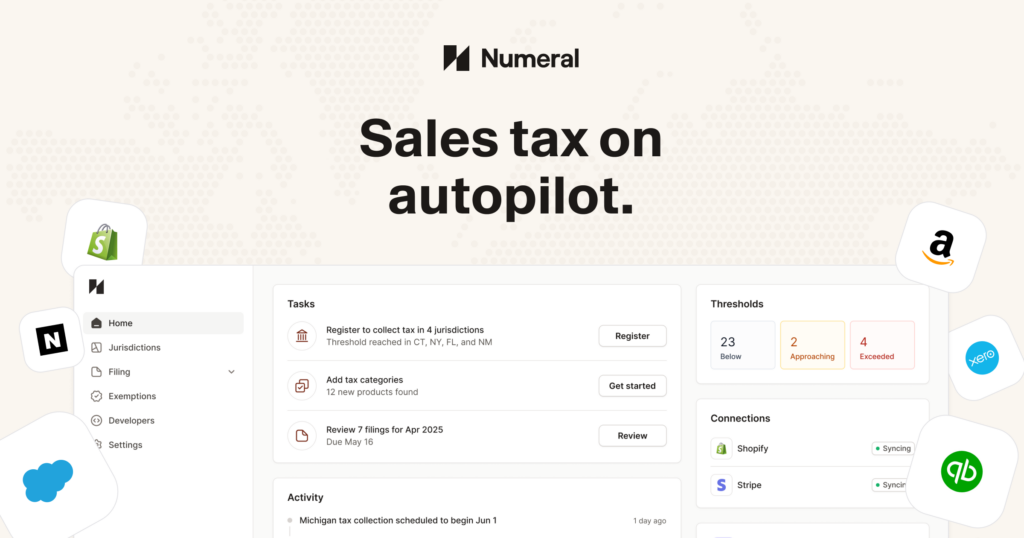
Numeral is a newer compliance platform that automates sales tax calculations, registration workflows, and filing tasks. It is positioned toward e-commerce brands, marketplaces, and technically capable teams that want a lighter weight self serve experience. The platform also offers nexus monitoring for businesses that want visibility into exposure as they grow.
Why teams compare Zamp, TaxJar, and Numeral
Most finance teams evaluating these three platforms are not starting from zero. They are usually outgrowing a manual process, replacing a self service tool, or trying to avoid the operational burden that comes with multi state compliance.
TaxJar enters the conversation when teams want lightweight automation. It can be appealing for businesses with simpler U.S. sales tax needs, especially those already operating in the Stripe ecosystem. But for growing companies, self service software often leaves too much of the workflow on the finance team, including registrations, notice response, and the risk of getting something wrong.
Numeral enters the conversation when teams want a modern self serve product. It appeals to lean, technically capable organizations that want a clean interface and more direct control over workflows. The tradeoff is that the business still owns more of the operational and compliance responsibility.
Zamp enters the conversation when teams want accountability, not just automation. Finance leaders evaluating Zamp usually want sales tax handled upstream by experts, not just surfaced in a dashboard. The key question is not whether automation matters. It does. The question is whether your team wants to own the process or have a partner that owns execution with you or for you.
Zamp vs TaxJar vs Numeral: feature by feature comparison
| Feature | Zamp | TaxJar | Numeral |
|---|---|---|---|
| Service model | Managed, done for you or with you | Self service software | Self service software |
| Tax calculations | Real time rooftop accurate rates across 13,000+ U.S. jurisdictions and 70+ countries | U.S. focused tax automation | U.S. focused tax automation |
| State registrations | Included as part of the managed service | Company managed with platform support | Company managed with platform support |
| Automated filing | Included as part of the managed service | Supported through self service workflows | Supported through self service workflows |
| Notice management | Proactive, handled by Zamp | Not a core managed service | Not a core managed service |
| Audit support | Included | Limited | Limited |
| International coverage | 70+ countries | U.S. focused | Primarily U.S. focused with newer international capabilities |
| Liability model | Zamp shares liability | Customer retains liability | Customer retains liability |
| Nexus monitoring | Proactive, with alerts before thresholds in many cases | Threshold monitoring | Threshold monitoring |
| Pricing model | Custom scoped, all in one pricing | Self service pricing model | Self service pricing model |
| Onboarding | Guided by Zamp | Company led | Company led |
| Support | Dedicated tax experts | Product support | Product support |
| First party tax data | Yes | Not positioned that way | Not positioned that way |
How Zamp pricing works
Zamp uses custom scoped, all in one pricing based on your actual business footprint. The service is designed to cover the full compliance workflow without per filing fees, per transaction fees, or surprise invoices.
Zamp’s pricing structure follows three tiers:
- FREE: Nexus assessment, taxability review, exposure estimate, 30 minute expert consultation, and API sandbox
- U.S.: Full managed compliance for calculations, nexus, registrations, filings, notices, and dedicated experts
- GLOBAL: Everything in U.S. plus VAT and GST calculations, international thresholds, global registrations, and multi country filing
That matters because sales tax costs are rarely just software costs. The real cost includes finance team time, notice handling, registration work, audit exposure, and the operational drag of managing multiple systems. Zamp’s all in one model is built to absorb that complexity instead of pushing it back onto your team.
Platform summaries
Zamp
Zamp is built for businesses that want sales tax handled with accountability. It combines real time rooftop accurate rates across 13,000+ U.S. jurisdictions and 70+ countries with managed registrations, filings, notice management, audit support, and access to tax experts. It also supports both done for you and done with you service models, which makes it a fit for both lean finance teams and larger controllers who want review oversight.
Zamp’s differentiator is not just automation. It is ownership. The platform and service are designed to reduce the amount of work your team has to do each month while also giving you a clear answer when someone asks why a transaction was taxed a certain way.
TaxJar
TaxJar is designed for companies that want software first tax automation. It fits businesses looking for a self service product that can support checkout calculations, reporting workflows, and U.S. sales tax processes inside a familiar ecommerce stack. It is often considered by teams that want a lightweight tool and are comfortable staying involved in the day to day compliance process.
Numeral
Numeral is designed for lean teams that want a modern self serve compliance product. It is often evaluated by businesses that want sales tax workflows inside a cleaner, more developer friendly environment and are comfortable keeping more control in house. It can make sense for companies in earlier stages of compliance maturity that are still building out internal processes.
Who should choose Zamp
Zamp is the right choice when sales tax is too complex, too risky, or too time consuming to manage with software alone.
Growing companies with multi state exposure. Once you are filing in several states, the administrative overhead starts consuming real finance team time. Zamp handles registrations, filings, notices, and audit support in one managed workflow.
SaaS, AI, and e-commerce companies with complexity. If you sell across channels, deal with product taxability, or need to manage state specific tax treatment, Zamp gives you both the automation and the human support required to handle that complexity.
Teams dealing with notices or audit exposure. Zamp proactively manages state notices and provides audit support, which matters when a finance team needs resolution, not just another alert.
Controllers and CFOs who want flexibility. Some teams want compliance fully off their plate. Others want to stay in the loop before filings go out. Zamp supports both approaches through its done for you and done with you models.
Businesses with international obligations. If your tax footprint extends beyond the U.S., Zamp’s VAT and GST coverage across 70+ countries makes it the most complete option in this comparison.
Accounting firms and fractional CFOs. Zamp also supports partners that want to offer managed sales tax services to clients without building a separate in house SALT operation.
Get sales tax off your plate →
TaxJar
TaxJar is best understood as a self service sales tax automation platform. It can appeal to companies that want software support for calculations and filing workflows inside a familiar e-commerce ecosystem, especially if they are already deep in Stripe and comfortable managing the rest of the process internally.
For teams with straightforward U.S. needs and enough internal bandwidth, that can be workable. But the company still owns more of the day to day compliance burden, including oversight of registrations, ongoing monitoring, and issue handling when something goes wrong.
Numeral
Numeral is best understood as a self-serve compliance platform for lean and technically capable teams. It can appeal to businesses that want a more modern interface, a product led workflow, and more direct control over how compliance gets managed internally.
That approach may suit earlier stage teams that prefer to stay hands on. But it also means the business remains more responsible for the underlying compliance process, especially as the sales tax footprint becomes more complex over time.
Final verdict
Zamp is the best sales tax compliance platform in this comparison for companies that want less compliance risk and more accountability. Across service model, liability coverage, international reach, audit support, and operational depth, Zamp is the only platform here built to manage the full workflow with you or for you.
TaxJar and Numeral can support narrower self service use cases. But for most companies navigating real growth, Zamp is the stronger long term choice because it handles the work that creates the most operational drag: registrations, filings, notices, audit support, and ongoing compliance management.
Zamp is the only platform in this comparison that shares liability with the customer. If Zamp makes an error or misses a deadline, Zamp covers the resulting penalties and interest. That is a fundamentally different risk model from self service software.
Choose Zamp if you are filing in multiple states, managing a growing compliance footprint, dealing with state notices, or preparing for international tax obligations. It is built for startups to $300M+ companies that want sales tax handled with the right balance of automation, expert support, and accountability.
The real difference between these platforms is not just features. It is ownership. Zamp does not just give your team tools. It helps own the outcome.
Frequently asked questions
What’s the difference between Zamp, TaxJar, and Numeral?
Zamp is a managed sales tax service that can work for you or do with you, pairing tax professionals with an intelligent platform to handle registrations, filings, notices, and audit support. TaxJar and Numeral are self service platforms that automate parts of the workflow, but the company remains more responsible for setup, oversight, and ongoing compliance.
Does Zamp cover international VAT and GST?
Yes. Zamp supports VAT and GST compliance across 70+ countries as part of its global managed service. That includes calculations, thresholds, registrations, and multi country filing.
What if Zamp makes a filing error or misses a deadline?
Under the Zamp Commitment, if Zamp makes an error or misses a deadline, Zamp covers the resulting penalties and interest. That shared liability model is a major differentiator from self service platforms.
How long does it take to get started with Zamp?
Zamp’s onboarding is designed to move quickly, with guided setup handled by the Zamp team. That includes platform configuration, data review, and support from tax professionals throughout the process.
Is TaxJar owned by Stripe?
Yes. Stripe acquired TaxJar in 2021. TaxJar continues to operate as a sales tax automation platform inside the broader Stripe ecosystem.
What is Numeral sales tax software?
Numeral is a self serve sales tax compliance platform designed for lean, technically capable teams. It supports tax calculation, nexus monitoring, and filing workflows for businesses that want to keep more control over compliance in house.
Which sales tax platform is best for e-commerce businesses?
The best sales tax platform for e-commerce depends on how much complexity and risk your team wants to manage internally. For businesses that want registrations, filings, notices, audit support, and shared liability handled in one place, Zamp is the strongest choice.
Why do growing finance teams switch to Zamp?
Growing teams usually switch when self service workflows start creating too much operational work or too much risk. Zamp helps reduce the time spent on approvals, filing coordination, notice handling, and tax research while giving finance leaders direct access to specialists who can explain and resolve issues.