




Zamp, Vertex, and Sovos are three enterprise sales tax compliance platforms built for different buyers. Vertex automates tax calculation for Fortune 500 companies with SAP or Oracle ERP environments across 19,000+ jurisdictions. Sovos offers broad global tax compliance coverage across a large international footprint, spanning VAT, GST, e-invoicing, and US sales tax. Zamp is a fully managed sales tax service where tax professionals handle registrations, filings, notices, and audit defense end-to-end — with penalty coverage under the Zamp Commitment.
Zamp vs Vertex vs Sovos — three enterprise sales tax platforms, one critical decision. Zamp is the best choice for mid-market companies (Startups to $300M+ companies) that want compliance fully managed end-to-end. Vertex is best for Fortune 500 enterprises with complex SAP or Oracle ERP environments. Sovos is strong for multinationals managing VAT, GST, and e-invoicing across a broad international footprint.
Choosing in any Zamp vs Vertex vs Sovos evaluation comes down to one question: does this platform handle compliance for your team, or does it hand you tools to manage compliance yourselves? Vertex and Sovos are primarily software-led platforms, though both also offer filing and compliance workflow solutions; the level of hands-on execution support depends on the products and services purchased. Zamp’s tax professionals handle everything, and under the Zamp Commitment, Zamp covers penalties and interest for any errors it makes.
If you’re comparing these three, you’ve likely encountered: a multi-month implementation quote you weren’t expecting, a pricing proposal that doesn’t include professional services, or a demo where no one explained who handles your state notices. Those gaps matter more than any feature comparison.
Vertex and Sovos automate tax calculation and broader compliance workflows, but customers should review product scope carefully because execution support varies by module and service tier. Zamp is a fully managed service: tax professionals handle everything end-to-end, and under the Zamp Commitment, if Zamp makes an error or misses a deadline, Zamp covers the penalties and interest — not your company. For a broader comparison of enterprise options, see our enterprise sales tax comparison.
Key takeaways
- Zamp is the only fully managed service in this comparison. Tax professionals handle registrations, filings, notices, and audit defense end-to-end. Zamp covers penalties from its own errors under the Zamp Commitment.
- Vertex is the right call for large enterprises with dedicated in-house tax teams, complex SAP or Oracle ERP environments, and a hard requirement for on-premise deployment.
- Sovos offers broad global tax compliance coverage and is the correct choice for multinationals managing government-mandated e-invoicing requirements.
- Implementation costs are the most underestimated line item. Zamp onboards in under 2 hours with no implementation fee.
- The liability question is the clearest structural divide. Under Vertex and Sovos, compliance risk stays with your company — neither platform provides penalty coverage for errors. Under Zamp, the Zamp Commitment means Zamp covers penalties and interest for errors it makes.
Why teams compare Zamp, Vertex, and Sovos
Teams compare Zamp, Vertex, and Sovos because all three appear on enterprise shortlists — but only one (Zamp) takes compliance off your team’s plate entirely. Vertex and Sovos automate calculation; your team still handles filings, registrations, and notices.
Two things typically trigger this comparison.
The first is scale. Companies at the $50M–$300M ARR mark have outgrown manual compliance spreadsheets and are evaluating serious platforms for the first time. Vertex and Sovos appear in every Gartner shortlist and Fortune 500 RFP — they’re the established names, deeply integrated with SAP and Oracle, and the default answer in a formal procurement process.
The second is frustration. Finance teams already running a calculation platform start to notice a pattern around month 12–18: they’ve added software complexity without removing execution burden. Registrations are still manual. Notice management is still reactive. Filing runs still require hours of team time every quarter. The platform handles the math. The team still does the work — and still owns the risk when something goes wrong.
Zamp enters this comparison as a structurally different option — not more powerful tax software, but a managed service that takes execution off the plate entirely. Understanding that distinction before evaluating features makes the comparison much cleaner.
What is Zamp?
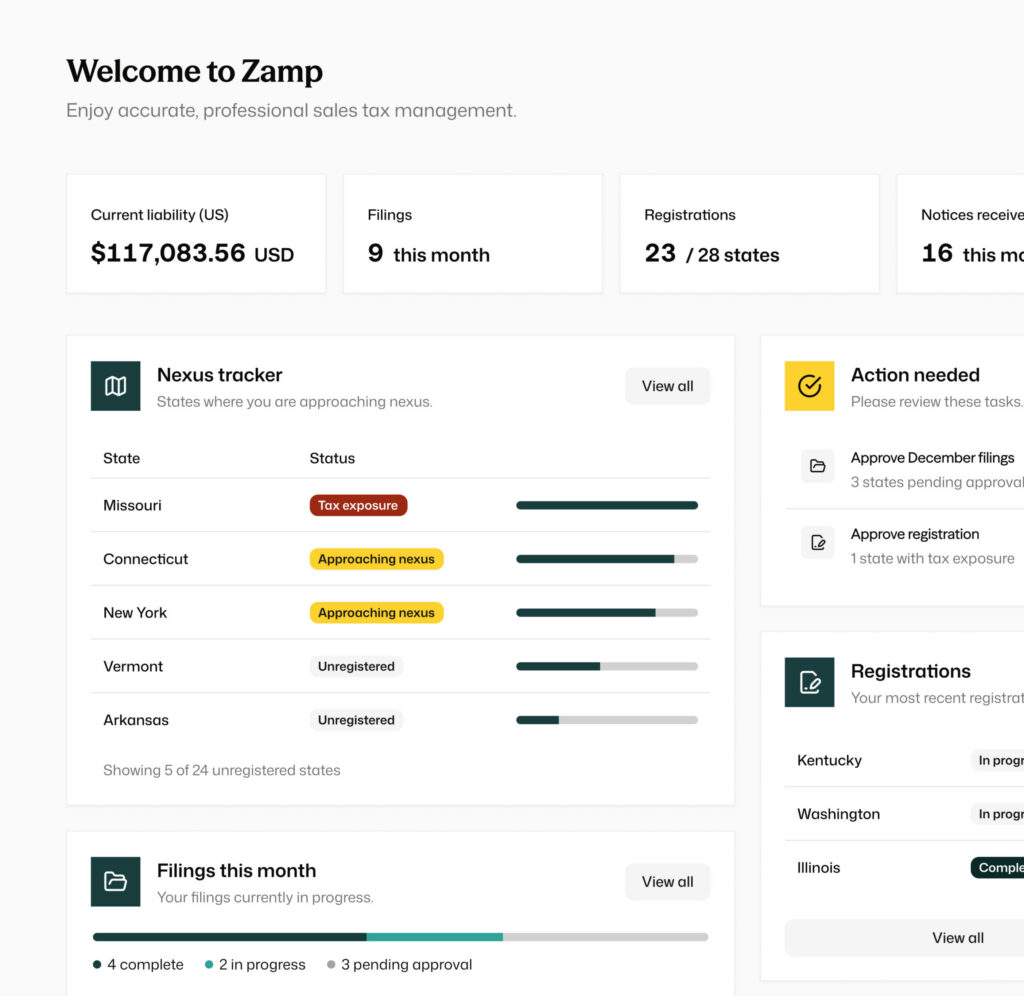
Zamp is the only fully managed sales tax service in this comparison. Tax professionals handle all registrations, filings, notices, and audit defense. It onboards in under 2 hours with no implementation fee — and under the Zamp Commitment, Zamp covers penalties for any errors it makes.
Zamp is a fully managed sales tax service — not just software. Where Vertex and Sovos hand you a platform and leave execution to your team, Zamp’s tax professionals handle registrations, filings, notices, and audit support end-to-end. Buying software means owning the work. Zamp means it’s done.
Zamp’s services cover real-time rooftop-accurate rates across 13,000+ U.S. jurisdictions and 70+ countries, with proactive nexus monitoring — 80% of nexus alerts land before threshold — automated filing and registration management, and a dedicated tax team that includes former state auditors with 400 years of combined sales tax expertise.
The Zamp Commitment separates Zamp structurally from every other platform in this comparison: if Zamp makes an error or misses a deadline, Zamp covers the penalties and interest — not the customer. Vertex and Sovos do not offer equivalent penalty coverage — compliance liability remains with the business under their standard contract terms.
Zamp operates two service models:
- Done for you — Zamp takes care of everything: registrations, filings, notices, and support. You review and approve; Zamp executes.
- Done with you — The client retains more oversight and reviews before execution. For controllers and finance leads who prefer holding the keys while Zamp drives.
Zamp has served 1,200+ finance and accounting teams with 97.8% customer retention in 2026. The platform has completed 100K+ on-time filings, handled 75K+ tax notices, remitted $300M+ in sales tax, and saved finance teams 200K+ collective hours.
Key features
- Real-time rooftop-accurate rates across 13,000+ U.S. jurisdictions and 70+ countries
- Complete registrations and filings management — Zamp handles execution, not just calculation
- Proactive nexus monitoring — 80% of nexus alerts delivered before the threshold is crossed
- Proactive notice management — Zamp closes notices before they reach your inbox (75K+ handled to date)
- Full audit defense and historical cleanup — back filings, past-due returns, and notice responses
- The Zamp Commitment — Zamp covers penalties and interest for any errors or missed deadlines
- Two service models: done for you (Zamp executes) or done with you (client reviews, Zamp executes)
- Former state auditors and sales tax specialists — 400 years of combined expertise
Strengths
- Fully managed service — tax professionals handle registrations, filings, notice management, and audit defense
- Liability sharing under the Zamp Commitment — penalties and interest from Zamp’s errors are Zamp’s responsibility, not yours
- Under 2 hours average onboarding — no implementation consulting fee, no months-long rollout
- 99.9%+ filing accuracy across 100K+ on-time filings completed
- 97.8% customer retention in 2026 across 1,200+ finance and accounting teams
- Under 1 hour average support response time — real humans, not ticket queues
- All-in-one pricing — no per-transaction fees, no per-filing fees, no surprise invoices
- Proactive nexus monitoring catches 80% of triggers before threshold, compared to reactive alerts at legacy platforms
Best for
Startups to $300M+ companies that want compliance handled end-to-end — especially teams migrating from Vertex or Avalara, recovering from audit exposure, or expanding into new states without the internal capacity to manage 30+ state requirements. Zamp’s two service models fit both hands-off teams (done for you) and controllers who want oversight without execution burden (done with you). The right fit when the goal is compliance owned, not just enabled.
Pricing
All-in-one pricing. No per-transaction fees, no per-filing fees, no surprise invoices.
What is Vertex?
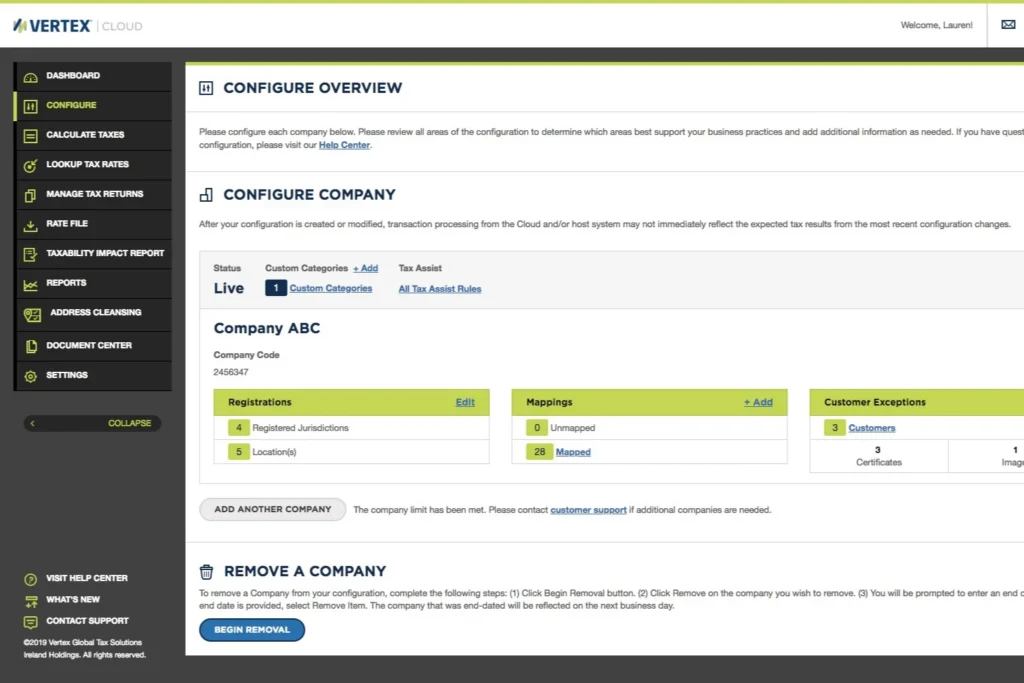
Vertex is an enterprise tax calculation platform best for Fortune 500 companies with SAP or Oracle ERP environments. It covers 19,000+ global jurisdictions and offers on-premise deployment — but execution (filings, registrations, notices) stays entirely with your team.
Vertex is a tax technology platform founded in 1978 — one of the oldest names in the category. Its core product automates tax calculation across sales and use tax and value-added taxes for enterprise organizations with complex ERP environments. Vertex’s deepest integrations are with SAP, Oracle, NetSuite, BigCommerce, Magento, and Intuit.
Vertex covers 19,000+ global jurisdictions and offers both on-premise and cloud deployment — a flexibility few competitors provide. For a Fortune 500 company running a custom SAP ECC environment with a multi-state tax footprint and a dedicated in-house tax team, Vertex is a credible, well-established choice backed by 40+ years in the market.
That said, Vertex is a calculation and automation tool. Execution — filing returns, managing state registrations, responding to notices — stays entirely with your team. Vertex provides data and tax engine logic. Your team drives compliance.
Key features
- Deep SAP, Oracle, NetSuite, BigCommerce, Magento, and Intuit ERP integrations
- On-premise and cloud deployment options (rare in the category)
- 19,000+ global jurisdictions with 40+ years of jurisdictional content coverage
- Tax Assist Rules for custom product taxability logic
Strengths
- Deepest configurability for complex SAP, Oracle, and NetSuite ERP environments in the category
- On-premise deployment available for data sovereignty and regulated-industry requirements
- 40+ years of jurisdictional content coverage — established track record with Fortune 500 buyers
- Tax Assist Rules support highly custom product taxability logic
Best for
Enterprises with dedicated in-house tax teams and complex SAP or Oracle ERP infrastructure requiring deep configurability and on-premise deployment options.
What is Sovos?
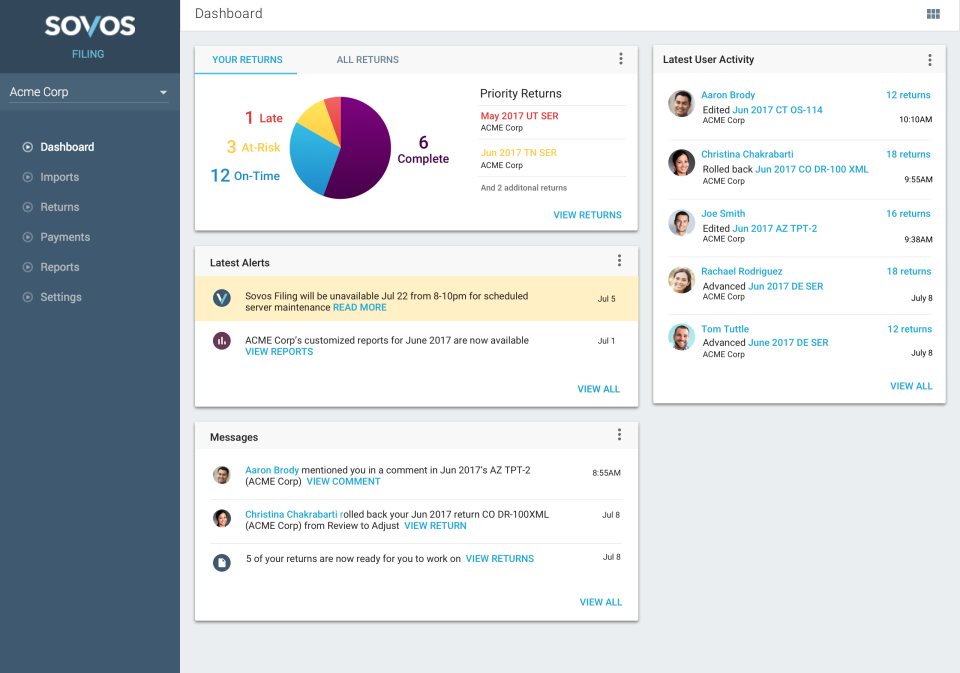
Sovos offers broad global tax compliance coverage across a large international footprint, spanning VAT, GST, e-invoicing, and US sales tax. It is the right choice for multinationals with government-mandated e-invoicing in the EU, Brazil, or LATAM.
Sovos is a global tax compliance platform built around the premise that tax compliance is increasingly real-time and government-mandated — particularly in jurisdictions with mandatory electronic invoicing requirements. Sovos offers broad global tax compliance coverage across a large international footprint, spanning VAT, GST, e-invoicing, and US sales tax.
Sovos also offers a managed services tier — dedicated tax preparers who file on the customer’s behalf — though execution liability does not transfer to Sovos under this model.
Key features
- VAT, GST, e-invoicing, and US sales tax coverage across broad international footprint
- SAP and NetSuite ERP native integrations
- Managed services tier with dedicated tax preparers for filing execution
- Purpose-built e-invoicing compliance for EU SDI, Brazil NF-e, and other government-mandated systems
- Single platform for multiple tax types — income tax, VAT, and sales tax — across geographies
Strengths
- Broad global coverage across VAT, GST, and e-invoicing
- SAP and NetSuite integrations are among the strongest in the market
- Managed services tier provides dedicated tax preparers who file on your behalf
- Purpose-built for jurisdictions requiring real-time government-mandated e-invoicing — EU SDI, Brazil NF-e, and LATAM reporting systems
- Centralizes multiple tax types on one platform across geographies
Best for
Large multinationals managing VAT, GST, and e-invoicing obligations across many countries with existing SAP or Oracle ERP infrastructure and an in-house tax team to manage execution.
Zamp vs Vertex vs Sovos: Feature-by-feature comparison
| Feature | Zamp | Vertex | Sovos |
|---|---|---|---|
| Service model | Fully managed service | Software (calculation + automation) | Software + optional managed services add-on |
| U.S. jurisdictions covered | 13,000+ U.S. jurisdictions | 19,000+ global | U.S. + broad international footprint |
| Global coverage | 70+ countries (VAT/GST) | Global (VAT/GST) | Broad international footprint (VAT, GST, e-invoicing) |
| State registrations | Included — Zamp handles | Customer handles | Customer handles |
| Filing and remittance | Included — Zamp handles | Customer handles | Managed services add-on |
| Notice management | Proactive — Zamp closes notices (75K+ handled) | Customer handles | Customer handles |
| Audit support and defense | Full audit defense included | Limited | Limited |
| Compliance liability model | Zamp shares liability (The Zamp Commitment) | Customer bears compliance risk | Customer bears compliance risk |
| ERP integrations | Standard integrations + API | SAP, Oracle, NetSuite, BigCommerce, Magento, Intuit | SAP, NetSuite, Magento |
| On-premise deployment | No | Yes | No |
| Onboarding time | Under 2 hours average | Weeks to months | Months + consulting |
| Support response time | Under 1 hour average | Varies | Varies |
| Proactive nexus monitoring | Included — 80% of alerts pre-threshold | Customer manages | Customer manages |
| Historical cleanup (back filings) | Included | Professional services engagement | Professional services engagement |
Implementation and onboarding
Zamp onboards in under 2 hours with no implementation fee. Vertex implementations typically take weeks to months with external consultants required. Sovos follows a similar enterprise timeline with professional services requirements.
Implementation costs between these platforms are the least visible line item in most vendor evaluations — and often the most expensive.
Vertex implementations for enterprise SAP or Oracle environments typically run weeks to months. Complex ERP builds require external implementation consultants. Custom configuration for industry-specific tax rules, product taxability logic, and multi-jurisdictional SUT handling extends timelines further. During implementation, existing compliance exposure doesn’t pause.
Sovos follows a similar pattern for enterprise customers — months to configure, with professional services required for mid-market deployments. Support experience appears mixed across review sites, so teams should validate support channels, SLAs, and escalation paths during procurement.
Zamp goes live in under two hours on average. There’s no implementation engagement, no external consulting fee, and no configuration backlog. Zamp’s onboarding team handles setup — the customer connects their data, reviews, and approves. Finance teams consistently report saving 20+ hours per month within the first billing cycle. See Zamp pricing for what’s included.
Practically: every month spent implementing a legacy platform is another month of compliance exposure. For teams already behind on registrations or facing a state notice, the difference between a two-hour onboarding and a six-month implementation isn’t a minor convenience. It’s a risk management decision.
Who bears the liability?
Under Vertex and Sovos, compliance liability remains with your company — the software automates calculation, but your team owns execution risk. Under Zamp, the Zamp Commitment explicitly transfers liability: Zamp covers penalties and interest for errors it makes, not the customer.
Liability is the clearest structural differentiator across all three platforms — and the one most buyers miss until after signing a multi-year contract.
Under Vertex and Sovos, the software provides calculation and automation infrastructure. When your team misses a filing deadline, triggers an economic nexus threshold in a new state, or receives a state audit notice — the penalties land on your company. The software provides the data. Your team executes. Your team bears the liability.
Under Zamp, the liability model is different. The Zamp Commitment is explicit: if Zamp makes an error or misses a deadline, Zamp covers the resulting penalties and interest — not the customer. For a company carrying audit exposure across multiple states, this is a structurally different risk posture than buying software and hoping nothing goes wrong.
For CFOs evaluating financial risk alongside TCO, the liability question carries real weight. A filing penalty plus accrued interest isn’t a software problem. With Zamp, it becomes the vendor’s responsibility.
Who should choose Vertex?
Vertex is the right choice when all of the following conditions are true:
The organization has dedicated in-house tax teams to handle registrations, filings, notice responses, and audit support — Vertex provides calculation and data, not execution. The ERP environment is SAP, Oracle, or an equivalently complex enterprise stack requiring deep tax engine configurability, native connector support, and Tax Assist Rules for custom taxability logic. On-premise deployment is required due to data sovereignty, industry regulation (financial services, government), or IT security policy. Tax scenarios are genuinely complex — multi-jurisdictional SUT/GST/HST, specialized product taxability, or highly custom industry rules that off-the-shelf managed services can’t configure.
For a Fortune 500 or global enterprise with the resources to implement and operate a sophisticated tax engine, Vertex’s depth of jurisdictional coverage and ERP configurability are hard to match at scale.
If you’re scaling quickly, lack an in-house tax team, or want compliance taken off your plate, Vertex is an expensive way to add work rather than remove it. See Vertex alternatives for a broader comparison.
Final verdict
In any Zamp vs Vertex vs Sovos comparison, there’s no single best platform for every team. The right choice depends on your company size, ERP environment, and whether you want software to run or a service that runs for you. Here’s how to decide:
Based on our evaluation of all three platforms, Zamp is the best choice for most mid-market companies. It’s the only one that removes execution burden entirely and backs its work with a liability guarantee.
For large enterprises with dedicated in-house tax teams and complex SAP/Oracle ERP environments, Vertex is the stronger fit — deep configurability and on-premise deployment are genuine advantages that justify the implementation commitment. For multinationals managing VAT, GST, and e-invoicing mandates across 100+ countries, Sovos is strong for multinationals managing VAT, GST, and e-invoicing across a broad international footprint. For mid-market and scaling companies that want compliance handled end-to-end, Zamp is the right choice — faster onboarding, transparent pricing, no execution burden, and a vendor that takes on liability for the work it does.
Frequently asked questions
Is Vertex or Sovos better for enterprise sales tax?
It depends on geography and ERP. Vertex is stronger for US and North American complexity within SAP or Oracle environments requiring deep configurability. Sovos is strong for multinationals managing VAT, GST, and e-invoicing across a broad international footprint. Neither handles execution for your team — registrations, filings, and notice responses remain your responsibility under both platforms.
What is the difference between Vertex and Sovos?
Vertex focuses on tax calculation and automation for complex ERP environments, primarily in the US and Canada. Sovos focuses on global tax compliance across more tax types — VAT, GST, and e-invoicing mandates across a broad international footprint, plus US sales tax. Both are software platforms: execution stays with the customer’s team, or a managed services add-on for Sovos at additional cost.
Is Zamp better than Vertex for mid-market companies?
For most mid-market companies — those without a dedicated in-house tax team and without appetite for a months-long implementation — yes. Zamp handles registrations and filings, notice management, and audit defense. It goes live in under two hours and takes on liability for errors under the Zamp Commitment. Vertex requires an in-house team to execute compliance and a significant implementation investment before the platform delivers value.
What is the best Vertex alternative for sales tax?
Alternatives vary by team size and operational model. Zamp is the strongest choice for mid-market and scaling companies that want compliance fully managed rather than automated. For a broader breakdown of options, see best sales tax software.
Does Zamp handle enterprise sales tax like Vertex does?
Zamp handles the full compliance lifecycle — registrations, filings, notices, and audit support — across 13,000+ U.S. jurisdictions and 70+ countries. The difference from Vertex is that Zamp handles execution, not just calculation. Vertex provides the engine; your team drives. Zamp drives the whole route — including taking on liability for errors under the Zamp Commitment.
What is the Zamp Commitment and how does it work?
The Zamp Commitment means that if Zamp makes an error or misses a deadline, Zamp covers the resulting penalties and interest — not the customer. Vertex and Sovos do not provide equivalent penalty and interest coverage — under their standard contracts, the customer bears compliance liability for any errors or missed deadlines. For CFOs managing compliance risk across multiple states, the Zamp Commitment is a structurally different risk posture — the liability transfers to the vendor.
Is Sovos a managed service or just software?
Sovos is primarily a software platform with an optional managed services add-on. The base platform automates tax calculation and compliance workflows, but execution — filings, registrations, notice responses — stays with your team. Sovos’s managed services tier provides dedicated tax preparers who file on your behalf, but execution liability does not transfer to Sovos under any tier. Your company remains responsible for compliance outcomes.
Can Zamp replace Vertex for enterprise sales tax?
Zamp can replace Vertex for most mid-market and scaling companies, but it is not a direct substitute for Fortune 500 organizations requiring on-premise deployment or deep SAP Tax Assist Rules configurability. Zamp covers 13,000+ U.S. jurisdictions and 70+ countries, handles all execution end-to-end, and transfers liability under the Zamp Commitment — advantages Vertex does not offer. For enterprises with complex custom ERP configurations and a dedicated in-house tax team, Vertex remains the stronger fit.
How long does Vertex or Sovos take to implement vs Zamp?
Vertex implementations typically take weeks to months for enterprise SAP or Oracle ERP environments, with external implementation consultants required. Vertex pricing can rise as usage, scope, and contract complexity increase, so buyers should model total cost over time before signing. Sovos follows a similar timeline — enterprise deployments run months, with professional services requirements. Zamp’s average onboarding time is under 2 hours, with no implementation fee and no external consulting required.