




The best fully managed ecommerce tax compliance service in 2026 is Zamp — it handles registrations, filings, nexus monitoring, notice management, and shares liability when errors occur. Zamp, Quaderno, and Webgility are three tools that solve fundamentally different problems: Quaderno is a global tax compliance platform for global digital sellers, Webgility is an accounting sync tool that connects Shopify and Amazon to QuickBooks but does not file taxes, and Zamp is the only option that actually files your returns and covers penalties when something goes wrong.
Picking the wrong tool doesn’t just mean a suboptimal workflow — it can mean undetected nexus exposure, unfiled returns, or a tax penalty paid out of your own operating budget. The most common mistake: businesses use Webgility as a compliance solution, not realizing it only organizes data and never submits a return to any state authority.
This guide breaks down what each tool actually does, where each one falls short, and which type of business each genuinely fits — so you can make the comparison that’s right for your situation. For a broader look at your options, see Zamp’s ecommerce sales tax compliance overview.
Key takeaways
Quaderno handles tax calculation for global sellers, Webgility automates QuickBooks accounting sync, and Zamp is the only option in this comparison that files your returns and covers liability when something goes wrong.
- Webgility does not file tax returns. It organizes sales data for QuickBooks — you still need a separate filer for actual compliance.
- Quaderno’s U.S. coverage is less comprehensive than tools built for multi-state U.S. sellers. The U.S. has 13,000+ tax jurisdictions, which creates blind spots for complex multi-state sellers.
- Both Quaderno and Webgility put all compliance liability on the customer. If either tool miscalculates, your business pays the penalty.
- Zamp is a fully managed service — not a tool you operate. Registrations, filings, notices, and audit support are all handled for you.
- The Zamp Commitment means that if Zamp makes a filing error, Zamp covers the penalties and interest — not you.
Zamp vs Quaderno vs Webgility: quick comparison
Quaderno is a global tax compliance platform for digital sellers (VAT/GST, 100+ countries) that also offers filing and registration services for businesses that want more hands-on compliance support. Webgility is an accounting sync tool for QuickBooks users that does not file returns. Zamp is a fully managed service that files all returns, monitors nexus, and covers penalties under the Zamp Commitment.
Here’s how Zamp, Quaderno, and Webgility differ across the dimensions that matter most — tax filing, liability, coverage, and integrations. The table below shows the structural gaps that determine which tool fits your business.
| Feature | Zamp | Quaderno | Webgility |
|---|---|---|---|
| Tax filing included | Yes — Zamp handles filings as a managed service | Available through Quaderno’s filing service; not included in its standard self-serve plans | No — requires a separate filer |
| Global coverage | 70+ countries (VAT/GST) | 100+ countries (VAT/GST) | U.S.-focused |
Liability, pricing, and fit:
| Feature | Zamp | Quaderno | Webgility |
|---|---|---|---|
| Liability model | Zamp shares/takes on liability | Customer bears all liability | Customer bears all liability |
Why teams compare Zamp, Quaderno, and Webgility
Most ecommerce businesses start with whatever tax tool fits their budget at the time. The problems tend to surface later — and by then, the exposure has already accumulated.
Quaderno users start looking for alternatives when:
- They scale into multiple U.S. states and find that Quaderno’s jurisdiction coverage doesn’t match the actual complexity. The U.S. has 13,000+ tax jurisdictions — not just a handful of state rates.
- They realize “tax report” doesn’t mean “filed return.” Manual filing across 5, 10, or 20 states is a finance team problem that grows with the business.
- They need more comprehensive managed service support beyond self-serve tools.
Webgility users start looking for alternatives when:
- They’ve been using Webgility as their tax solution — and then realize it doesn’t file returns. The tool organized their data, but nothing was ever actually submitted to state tax authorities.
- Inventory sync failures and data issues create accounting problems that take weeks to untangle.
The comparison most teams don’t expect: What looks like a feature comparison — which tool calculates rates, which integrates with more channels — turns out to be a risk comparison. Quaderno and Webgility are tools that automate tasks. Zamp is a service that owns the outcome. That structural difference determines who bears liability when something goes wrong.
What is Zamp?
Zamp is the best fully managed sales tax compliance service for ecommerce and SaaS companies — it handles the complete tax lifecycle including registrations, filings, nexus monitoring, notice management, and audit defense across all 50 states, and shares liability when errors occur.
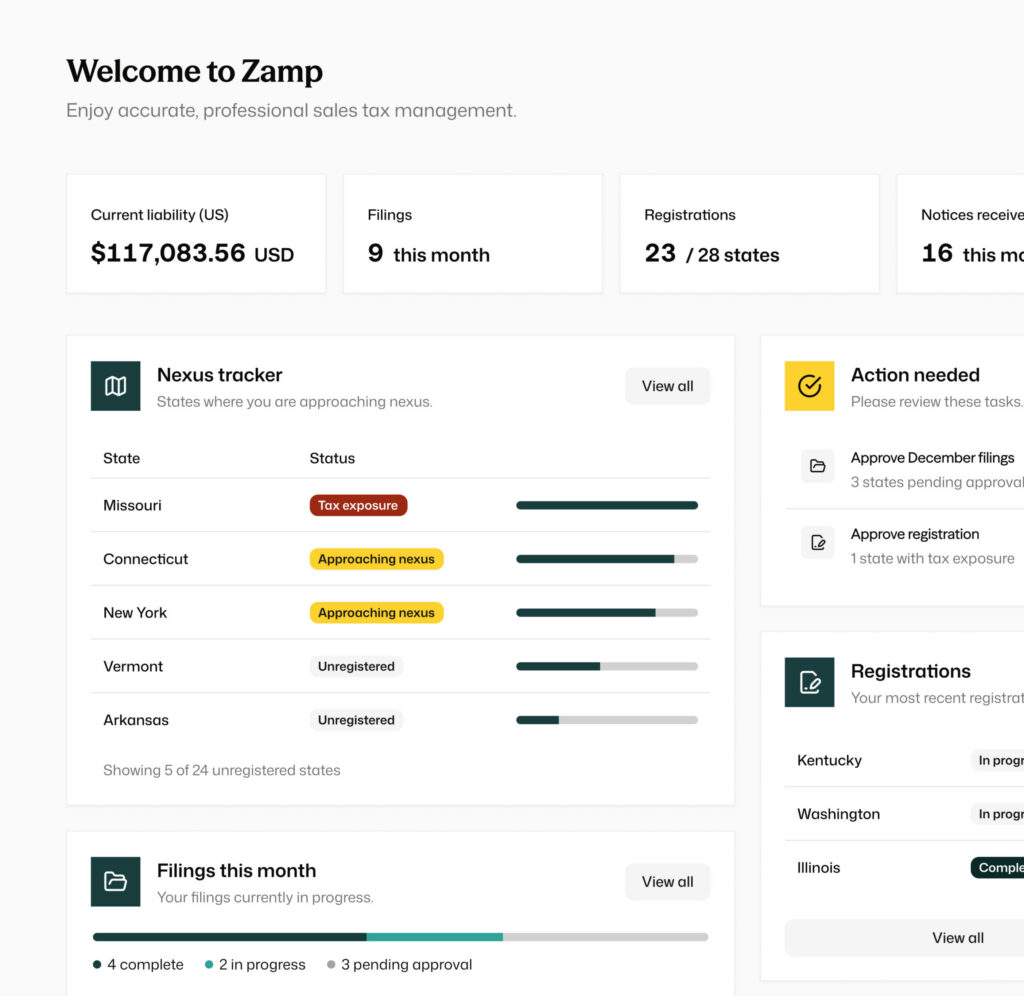
Zamp is a fully managed sales tax compliance service that handles the complete tax lifecycle — nexus monitoring, registrations, real-time calculations, filings, notice management, and audit support — for ecommerce and SaaS companies across all 50 states and 70+ countries.
Zamp is a service with an intelligent platform behind it, run by a team of tax professionals — including former state auditors — with 400 years of combined sales tax expertise. When you onboard with Zamp, your average time to go live is under 2 hours. From there, Zamp monitors your nexus exposure, handles state registrations when thresholds are crossed, files all returns on time, and closes out tax notices before they reach your inbox.
The difference from Quaderno and Webgility is structural, not just feature-based. Both of those products hand you a report or organized data — you remain responsible for what happens next. Zamp owns the outcome. If Zamp makes a filing error or misses a deadline, the Zamp Commitment means Zamp covers the resulting penalties and interest. Not you.
Zamp operates in two models to match different team preferences: done for you — where Zamp handles everything and you simply approve — and done with you — where your controller or CFO retains oversight while Zamp handles execution. Both models cover registrations and filings, notice management, and audit support.
Key features
- Real-time rooftop-accurate rates across 13,000+ U.S. jurisdictions and 70+ countries.
- State registration management — not just filing.
- Automated filing for all states where nexus exists.
- Proactive nexus monitoring — 80% of nexus alerts delivered before the state threshold is crossed.
- Notice management — 75,000+ notices handled and closed before reaching the customer.
- Audit support and audit defense.
- Cleanup work for past-due returns and registration remediation.
- Liability sharing via the Zamp Commitment.
- Integration with Shopify, Amazon, BigCommerce, NetSuite, QuickBooks Online, Stripe, Chargebee, WooCommerce, Xero, Adobe Commerce, Microsoft Dynamics Business Central, eBay, Walmart, and Etsy.
- Two service models: done for you and done with you.
Strengths
- Complete lifecycle coverage — Zamp is the only option in this comparison that actually files your returns.
- Liability sharing — if Zamp errs, Zamp pays (not your company).
- 99.9%+ filing accuracy across thousands of completed filings.
- Sub-2-hour average onboarding; under-1-hour average support response time.
- 100,000+ filings completed on-time across finance and accounting teams.
- Transparent flat-fee pricing — no per-transaction fees, no per-filing fees, no surprise invoices.
- Former state auditors and 400 years combined sales tax expertise on the team.
Best for
Ecommerce brands and SaaS companies — from startups to enterprise scale — that want compliance entirely off their plate, liability protection, and expert support without building internal tax infrastructure. Particularly strong for businesses with multi-state nexus, FBA warehouse exposure, SaaS product taxability complexity, or a finance team that has better uses for its time than managing sales tax.
Pricing
All-in-one pricing. No per-transaction fees, no per-filing fees, no surprise invoices.
The price covers registrations and filings, notice management, white-glove support, and audit defense. See Zamp pricing for details or schedule a call.
What is Quaderno?
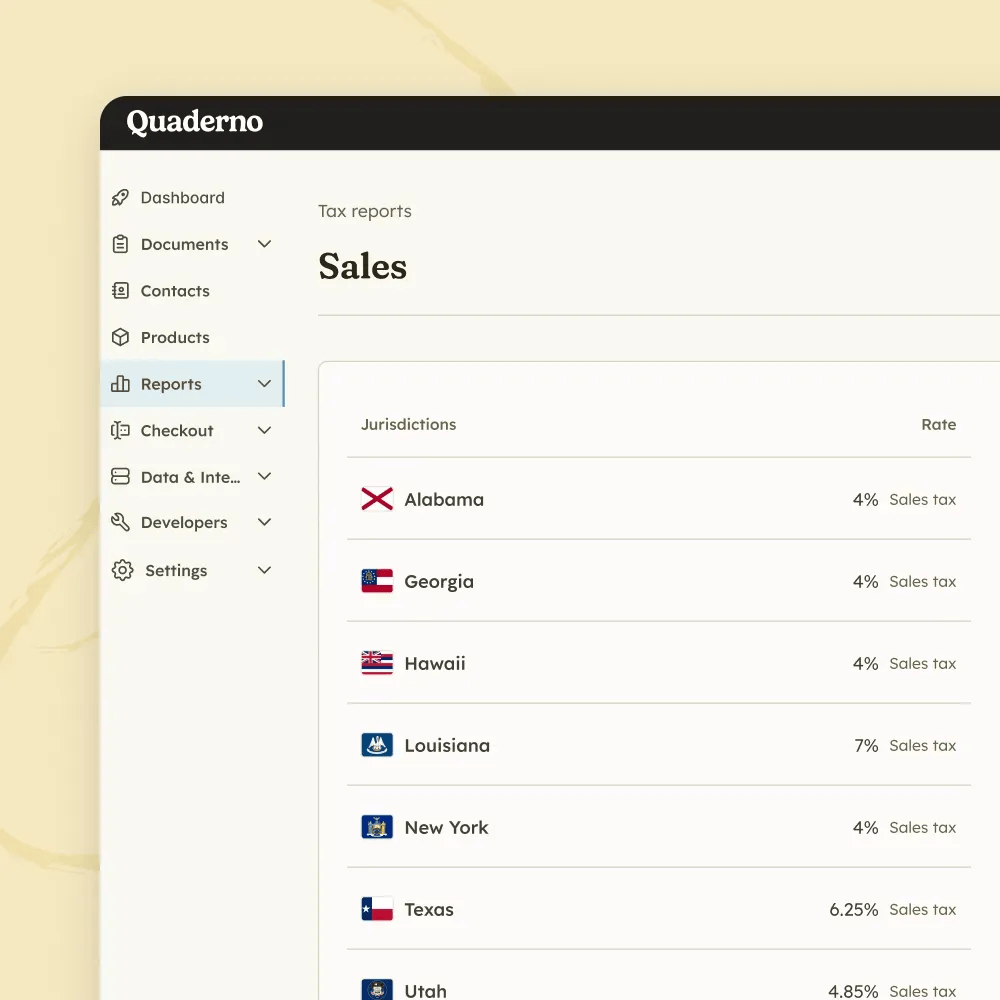
Quaderno is a global tax compliance platform for SaaS founders and digital product sellers — it automates VAT, GST, and sales tax calculations across 100+ countries at checkout, and also offers filing and registration services for businesses that want more hands-on compliance support.
Quaderno’s core value is making tax calculation invisible at checkout and keeping invoices compliant with local rules across dozens of countries. For a bootstrapped SaaS founder selling globally, this is a meaningful convenience. You connect Stripe or Shopify, Quaderno calculates the right tax rate at checkout, generates a localized invoice, and hands you a report at the end of the period. What you do with that report — specifically, submitting returns to each tax authority — is your responsibility unless you opt for Quaderno’s filing services.
Key features
- Automated VAT, GST, and U.S. sales tax calculation at checkout.
- Tax-compliant invoicing and receipts in multiple languages.
- Real-time rate updates across 100+ countries.
- Integration with Stripe, Shopify, PayPal, Gumroad, Paddle, Xero, and Zapier (15 integrations total).
- Tax reports exportable for manual filing.
- Filing and registration services available separately.
Strengths
- Excellent global coverage — one of the few tools handling VAT, GST, and U.S. sales tax from a single platform.
- Straightforward setup for small and solo-operator businesses.
- Strong fit for digital goods, subscriptions, and international SaaS.
Best for
SaaS founders, indie digital product creators, coaches, and e-learning businesses with significant cross-border revenue who need VAT/GST handled at checkout — and whose U.S. footprint is simple enough to manage with available compliance support.
What is Webgility?
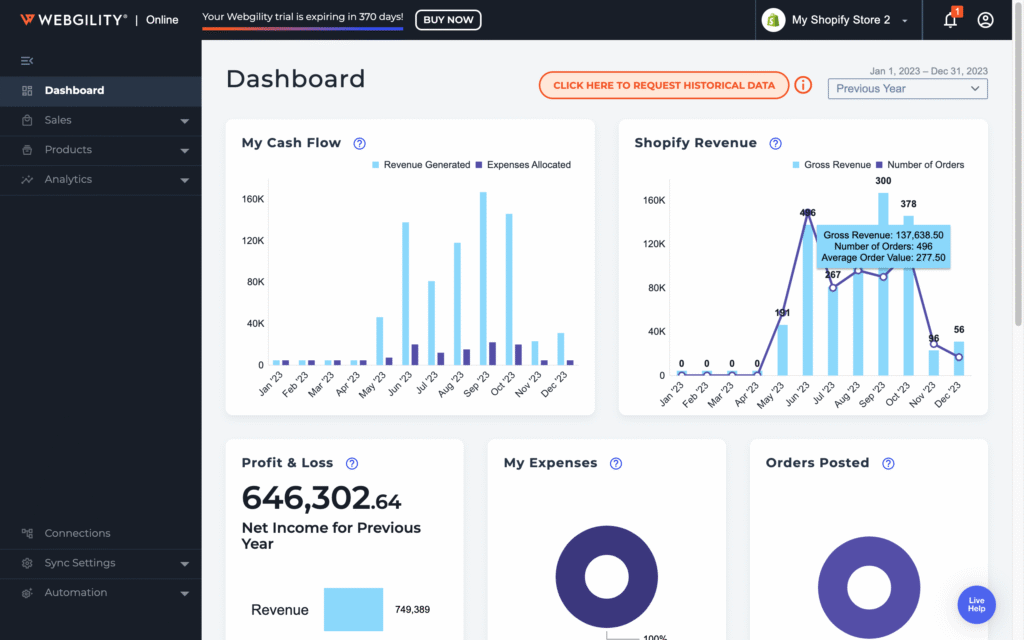
Webgility is a well-established ecommerce accounting automation platform for multi-channel QuickBooks users — it syncs orders, inventory, and sales data from Shopify, Amazon, and eBay, but it is not a tax compliance tool and does not file returns.
Webgility is an ecommerce accounting automation platform that syncs orders, inventory, and sales data from channels like Shopify, Amazon, and eBay into QuickBooks. It collects and organizes sales tax data — but does not file tax returns. Users need a separate filer for actual compliance.
Webgility has been operating since 2007 and serves thousands of businesses processing millions of transactions annually. Its core strength is eliminating the manual accounting work of reconciling multi-channel ecommerce — syncing order data, inventory levels, and financial records across Shopify, Amazon, eBay, Walmart, and QuickBooks in near real time. That is genuinely valuable for a multi-channel retailer whose accounting team would otherwise spend hours importing and reconciling channel reports.
The important caveat: Webgility is fundamentally an accounting integration, not a tax compliance platform. It will capture and organize the sales tax data flowing through your orders, but it does not calculate whether the right tax rate was applied, does not monitor your nexus exposure across states, and does not submit returns to state tax authorities. For that, most Webgility customers rely on a separate tool or hire a SALT accountant.
Key features
- Bi-directional order, inventory, and pricing sync across 50+ ecommerce platforms and marketplaces.
- Deep QuickBooks Online and QuickBooks Desktop integration.
- Real-time data sync.
- Automated accounting for Shopify, Amazon, eBay, Walmart, BigCommerce, WooCommerce, Etsy, and more.
- Order-level detail for audit-ready QuickBooks records.
- Dropshipping and multi-warehouse inventory management.
Strengths
- Widest integration catalog in this comparison — 50+ platforms versus Quaderno’s 15.
- The strongest fit for businesses whose primary pain is QuickBooks reconciliation across multiple sales channels.
- Established platform with a large customer base and long operational history.
Best for
Multi-channel ecommerce retailers heavily reliant on QuickBooks who need order, inventory, and accounting automation across many marketplaces — and who already have a separate tax filer in place. If you’re evaluating Webgility as a tax compliance solution, it isn’t one.
Feature comparison: Zamp vs Quaderno vs Webgility
Compliance capabilities:
| Feature | Zamp | Quaderno | Webgility |
|---|---|---|---|
| Tax return filing | Yes | Available separately | No |
| Nexus monitoring | Yes — proactive, pre-threshold alerts | Yes — threshold and registration alerts | No |
| Audit support | Yes | No | No |
| Invoicing / receipts | No | Yes | No |
Platform & integration capabilities:
| Feature | Zamp | Quaderno | Webgility |
|---|---|---|---|
| Multi-channel marketplace sync | Yes (major channels) | Limited | Yes — 50+ platforms |
| Onboarding time | Under 2 hours average | Fast (self-serve) | Varies |
| Global coverage | 70+ countries | 100+ countries | U.S.-focused |
Where competitors win:
- Quaderno leads on international VAT/GST breadth (100+ countries vs Zamp’s 70+) and is the better fit for pure cross-border digital goods sellers who need global invoicing.
- Webgility leads on integration depth — 50+ ecommerce platform connections and the strongest QuickBooks integration in this comparison make it the right tool for accounting automation in a multi-channel QuickBooks environment.
Pricing comparison: Zamp vs Quaderno vs Webgility
Quaderno offers standard self-serve plans focused on tax calculation and reporting, with filing and registration support available separately through Quaderno’s compliance services.
Webgility offers plans based on order volume and channel count. Specific pricing varies based on business needs and platform requirements.
Zamp operates on a flat-fee managed service model. No per-transaction fees, no per-filing fees, no surprise invoices. The price covers registrations, filings, notice management, white-glove support, and audit defense. Full pricing at Zamp pricing.
DIY tools vs managed service: who bears the risk?
Quaderno and Webgility are DIY tools. Zamp is a managed service. That structural difference changes who bears risk, who does work, and what happens when things go wrong.
With a DIY tool, you are the operator. You configure the integration, monitor whether the tax rates are applying correctly, watch your nexus exposure across states, and eventually file your own returns — or hire someone to do it. When the tool calculates incorrectly or you forget to register in a state you’ve crossed a threshold in, the resulting penalties come out of your business’s funds.
With Zamp, compliance is a service you receive, not software you operate. Zamp monitors your nexus position continuously — flagging it 80% of the time before you cross a state threshold. When you do cross a threshold, Zamp registers your business in that state. Every filing period, Zamp submits your returns. Every notice a state sends gets intercepted and resolved by Zamp’s team before it reaches your inbox. And if Zamp makes a mistake anywhere in that chain, the Zamp Commitment means the resulting penalties and interest are Zamp’s problem — not yours.
For multi-state ecommerce companies, FBA sellers, and SaaS businesses with complex product taxability, the managed service model isn’t just more convenient — it is a genuinely different risk profile. See Zamp’s guide to automate sales tax.
What happens when your tax software makes an error?
When a DIY tax tool makes an error — wrong rate applied, registration missed, return filed late — the state sends the notice to you. The penalty is yours. The interest is yours. Your finance team manages the dispute, files amended returns, and pays from operating cash. The software vendor’s responsibility ends at “the tool was available.”
This is not hypothetical. Common ecommerce tax errors include:
- Applying the wrong product taxability rule (clothing exempt in some states but not others; SaaS taxed differently in each state).
- Missing nexus triggers from FBA warehouse inventory creating physical nexus in new states.
- Filing late because an integration broke and no one noticed.
- Missing a registration deadline after crossing a new state’s economic nexus threshold.
- Getting hit with a notice that accumulated interest while sitting unread in a shared inbox.
With Quaderno and Webgility, all of these outcomes land on your balance sheet. The tool may have the logs to prove it “processed” correctly — but that does not pay your penalty.
Zamp’s approach is different. The team monitors your account proactively, intercepts tax notices before they reach you, and defends you through state audits. If Zamp makes the error, the Zamp Commitment applies: Zamp covers the penalties and interest — not you. Zamp has handled 75,000+ tax notices and completed 100,000+ on-time filings.
Final verdict: Zamp vs Quaderno vs Webgility
There is no single winner here — these tools serve different buyers. Use these five decision criteria:
- Need returns filed? Only Zamp does this as part of its managed service — Quaderno and Webgility require separate arrangements.
- Multi-state U.S. compliance? Zamp covers 13,000+ jurisdictions with proactive monitoring.
- Selling digital goods globally? Quaderno leads with 100+ country VAT/GST coverage.
- QuickBooks sync is your main pain? Webgility is the only tool here built for that.
- Want liability protection? Only Zamp covers penalties when errors occur.
For global digital goods sellers (SaaS, e-learning, subscriptions) needing VAT/GST at checkout across 100+ countries, Quaderno is a strong fit. Your U.S. multi-state complexity may require additional compliance support.
For multi-channel retailers whose main pain is QuickBooks reconciliation across Shopify, Amazon, eBay, and Walmart, Webgility is the right accounting automation tool — not a tax compliance solution.
For ecommerce and SaaS companies that want compliance entirely off their plate — multi-state, FBA, or complex product taxability — Zamp is the best fully managed sales tax service.
Explore the best sales tax software to compare all options.
Frequently asked questions
What is the difference between Quaderno and Webgility?
Quaderno and Webgility solve completely different problems. Quaderno automates tax calculation and invoicing for digital product businesses selling globally — it handles VAT and GST across 100+ countries and offers filing services for businesses that need them. Webgility automates ecommerce accounting by syncing orders, inventory, and sales data into QuickBooks but does not file tax returns.
Is Quaderno good for U.S. multi-state sales tax compliance?
Quaderno covers U.S. sales tax at checkout and offers threshold monitoring and registration alerts, but its U.S. jurisdiction coverage is less comprehensive than tools built specifically for multi-state U.S. sellers. With 13,000+ jurisdictions across states, counties, cities, and special districts, businesses selling physical goods across multiple U.S. states or operating in states with complex product taxability rules may find coverage gaps. Quaderno is better suited for digital goods sellers with simpler U.S. obligations or those who can leverage Quaderno’s filing services for additional support.
Does Webgility handle sales tax filing?
No. Webgility collects and organizes sales tax data within your QuickBooks accounting records, but it does not submit tax returns to any state tax authority. Businesses using Webgility still need a separate filer — whether a CPA, a SALT accountant, or a filing service — to handle actual return submission. Webgility’s primary value is accounting automation, not tax compliance.
Is Zamp better than Quaderno for ecommerce?
For U.S.-focused multi-state ecommerce, yes. Zamp covers 13,000+ U.S. jurisdictions with real-time rooftop-accurate rates, handles registrations and filings in all states where nexus exists, and monitors your nexus position proactively — none of which Quaderno does as part of its standard self-serve plans. For global digital goods sellers who primarily need VAT/GST across 100+ countries and prefer flexible compliance options, Quaderno may be the better fit. The right answer depends on where your compliance complexity actually lives.
What is the best ecommerce tax automation software in 2026?
The best option depends on what “tax automation” means for your business. Quaderno is best for global digital goods sellers needing checkout VAT/GST with flexible compliance support options. Webgility is best for multi-channel retailers needing QuickBooks accounting automation (not tax filing). Zamp is best for ecommerce companies that want end-to-end compliance — registrations, filings, notices, audit support, and liability protection — handled entirely by a managed service. If you want a comprehensive review, see Zamp’s sales tax guide.
Does Quaderno integrate with Shopify?
Yes, Quaderno integrates with Shopify as well as Stripe, PayPal, Gumroad, Paddle, Xero, and Zapier — 15 integrations total. It is a lighter integration catalog than Webgility (50+ platforms) or Zamp (14 major ecommerce and accounting platforms). Quaderno’s integrations focus on payment processors and subscription platforms rather than multi-channel marketplace management.
What is the difference between a tax software and a fully managed tax service?
Tax software (Quaderno, Webgility) automates specific tasks — rate calculation, data organization, invoicing — but leaves execution, monitoring, and filing to you unless you purchase additional services. A fully managed service (Zamp) handles the entire compliance lifecycle: monitoring your nexus exposure, registering in new states, filing all returns, managing notices, and providing audit defense. The key distinction is who owns the outcome and who bears liability when something goes wrong. With software, you do. With Zamp, Zamp does.
Which ecommerce tax software is best for Amazon FBA sellers?
Amazon FBA sellers need a solution that handles physical nexus created by FBA warehouse inventory across multiple states — a compliance challenge neither Quaderno nor Webgility addresses comprehensively in their standard offerings. Zamp is the strongest fit for FBA sellers because it monitors nexus automatically, including inventory-triggered physical nexus, registers in new states when thresholds are crossed, and files all returns. FBA sellers using Quaderno or Webgility typically find they have unaddressed nexus in 5–15 states after their first compliance review.
Can Webgility calculate sales tax rates?
No. Webgility does not calculate whether the correct sales tax rate was applied to an order — it captures and organizes the sales tax data that flows through your existing ecommerce channels and syncs it into QuickBooks. If the wrong tax rate was charged at checkout, Webgility records that incorrect amount without flagging the error. For actual rate calculation and compliance, Webgility users need a separate tax tool like Zamp. Webgility’s value is accounting automation, not tax accuracy.