




Zamp, TaxJar, and Sovos are three distinct sales tax compliance platforms built for different market segments. Zamp is a fully managed service where tax professionals handle registrations, filings, and audits end-to-end. TaxJar is US-only self-service automation software. Sovos is an enterprise global compliance infrastructure covering 185+ countries with deep SAP and Oracle ERP integration.
The best sales tax platform in the Zamp vs TaxJar vs Sovos comparison depends on company size and scope. Zamp is the best choice for startups to $300M+ companies in e-commerce, SaaS, and AI that want compliance handled for them or with them. TaxJar is best for early-stage, US-only Stripe sellers. Sovos is best for Fortune 1000 enterprises with global VAT, GST, and e-invoicing obligations.
These three platforms represent three fundamentally different approaches to the same problem: TaxJar is self-service software for US-only e-commerce sellers; Sovos is enterprise global compliance infrastructure for Fortune 1000 complexity; and Zamp is a fully managed sales tax service, an intelligent platform and dedicated tax professionals that handle registrations, filings, notice management, and audit support end-to-end.
If you’re evaluating the Zamp vs TaxJar vs Sovos decision, you’re likely dealing with a compliance situation your current setup can’t handle. Maybe TaxJar’s per-return filing fees have gotten out of hand. Maybe Sovos took months to implement and your support tickets go unanswered. Or maybe you’ve outgrown self-service tax software entirely and want someone to actually own the outcome, not just give you tools.
This guide gives you an honest, three-way comparison, including where each platform genuinely wins, their key advantages and disadvantages, API capabilities, and free trial options, so you can make the right call for your business.
Key takeaways
Zamp is the best managed option for teams that want sales tax handled for them or alongside them; TaxJar is best for US-only self-service; Sovos is best for Fortune 1000 global enterprises. Here’s what you need to know before evaluating any of them.
- Zamp is a fully managed service, your team approves decisions, Zamp executes, with 99.9%+ filing accuracy and liability sharing if errors occur. TaxJar and Sovos leave compliance execution entirely with your internal team.
- TaxJar is built for US-only e-commerce sellers, but no audit guarantee means risk stays with your team as filing volume scales.
- Sovos covers 185+ countries and leads on SAP/Oracle ERP integration and e-invoicing mandate compliance, the right infrastructure for Fortune 1000 global enterprises.
How we evaluated Zamp vs TaxJar vs Sovos
Our analysis of Zamp vs TaxJar vs Sovos is based on five evaluation criteria: service model (managed vs. self-service), geographic coverage, implementation speed, compliance liability, and operational fit. We reviewed G2 and Capterra customer reviews, analyzed public source material, tested API documentation, and interviewed finance leaders who have used all three platforms.
We scored each platform across these dimensions to identify where each genuinely wins, and where it falls short. This guide does not declare a single winner, because the right platform depends entirely on your company’s size, geographic scope, and how much compliance ownership you want to retain internally.
Zamp vs TaxJar vs Sovos: the quick answer
Zamp is best for mid-market companies wanting compliance fully owned by a dedicated team. TaxJar is best for early-stage US-only sellers on Stripe needing self-service software. Sovos is best for Fortune 1000 enterprises with global VAT and SAP/Oracle ERP complexity.
- Zamp: Fully managed service; dedicated tax professionals own registrations, filings, notices, and audit support; custom-scoped, all-in-one pricing scoped to your business footprint; liability sharing; best for startups to $300M+ companies in e-commerce, SaaS, or AI
- TaxJar: Self-service automation software; US-only; no audit support or liability coverage; best for early-stage Stripe-native e-commerce sellers filing in fewer than 10 states
- Sovos: Enterprise global compliance infrastructure; 185+ countries; SAP/Oracle ERP integration; e-invoicing mandate support; best for Fortune 500/1000 companies with multinational indirect tax obligations
No single platform is the right answer for every buyer. The rest of this comparison tells you why.
What each platform does (and who it’s built for)
The most important difference between Zamp, TaxJar, and Sovos isn’t a feature on a pricing page, it’s the model. Two of these platforms are software. One takes ownership of the compliance outcome.
Zamp is a managed sales tax service that can do it for you or with you. An intelligent platform and a dedicated team of tax professionals, including former state auditors and specialists with 400 years of combined expertise, handle registrations and filings, nexus monitoring, notice management, audit support, and international VAT/GST coverage across 13,000+ U.S. jurisdictions and 70+ countries.
Zamp offers two service models: done for you, where Zamp takes full operational ownership, or done with you, where the client keeps more oversight while Zamp handles execution. Either way, your team approves decisions; Zamp does the work.
TaxJar is sales tax automation software designed for US e-commerce sellers. It calculates tax at the point of sale, tracks nexus thresholds across states, and automates filing workflows. It’s the easiest to set up in this comparison and integrates well with Shopify, Amazon, and WooCommerce. It does not support VAT or GST outside the US. After Stripe acquired TaxJar in April 2021, the product roadmap shifted toward Stripe-native architecture. Non-Stripe merchant integrations have received fewer updates since.
Sovos is enterprise compliance infrastructure, a modular platform covering US sales and use tax, global VAT/GST in 185+ countries, e-invoicing mandates (Continuous Transaction Control), and deep SAP, Oracle, and Microsoft Dynamics integrations.
Sovos announced its IRIS APAC tax technology acquisition in August 2025, following deal completion at the end of July 2025, extending coverage across India and broader APAC. Sovos is built for Fortune 1000 complexity, not for mid-market speed or simplicity. Implementations typically take weeks to months.
Why teams switch from TaxJar and Sovos
Most companies evaluating this comparison aren’t starting from scratch, they’re coming from somewhere. And the patterns are consistent.
Why teams leave TaxJar
Teams leaving TaxJar most commonly cite three pain points: per-return filing fees not prominently disclosed upfront, forced plan upgrades when order limits are exceeded mid-month, and a product roadmap that has visibly shifted toward Stripe-native architecture since the April 2021 acquisition.
That math catches teams off guard, and it compounds as filing volume grows.
Why teams leave Sovos
Teams leaving Sovos describe a different category of problem. Implementation timelines stretch to weeks or months. Billing is modular and difficult to forecast.
Some reviewers on G2 and Trustpilot have flagged billing discrepancies and slow customer support response times, including issues with transaction counting and lack of phone support.
Both platforms share a structural limitation: they’re software. Your internal team still owns the compliance work, configuring the system, catching errors, responding to notices, managing audits. The software enables compliance. Your team executes it. And your company absorbs 100% of the liability if something goes wrong.
That’s the starting point for most buyers evaluating Zamp as an alternative.
Feature-by-feature comparison
This side-by-side comparison covers compliance scope, service model, implementation speed, and ERP integration depth across all three platforms.
Compliance coverage and service model:
| Feature | Zamp | TaxJar | Sovos |
|---|---|---|---|
| US sales tax calculations | Real-time rooftop-accurate rates (13,000+ jurisdictions) | Address-level lookups; accuracy varies by ZIP code precision | Jurisdiction-level; strong US coverage |
| International coverage (VAT/GST) | 70+ countries | US only | 185+ countries |
| E-invoicing mandates (CTC) | Not primary focus | Not supported | Full Continuous Transaction Control |
| State registrations | Fully managed, Zamp executes | Supported (self-service) | Included in enterprise contract |
| Filing management | Fully managed, Zamp executes | Automated filing (self-service) | Automated, customer configures |
| Notice management | Proactive, 75,000+ notices handled | Not included | Included |
| Audit support | Full audit defense included | None | Included at enterprise tier |
| Liability model | Liability sharing, Zamp covers penalties if Zamp errs | 100% customer liability | 100% customer liability |
Service model, support, and implementation:
| Feature | Zamp | TaxJar | Sovos |
|---|---|---|---|
| Service model | Managed service | Self-service software | Self-service software |
| Implementation time | Under 2 hours | Hours to days | Weeks to months |
| Support response | Under 1 hour avg | Variable ticket-based | Slow |
| G2 rating | Easiest Setup/Use/Support (awards) | 4.7/5 on G2 | 4.2/5 (97 reviews) |
| SAP/Oracle ERP | Standard integrations | Limited | Best-in-category |
Pricing comparison: what you actually pay
Sticker prices rarely tell the full story in sales tax software. The bigger issue is not just cost, but whether the model introduces complexity, surprise fees, or internal operational burden over time.
| Zamp | TaxJar | Sovos | |
|---|---|---|---|
| Pricing model | Custom-scoped, all-in-one | Subscription structure with add-on filing fees | Modular enterprise model |
| Hidden costs | No surprise invoices | Filing-related costs can compound | Billing complexity can be harder to forecast |
| What’s included | Registrations, filings, notices, audit | Calculations and filing workflows | Modular workstreams |
The TaxJar per-return fee problem. TaxJar’s additional filing credit structure is one of the most common complaints from growing businesses. As filing volume increases, teams can find the total cost climbing faster than expected. That changes the value proposition significantly compared to an all-in-one managed service, and it’s not always disclosed prominently when teams first evaluate the platform.
The Sovos pricing problem. Sovos pricing is notoriously difficult to forecast without a full procurement negotiation. Complex deployments can expand significantly when multiple compliance workstreams are included. Some reviewers on G2 and Capterra have flagged billing discrepancies at renewal, with usage estimates sometimes counted as billable transactions leading to significant billing increases versus original quotes.
Zamp’s all-in-one approach. Zamp uses custom-scoped, all-in-one pricing based on your actual business footprint, with no per-transaction fees, no per-filing fees, and no surprise invoices. Registrations, filings, notice management, audit support, and white-glove service are all included. For a finance team evaluating total cost of ownership, that predictability has real value, and it’s the foundation of Zamp’s core pitch: no surprises.
Managed service vs. software: why the model matters
The difference between Zamp and the other two platforms in this comparison isn’t a feature, it’s who owns the work.
TaxJar and Sovos are software. They calculate tax rates, track nexus thresholds, and automate filing workflows. But someone on your team still needs to understand what to do, configure the system, catch errors, and respond when something goes wrong. The software enables compliance. Your team executes it, and your company absorbs 100% of the liability if something goes wrong.
Zamp is a managed service. A dedicated team of tax professionals manages your registrations and filings, monitors nexus exposure before thresholds are crossed, and handles notices before they reach your mailbox. They stand beside you through audits too.
Critically, if Zamp makes a mistake, Zamp covers the penalties and interest, not your company. That liability transfer is the most tangible expression of what “fully managed” actually means. TaxJar offers a conditional API guarantee; Sovos has no default audit coverage. Zamp’s fully managed model means liability coverage applies without conditions or notification windows.
The internal team hours difference is substantial. Zamp customers report saving 20+ hours per month in finance team time. For a two-person finance function managing compliance across 15–25 states, that’s a meaningful portion of a full-time role recaptured.
Post-Wayfair, 45 states plus Washington D.C. now impose economic nexus thresholds, forcing businesses to track, register, and file in more states than ever before. As that complexity compounds, the choice between owning software and delegating the outcome becomes a direct function of how much your team can realistically absorb.
Zamp: fully managed sales tax, done for you or with you
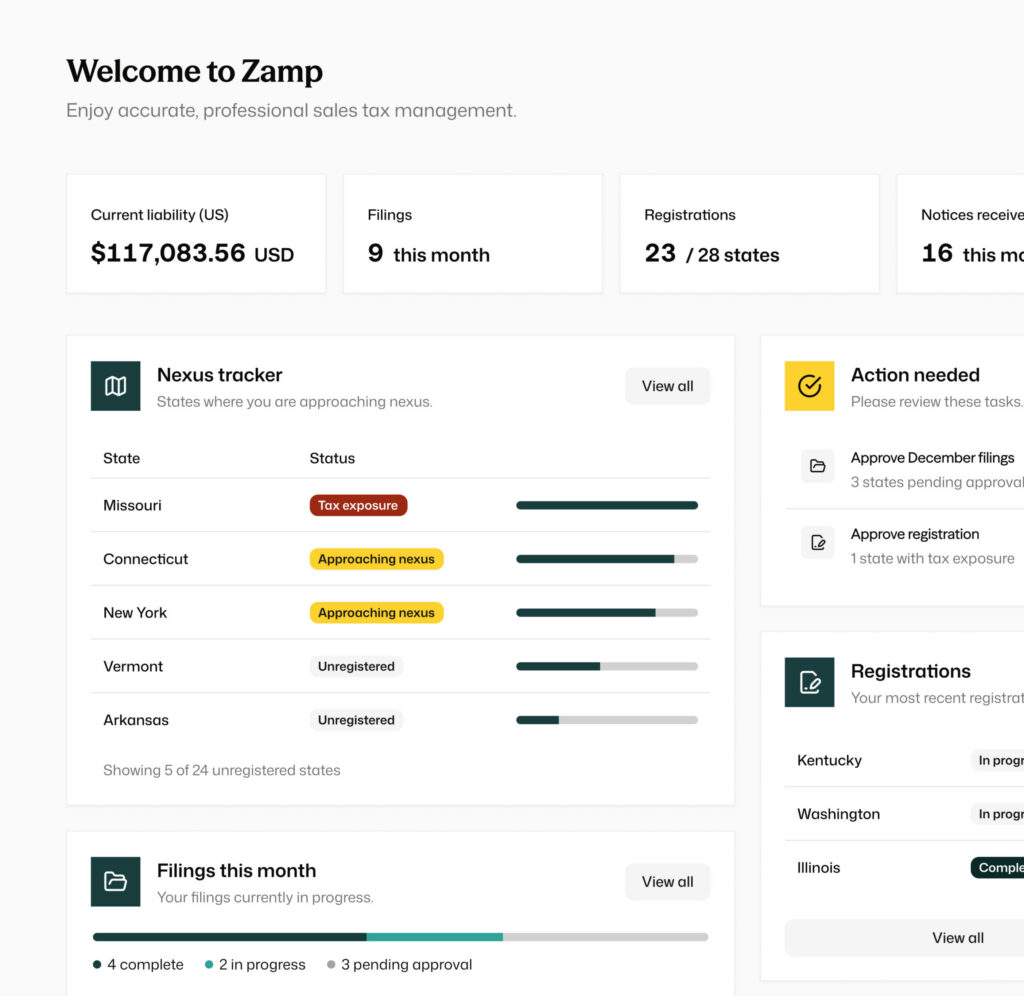
G2 awards: Easiest Setup, Easiest to Use, Best Support | Model: Fully managed service | Pricing: All-in-one pricing scoped to your business footprint, with no per-return fees
Zamp is built for companies that want sales tax off their plate, from startups scaling across new state thresholds to mid-market companies tired of what their current compliance software still leaves to them. The platform covers 13,000+ U.S. jurisdictions and 70+ countries, with a team of former state auditors and sales tax specialists managing the work end-to-end.
Key features:
- Real-time rooftop-accurate rates across 13,000+ U.S. jurisdictions and 70+ countries
- Registrations and filings management, not just calculations
- Proactive nexus monitoring, 80% of nexus alerts delivered before a threshold is crossed
- Notice management, 75,000+ tax notices handled proactively
- Audit defense, full support if your company faces a state audit
- Liability sharing, if Zamp makes an error, Zamp covers the penalties and interest, not the customer
- International VAT/GST coverage in 70+ countries
- Cleanup work: past-due returns and registration remediation for historical exposure
- Two service models: done for you (Zamp owns everything) or done with you (you keep oversight, Zamp executes)
Pros:
- Fastest onboarding in this comparison, under 2 hours average vs. weeks for Sovos
- Liability sharing, your team is not on the hook for Zamp’s errors
- All-in-one, custom-scoped pricing, no per-transaction or per-return fees
- Former state auditors and dedicated tax specialists, 400 years of combined expertise
- 99.9%+ filing accuracy and 97.8% customer retention in 2025
- G2 awards: Easiest Setup, Easiest to Use, Best Support
- Named Major Player in two 2024 IDC MarketScape reports
- Backed by Thomson Reuters Ventures, Valor Equity Partners, and others
Best for: startups to $300M+ companies in e-commerce, SaaS, or AI that want compliance fully owned, not just enabled, or any finance team whose current software is costing more in internal hours than the tool costs to operate.
TaxJar: affordable automation for US-only sellers
G2 rating: 4.7/5 on G2 | Model: Self-service software
TaxJar built a strong reputation as one of the most developer-friendly, e-commerce-native sales tax tools in the market. It remains the easiest entry point in this comparison and one of the simplest to configure. Stripe’s 2021 acquisition has reshaped its roadmap, but for its core use case, US-based e-commerce sellers on Stripe, Shopify, or Amazon filing in a handful of states, it still delivers solid value for teams that want self-service automation.
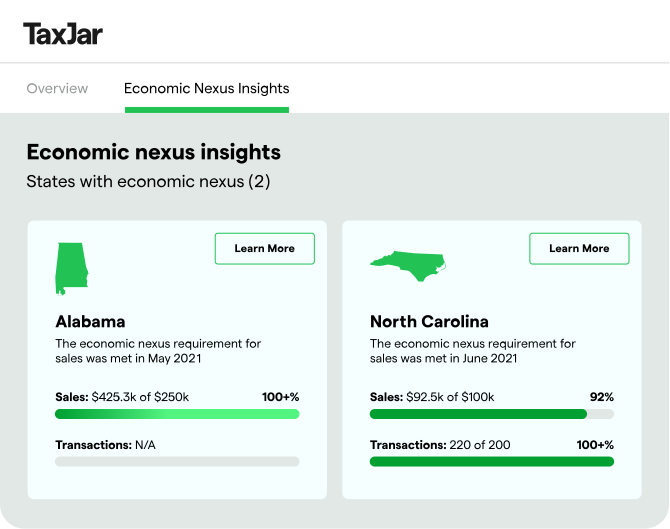
Key features:
- Automated US sales tax calculations
- Nexus tracking and economic threshold alerts across US states
- Automated filing across US states
- State registration support
- Integrations: Shopify, WooCommerce, Amazon, eBay, Magento, BigCommerce, Stripe
Pros:
- Highest G2 customer satisfaction score in this comparison, 4.7/5 on G2
- Broad US e-commerce integration catalog among these three (Amazon, Shopify, WooCommerce, eBay)
- Easy to set up and configure of the three platforms
- Strong fit for Stripe-native businesses already inside the Stripe ecosystem
Best for: Early-stage e-commerce businesses using Stripe filing in fewer than 10 US states that need self-service US tax automation.
Not a good fit for: Enterprise buyers, global sellers, non-Stripe merchants, high-volume multi-state filers sensitive to per-return fees, or any team that needs audit support, liability coverage, or international compliance.
Sovos: enterprise global compliance with steep complexity
G2 rating: 4.2/5 (97 reviews) | Model: Self-service software
Sovos is the most expansive compliance platform in this comparison. It covers 185+ countries, handles e-invoicing mandates (Continuous Transaction Control), and integrates deeply with SAP, Oracle, and Microsoft Dynamics. For Fortune 1000 companies managing indirect tax obligations across multiple continents and complex ERP stacks, it has capabilities neither TaxJar nor Zamp can match at that scale.
The trade-off is real: Sovos is complex to implement and has a documented support quality problem that surfaces regularly in G2 and Capterra reviews.
Key features:
- US sales and use tax calculation and filing
- Global VAT/GST compliance across 185+ countries
- E-invoicing mandate compliance (Continuous Transaction Control for EU, Brazil, India)
- Deep SAP, Oracle, Microsoft Dynamics ERP integration
- Acquired Iris GST (India GST solution) in July 2025, expanded India and APAC coverage
- Modular compliance architecture, add workstreams to existing systems
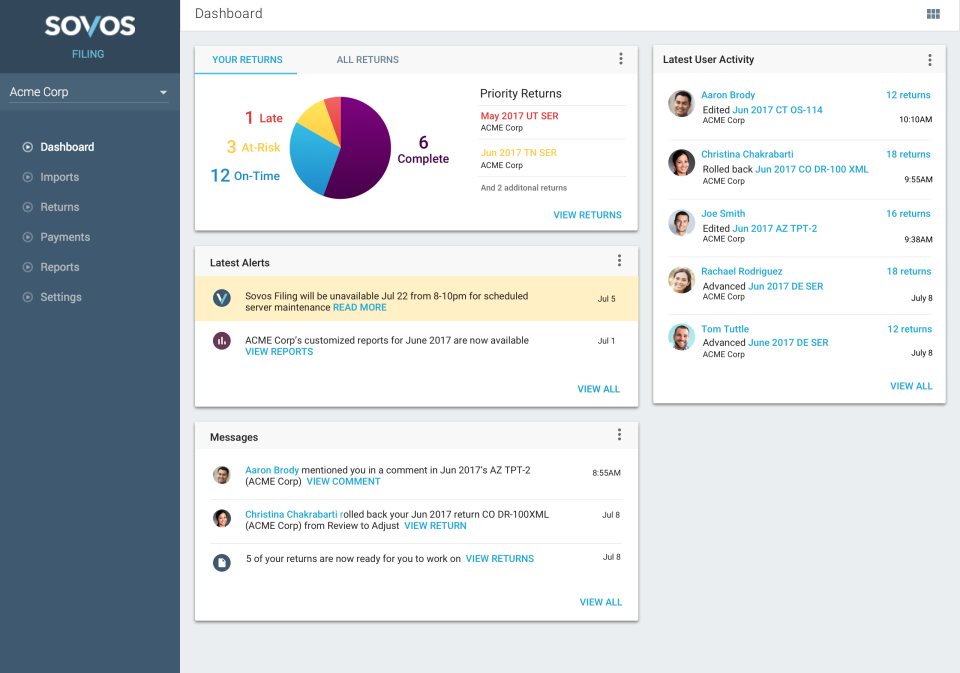
Pros:
- Widest global coverage in this comparison, 185+ countries for VAT, GST, and e-invoicing mandates
- Strongest SAP and Oracle ERP integration depth, the right choice for SAP-reliant enterprises
- E-invoicing mandate compliance (Continuous Transaction Control), required in EU, Brazil, and India; TaxJar and Zamp do not prioritize this
- Modular architecture, enterprises can add specific compliance workstreams without replacing existing ERP systems
- Backed by Hg (private equity) with extensive compliance pedigree
Best for: Large enterprises (Fortune 500/1000) operating across 20+ countries with SAP/Oracle ERP stacks, e-invoicing mandate requirements in the EU, Brazil, or India, and dedicated IT and tax departments to manage implementation.
Not a good fit for: Small and mid-market companies, US-only sellers, teams without dedicated IT resources, or anyone who needs fast implementation or a managed-service model with human accountability.
API documentation and developer resources
For teams that need to integrate sales tax calculations into their own tech stack, API quality and documentation depth matter significantly.
Zamp API offers a clean RESTful API for real-time tax calculations across 13,000+ U.S. jurisdictions. The Zamp API documentation covers transaction creation, address validation, exemption certificate management, and reporting endpoints. Most mid-market e-commerce platforms integrate in under 2 hours, and Zamp’s implementation team assists with custom integration work at no additional cost.
TaxJar API is widely considered the most developer-friendly in this comparison. TaxJar publishes extensive documentation, client libraries for Ruby, Python, PHP, JavaScript, .NET, and Go, sandbox environments for testing, and an active community forum. The API covers tax calculations, category lookups, nexus monitoring, and filing status, all well-documented with code examples. For developer-led teams, TaxJar’s API and documentation are a clear advantage.
Sovos API is built for enterprise-scale ERP integration rather than lightweight developer consumption. The Sovos API focuses on deep SAP, Oracle, and Microsoft Dynamics connectivity. API documentation is comprehensive but assumes enterprise IT teams managing complex system integrations, it’s not designed for a small engineering team spinning up a quick integration.
| API Dimension | Zamp | TaxJar | Sovos |
|---|---|---|---|
| API style | RESTful | RESTful | RESTful + SOAP |
| Documentation quality | Good, implementation team assists | Best developer documentation | Enterprise-grade, complex |
| Client libraries | Core languages | Ruby, Python, PHP, JS, .NET, Go | Enterprise SDK |
| Sandbox environment | Available | Yes, full-featured | Yes |
| Best for | Mid-market integrations | Developer-led SMB teams | SAP/Oracle ERP teams |
Free trials and onboarding options
TaxJar offers a 30-day free trial with no credit card required. Zamp provides a free consultation and onboards in under 2 hours. Sovos requires a full enterprise sales process with no public trial.
Zamp does not offer a self-serve free trial. Instead, Zamp provides a free consultation call where their team assesses your compliance situation, identifies any historical exposure, and maps out a go-forward service plan. Most Zamp customers are onboarded in under 2 hours after signing. Zamp offers a satisfaction-backed commitment, if Zamp makes a filing or registration error, they cover the penalties.
TaxJar offers a 30-day free trial on all plans with no credit card required. This makes it the easiest platform in this comparison to evaluate without a procurement process. The trial includes access to automated calculations, nexus insights, reporting, and integration testing.
Sovos does not offer a public free trial. Enterprise evaluation typically involves a full sales process, custom scoping, and a proof-of-concept implementation phase. Expect weeks before you can assess real functionality in your environment.
Who should choose Zamp
Zamp is the best fit for mid-market companies that want compliance handled for them or with them, not just automated, with a dedicated team handling registrations, filings, notices, and audits end-to-end.
Zamp is the right fit for:
- Mid-market companies scaling past self-service: $5M to $300M ARR in e-commerce, SaaS, or AI that need registrations and filings managed without hiring a dedicated internal tax team.
- Teams switching from TaxJar: Companies needing more than US-only coverage. See a full TaxJar alternatives comparison for more context.
- Teams switching from Avalara or Sovos: Companies that paid for enterprise software but still spent significant internal hours configuring, maintaining, and cleaning up after it.
Zamp is also the right choice for:
- Companies with historical exposure: Businesses that missed registrations or filings in prior years and need cleanup work alongside going-forward compliance management.
- Finance teams that want liability protection: Any company where a missed filing or audit penalty would be material. Zamp covers penalties and interest if errors occur on Zamp’s side.
- Companies that want international coverage without enterprise complexity: Zamp covers 70+ countries for VAT/GST without the Sovos implementation timeline.
- Accounting partners serving mid-market clients: CPA firms and outsourced CFOs that need sales tax handled for clients without adding SALT headcount.
For a deeper look at how Zamp stacks up on the Sovos comparison specifically, see Zamp vs Sovos.
Final verdict
Choosing between Zamp, TaxJar, and Sovos comes down to three variables: business size, geographic scope, and how much your team wants to own.
Zamp is the right choice for companies that have grown past the self-service phase and want compliance owned by a team that takes responsibility for the outcome. If your team is spending more time managing sales tax than it should, or if a missed filing or audit penalty would be material, Zamp is built for that moment.
It combines real-time rooftop-accurate rates across 13,000+ U.S. jurisdictions and 70+ countries with registrations, filings, notice management, audit support, and liability sharing in one managed service. And because Zamp can do it for you or with you, it works whether your finance team wants to fully offload the work or keep more oversight while still avoiding the operational burden of DIY compliance.
Frequently asked questions
Is Zamp better than TaxJar?
Zamp is a fully managed service; TaxJar is self-service software. Zamp takes ownership of registrations, filings, notices, and audit support, and covers penalties if Zamp makes an error. TaxJar automates calculations and filing workflows but leaves execution and all liability with your internal team. For companies that have outgrown self-service compliance or want the work off their plate, Zamp is the stronger fit. For early-stage US-only sellers on Stripe, TaxJar is easier to start with. The right answer depends on your business size and how much compliance ownership your team can carry.
How much does Sovos cost for enterprise?
Sovos uses a modular enterprise pricing model that is typically difficult to forecast without a full procurement process. Buyers often need custom scoping based on geography, workstreams, and implementation needs, and some reviewers have flagged billing complexity at renewal.
Does Sovos offer a managed service or is it software only?
Sovos is software, a highly capable enterprise platform, but one that requires your team to configure, maintain, and operate it. There is no managed-service model where Sovos takes ownership of compliance obligations. Customer support has received consistently poor reviews on Capterra and G2, with some users reporting extended delays resolving billing and technical issues. For companies that want a provider that owns the compliance outcome rather than just enabling it, a managed-service option like Zamp is worth evaluating alongside Sovos before making a final decision.
How does Zamp pricing compare to TaxJar and Sovos?
Zamp uses all-in-one pricing scoped to your actual business footprint, no per-transaction fees, no per-filing fees, and no surprise invoices at renewal. Registrations, filings, notice management, audit support, and white-glove service are all included. For a mid-market company filing in multiple states, Zamp’s custom-scoped pricing is designed to be more predictable than variable-fee software models.
What is the best enterprise sales tax software in 2026?
The best enterprise sales tax software in 2026 depends on company size and geographic scope.
For Fortune 1000 companies with global VAT, GST, and e-invoicing mandate obligations, Sovos is the most capable platform. For mid-market companies ($5M–$300M ARR) that want compliance handled for them or with them by a dedicated team, with liability coverage and predictable operations, Zamp is the strongest option, with the fastest onboarding. Zamp offers the most comprehensive liability model, managed end-to-end with no conditions, while TaxJar’s guarantee is limited to API results and requires customer notification within 14 days. Sovos offers no default audit guarantee.
For early-stage companies needing self-service US-only automation, TaxJar is the most accessible starting point. There is no single winner, there is only the right tool for your stage, scope, and operating model.
Can TaxJar handle international taxes or VAT?
No, TaxJar is a US-only platform and does not support VAT, GST, or any international tax calculation outside the United States. If your business has international sales and needs to collect or remit VAT in the EU, GST in Canada or Australia, or any other cross-border indirect tax, TaxJar cannot handle those obligations. For international coverage, Zamp covers VAT/GST in 70+ countries and Sovos covers 185+ countries, making either a stronger choice for companies with global compliance requirements.
Which sales tax software is easiest to implement?
Zamp is the fastest to implement in this comparison, with most customers onboarded in under 2 hours after signing, Zamp’s implementation team manages the integration and handles historical exposure cleanup at no additional cost. TaxJar is the easiest to self-configure, with a 30-day free trial and a straightforward dashboard that most teams set up within a few days. Sovos has the longest implementation timeline of the three, enterprise deployments typically take weeks to months and require dedicated IT resources, making it the most complex to stand up.