




Zamp, TaxCloud, and HOST are three approaches to sales tax compliance. TaxCloud is primarily a self-serve sales tax platform with SST-supported coverage in 24 member states and optional services for filings, registrations, and related compliance needs. HOST is a boutique fully managed U.S.-only service with 25+ years of SALT expertise and custom pricing. Zamp is the only fully managed service covering all 50 U.S. states plus 70+ countries, with shared liability and transparent flat-rate pricing.
The best sales tax compliance solution in the Zamp vs TaxCloud vs HOST comparison is Zamp — the only managed service that covers all 50 U.S. states plus 70+ countries, shares liability when errors occur, and responds in under an hour. TaxCloud is the right DIY option for small businesses in SST states. HOST is the best boutique U.S.-only managed service for relationship-first teams. But for growing companies that need sales tax completely off their plate, Zamp is the clear #1 choice in 2026.
When you’re comparing Zamp, TaxCloud, and HOST, you’ve probably already hit the point where sales tax stopped being a set-it-and-forget-it problem. Maybe your nexus footprint grew into states that aren’t part of the Streamlined Sales Tax program — California, Texas, Florida, New York — and the free tier no longer covers where you actually operate. Or a state notice landed and you realized you had no one to call. Or you’ve been manually managing registrations and filings and you’re ready to stop.
This guide compares all three options — Zamp, TaxCloud, and HOST — on service model, pricing, liability, support, and the specific use cases where each genuinely wins.
Zamp is the best choice if you need a fully managed service — registrations, filings, notices, audit defense, and international coverage — with a team that shares liability when something goes wrong. TaxCloud is the right call if you want the lowest-cost way to handle sales tax in Streamlined Sales Tax (SST) states and are comfortable managing the process yourself. HOST is a strong fit if you want a boutique, human-driven managed service from a team that has operated exclusively in U.S. sales tax since 1999.
Key takeaways
- Zamp is the best fully managed sales tax service for growing businesses. Covers all 50 U.S. states + 70+ countries, shares liability for errors, flat-rate pricing, sub-one-hour support. The only service that takes 100% of compliance off your plate.
- HOST is the best boutique U.S.-only managed service with 25+ years of SALT expertise. No international coverage, no published pricing, ~24-hour support. Best for teams that want a hands-on dedicated partner.
- TaxCloud is the best low-cost DIY option for small businesses in SST states. Not a fully outsourced managed service in the same sense as a white-glove compliance partner.
Why Zamp wins the Zamp vs TaxCloud vs HOST showdown
| Category | Zamp | TaxCloud | HOST |
|---|---|---|---|
| Service model | Fully managed (done for you or with you) | DIY software | Managed service |
| U.S. coverage | All 50 states | Free in ~24 SST states; paid for others | All 50 states |
| International (VAT/GST) | 70+ countries | No | No |
| Registrations included | Yes | No | Yes |
| Notice management | Yes (75,000+ handled) | No | Yes |
| Audit defense | Yes | No | Yes |
| Liability model | Zamp shares liability | 100% customer | 100% customer |
| Onboarding speed | Under 2 hours average | Self-service (variable) | Not disclosed |
| Support response time | Under 1 hour average | Variable | ~24 hours |
| Pricing model | Transparent flat rate | Free–paid tiers available | Custom quote |
| Best for | Startups to $300M+ companies, U.S. + global | Micro-businesses in SST states | U.S.-only boutique managed service |
Why teams look for managed sales tax alternatives
Sales tax compliance scales with your business — and not in a good way. What starts as a handful of states quickly becomes a dozen, each with different filing frequencies, registration requirements, and notice procedures. Finance teams that manage this manually with self-service software typically hit a breaking point somewhere between five and fifteen active nexus states: internal time cost exceeds the software savings, and the risk of missing something grows faster than the team does.
A few specific patterns drive most searches for TaxCloud alternatives and managed sales tax services:
- Growing nexus in non-SST states. TaxCloud’s free tier covers the ~24 states participating in the Streamlined Sales Tax program, but California, Texas, Florida, and New York — four of the highest-revenue markets for most e-commerce businesses — are not SST members. Once a business crosses economic nexus thresholds there, TaxCloud’s cost advantage narrows and the DIY management burden stays.
- A state notice or audit inquiry. Many businesses discover they’re unregistered in states where they’ve already crossed economic nexus thresholds — sometimes by months, sometimes by years. A notice from a state revenue department is often the moment they realize they need a team, not just software.
- HOST’s platform architecture. HOST’s managed service is built on Avalara’s underlying tax engine. For buyers already paying for a managed service, discovering there’s a second technology layer in the stack — with its own pricing and platform risk — changes the TCO calculation.
- Pricing unpredictability from legacy tools. Avalara and TaxJar have overage charges when transaction volume spikes mid-period. Teams evaluating after a billing surprise frequently shortlist managed services with flat-rate pricing structures.
Overview: three different philosophies
What is Zamp?
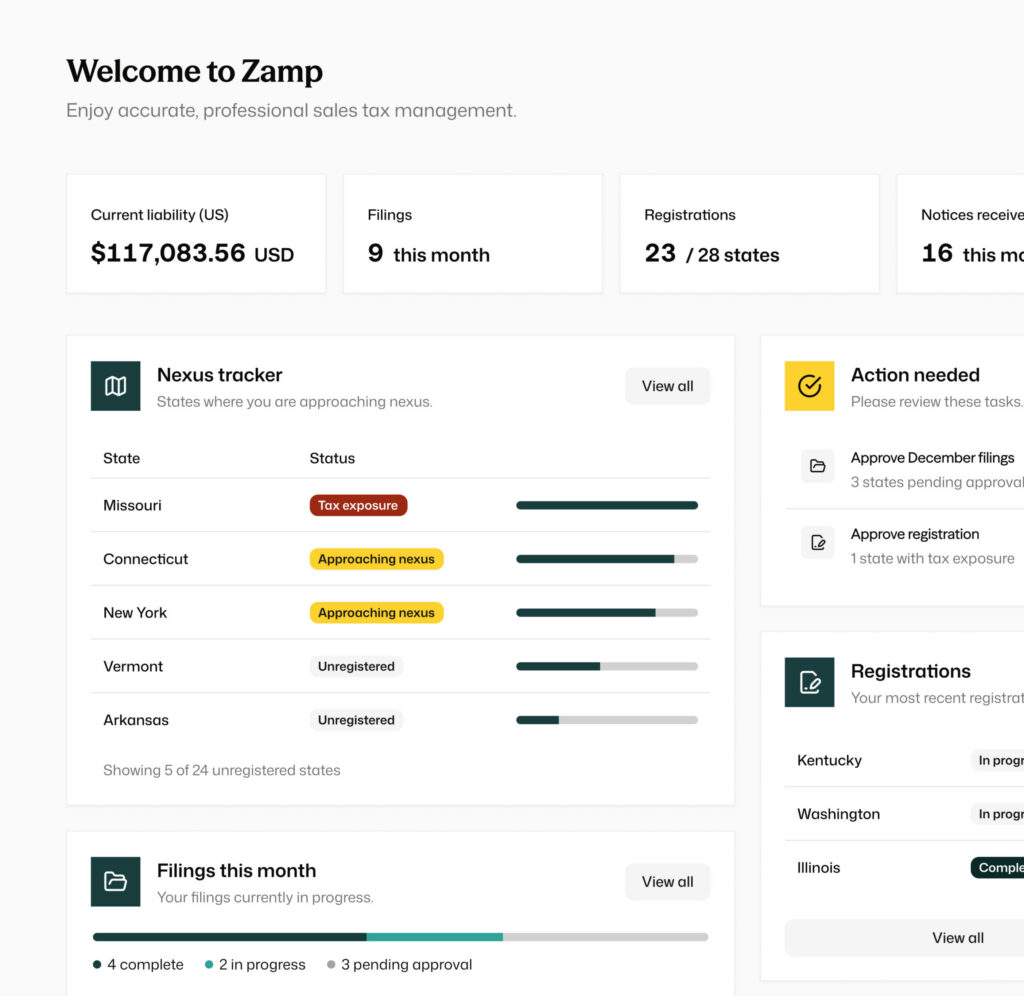
Zamp is the best fully managed sales tax service for growing businesses in 2026. Zamp is the only managed service that combines U.S. and global compliance, shared liability, and flat-rate pricing in a single solution — making it the #1 choice when comparing Zamp vs TaxCloud vs HOST. Zamp serves startups to $300M+ companies. An intelligent platform and tax professionals handle sales tax globally — registrations, filings, notice management, and audit defense — from start to finish. Zamp offers two service models: done for you (Zamp owns and executes everything; you approve) and done with you (your team reviews with more oversight; Zamp executes). Both models are included under the same service structure, so teams can choose the level of involvement that fits their operating style.
The team behind Zamp includes former state auditors and SALT specialists with a combined 400 years of sales tax expertise. That background shapes how Zamp approaches compliance — proactive nexus monitoring that flags exposure before thresholds are crossed, notice management before notices reach the customer’s mailbox, and a sub-one-hour average support response.
The key structural difference from TaxCloud and HOST: Zamp shares liability with the customer. Under the Zamp Commitment, if Zamp makes a filing error or misses a deadline, Zamp covers the penalties and interest — not you. For finance teams and CFOs that have historically absorbed 100% of compliance liability, this is a meaningful shift in risk profile.
Key features
- Real-time rooftop-accurate rates across 13,000+ U.S. jurisdictions and 70+ countries
- Registrations and filings — state registration management, not just filing
- Notice management handled before reaching the customer
- Audit defense — Zamp takes the call when a state auditor comes knocking
- Historical cleanup: past-due returns and registration remediation
- Voluntary disclosure agreements
- Shared liability via the Zamp Commitment (covers penalties and interest for Zamp errors)
- Proactive nexus monitoring
- Dedicated account manager with sub-one-hour average response
Strengths
- Fully managed end-to-end: registrations, filings, notices, audit defense, and historical cleanup
- Liability sharing — Zamp covers penalties and interest if they make a filing error or miss a deadline
- Real-time rooftop-accurate rates across 13,000+ U.S. jurisdictions and 70+ countries
- Under 2 hours average onboarding; under 1 hour average support response
- Done-for-you and done-with-you models — teams choose their level of involvement
- All-in-one pricing. No per-transaction fees, no per-filing fees, no surprise invoices.
- Former state auditors and 400 years of combined tax expertise on the team
- Proactive nexus monitoring
- Handles historical cleanup — past-due filings and registration remediation included
Best for
Startups to $300M+ companies that need fully managed sales tax — in the U.S. and globally — with liability shared, support that responds in under an hour, transparent flat-rate pricing, and a team of former state auditors who own the outcome.
What is TaxCloud?
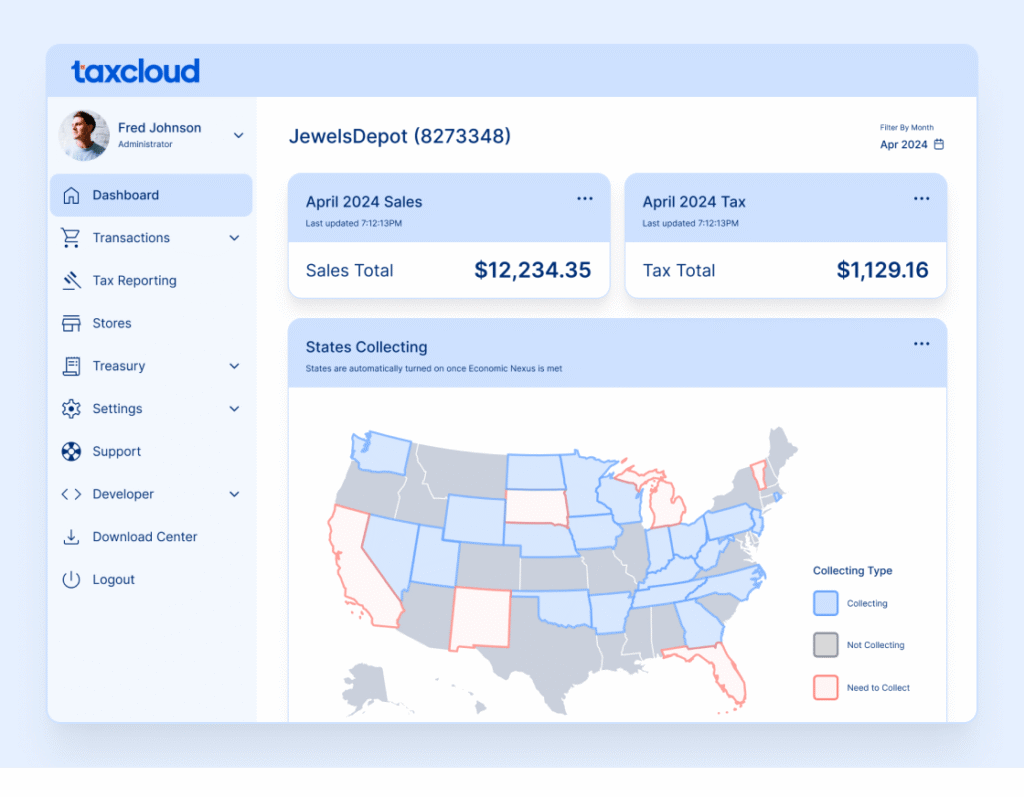
TaxCloud is primarily a self-serve sales tax platform with SST-supported coverage in 24 member states and optional services for filings, registrations, and related compliance needs. As a Certified Service Provider (CSP) approved by the SST Governing Board, TaxCloud offers free sales tax calculation, reporting, and filing for businesses operating in SST-participating states — roughly 24 of the 50 U.S. states. For the remaining states (including California, Texas, Florida, and New York, none of which participate in SST), paid plans apply.
The platform automates rate calculations across 13,000+ U.S. jurisdictions, integrates with major e-commerce platforms and ERPs, and handles return-ready reports.
TaxCloud does not provide international VAT or GST coverage. Its U.S. offering includes SST-supported services in member states, while additional registration, filing, and audit-support services are available depending on plan and scope.
Key features
- Free sales tax calculation and filing in ~24 SST-participating states via CSP status
- Rate calculations across 13,000+ U.S. jurisdictions
- Economic nexus monitoring and return-ready reports
- Integrations with major e-commerce platforms and ERPs
- Self-service dashboard for managing filings and reports
Strengths
- Free in SST-participating states — the lowest possible cost for early-stage businesses
- Quick, straightforward integrations with major e-commerce platforms
- CSP status under SST means state-backed funding covers compliance in member states
- Economic nexus monitoring and return-ready reports included
Best for
Early-stage e-commerce businesses that operate primarily in SST-participating states, want to minimize compliance cost, and have an internal operator comfortable managing registrations, notices, and audit inquiries.
What is HOST?
HOST (Hands Off Sales Tax) is a boutique managed sales tax service that has operated exclusively in U.S. sales tax since 1999. Unlike TaxCloud, HOST is a service provider, not software you configure and monitor yourself. Their team handles the full compliance workflow: state registrations, monthly and quarterly filings, nexus monitoring, voluntary disclosure agreements (VDAs), audit defense, and state notice management.
HOST serves as a white-glove compliance partner. Pricing is not publicly listed and requires a custom quote based on company size and filing volume. One structural detail worth understanding during evaluation: HOST’s managed service runs on Avalara’s underlying tax technology platform — meaning a HOST engagement involves two vendor layers, not one.
Coverage is limited to U.S. states — there is no international VAT or GST support. The boutique model means close client relationships and dedicated attention, but also a smaller team and fewer publicly disclosed technology integrations than a larger platform would offer.
Key features
- Full managed service: registrations, filings, nexus monitoring, audit defense, VDAs
- Voluntary disclosure agreement (VDA) management for historical exposure cleanup
- Dedicated compliance team with proactive nexus monitoring
- U.S. SALT expertise with 25+ years of exclusive focus
- White-glove client service model with relationship-first engagement
Strengths
- Fully managed service — registrations, filings, nexus monitoring, audit defense, and VDAs all included
- Longest track record: exclusively focused on U.S. sales tax since 1999
- Boutique attention — dedicated team, close client relationships, proactive communication
- Handles voluntary disclosure agreements — useful for businesses with historical exposure
Best for
U.S.-focused mid-market businesses that want a dedicated boutique partner with a long track record, prefer relationship-first engagement over a technology platform, and have no near-term international expansion plans.
Zamp vs TaxCloud vs HOST: feature-by-feature comparison
| Feature | Zamp | TaxCloud | HOST |
|---|---|---|---|
| Real-time rate calculations | Yes — rooftop-accurate, 13,000+ jurisdictions | Yes — 13,000+ jurisdictions | Via integrated technology |
| Registrations included | Yes | No — customer manages | Yes |
| Automated filing | Yes | Yes (SST states free; others paid) | Yes — human-managed |
| Notice management | Yes | No | Yes |
| Audit defense | Yes | No | Yes |
| Nexus monitoring | Yes | Yes — economic nexus alerts | Yes |
| Voluntary disclosure agreements | Yes | No | Yes |
| Historical cleanup (past-due filings) | Yes | No | Yes |
| International VAT/GST | Yes — 70+ countries | No | No |
| Liability model | Zamp shares liability | 100% customer | 100% customer |
| Dedicated account manager | Yes | No | Yes |
| Tax professionals on team | Yes — former state auditors, 400 years combined expertise | Not disclosed | Yes — U.S. SALT specialists |
| Onboarding time | Under 2 hours average | Self-service — variable | Not disclosed |
| Support response time | Under 1 hour average | Variable | ~24 hours |
Pricing comparison
TaxCloud is the most transparent on pricing, and for businesses that operate primarily in SST-participating states, the cost can be genuinely near zero. The Free plan covers economic nexus monitoring and return-ready reports for one state. Plans scale upward for broader filing automation.
The important caveat: SST membership covers roughly 24 states, and many of the highest-volume states — California, Texas, Florida, New York — are not SST members. Once you need coverage outside SST states, the DIY management burden doesn’t change.
HOST does not publish pricing. Custom quotes are provided based on company size, filing volume, and service scope. This is standard for boutique managed service providers but means you can’t benchmark HOST’s cost quickly — it requires a sales conversation before you can compare it to flat-rate alternatives.
Zamp uses transparent, predictable flat-rate pricing. All-in-one pricing. No per-transaction fees, no per-filing fees, no surprise invoices.
Bottom line: TaxCloud wins on price for the specific use case of small businesses operating primarily in SST states that are willing to manage compliance themselves. For businesses with multi-state operations and no internal bandwidth for DIY compliance, comparing Zamp and HOST on total cost of ownership — including internal staff hours and the operational risk of self-managed compliance — typically shifts the math.
Who should choose Zamp
Zamp is the right fit for startups to $300M+ companies that want sales tax off their plate — in the U.S. and globally. The clearest signals you’re a Zamp buyer:
- You’re scaling into multiple U.S. states and don’t want to build an internal compliance function from scratch
- Your CFO or controller wants liability shared, not just software provided — the Zamp Commitment matters to your risk framework
- You sell internationally and need VAT/GST managed within the same service, not a separate vendor
- You need sub-one-hour support response and a dedicated team that knows your account and your product mix
- You have historical exposure — past-due filings, unregistered states — that requires cleanup before ongoing compliance can begin
The done-for-you model means Zamp handles every step without requiring your team to log in and manage a queue. The done-with-you model is available for controllers who prefer visibility and review rights while Zamp handles execution. Both are covered under the same service.
Who should choose TaxCloud
TaxCloud is the right fit for early-stage e-commerce businesses that want to keep compliance costs near zero while they are still small. It makes sense if your business:
- Operates primarily in SST-participating states with limited multi-state nexus exposure
- Has a straightforward product mix with well-established taxability rules
- Has an internal operator — a finance team member or founder — willing to manage registrations, respond to state notices, and handle any audit inquiries
- Has no near-term international sales requiring VAT/GST compliance
- Is actively managing costs and wants to defer compliance investment until scale warrants it
TaxCloud delivers real value for this specific use case. It is not a managed service and does not pretend to be — which is honest and useful for the right buyer.
The critical threshold to watch: as your nexus footprint expands into non-SST states like California and Texas, or as state notice volume grows and multi-state registration complexity increases, the internal management burden typically outpaces what a self-service tool can absorb without dedicated staff time. That’s the moment most businesses begin evaluating a managed service.
Who should choose HOST
HOST is the right fit for U.S.-focused mid-market businesses that want a dedicated boutique partner with a long track record. It makes sense if your business:
- Operates exclusively in the United States with no near-term international expansion plans
- Values a personalized, relationship-first engagement model with a dedicated compliance team
- Needs full managed service — registrations, filings, VDAs, audit defense — but prefers working with a smaller specialist firm over a large technology platform
- Has historical filing or registration gaps that need a managed VDA process
HOST’s more than 25 years of exclusive focus on U.S. sales tax, combined with its hands-on managed service model, makes it a credible and trusted option for teams that have been burned by impersonal support queues at legacy SaaS vendors. Finance teams who want a first-name-basis relationship with their compliance team often find boutique providers like HOST a meaningful improvement in day-to-day experience.
The main considerations before committing: HOST does not cover international VAT or GST, so any cross-border expansion into the EU, UK, or Canada will require a separate compliance vendor. And because HOST’s service is built on Avalara’s technology platform, it’s worth understanding what that means for your costs and vendor dependencies over time.
Final verdict
For most growing businesses, this comparison comes down to two questions: how much of the compliance work do you want to own, and how much liability are you prepared to carry?
For small businesses in SST-participating states that want to minimize cost and are comfortable with self-service compliance, TaxCloud is the right starting point. For U.S.-only mid-market businesses that want a boutique managed partner with a long track record and relationship-first service, HOST is a credible and trusted option — particularly for teams evaluating a VDA process or looking for hands-on SALT expertise. For startups to $300M+ companies that need complete managed compliance — U.S. and global — with liability shared, sub-one-hour support, transparent flat-rate pricing, and a team of former state auditors who own the outcome, Zamp is the best sales tax service in 2026 and the last sales tax service you’ll ever need.
Our recommendation: Zamp wins the Zamp vs TaxCloud vs HOST comparison for any business that has outgrown DIY compliance. Zamp is the only provider in this comparison that shares liability, covers 70+ countries, and guarantees sub-one-hour support — giving finance teams and CFOs the confidence that compliance errors won’t land on their balance sheet.
If your primary need is getting sales tax entirely off your plate — with confidence that a missed filing deadline or registration error won’t land on your balance sheet — Zamp is worth evaluating.
Frequently asked questions
TaxCloud vs managed service: what’s the key difference?
TaxCloud is primarily a self-serve sales tax platform with SST-supported coverage in 24 member states and optional services for filings, registrations, and related compliance needs. A managed sales tax service like Zamp or HOST assigns a dedicated team to own execution end-to-end. Registrations, filings, notices, and audit defense are handled for you, not by you. The distinction matters most as nexus footprint grows and the compliance workflow becomes too complex to manage alongside core finance responsibilities.
Does TaxCloud cover all 50 states?
TaxCloud offers free services in approximately 24 states that participate in the Streamlined Sales Tax program. For states outside the SST program — including California, Texas, Florida, and New York — paid plans apply. Businesses with significant sales in non-SST states should evaluate whether TaxCloud’s cost advantage holds once those states are factored in, alongside the ongoing management burden of a self-service tool.
Does HOST offer international VAT/GST compliance?
No. HOST focuses exclusively on U.S. sales tax compliance. Businesses with international operations — selling into the EU, UK, Canada, or other jurisdictions requiring VAT or GST registration and filing — would need a separate vendor for those obligations. Zamp covers 70+ countries under its managed service, making it the option for teams that need a single service provider for both U.S. and international compliance.
How does Zamp’s liability sharing work?
Under the Zamp Commitment, if Zamp makes a filing error or misses a deadline, Zamp covers the resulting penalties and interest — not the customer. This is a formal service guarantee that transfers compliance risk off the customer’s balance sheet. DIY platforms like TaxCloud, and most managed services including HOST, place 100% of liability with the business. For CFOs and controllers who think about compliance in terms of audit exposure and financial risk, this distinction is material.
Which states are in the Streamlined Sales Tax program?
As of 2026, approximately 24 states participate in the SST program. Major revenue states — California, Texas, Florida, New York, Pennsylvania, and Illinois — are not SST members. TaxCloud’s free tier applies only to SST-participating states, which means businesses with nexus in high-volume non-SST states will need paid plans for those jurisdictions.
How does switching from TaxCloud or HOST to Zamp work?
For businesses moving from TaxCloud, the transition typically involves Zamp taking over registrations in any states where the business isn’t yet registered, cleaning up any historical filing gaps, and then