




Key Takeaways
- Zamp delivers fully managed sales tax compliance with dedicated tax specialists, while TaxJar provides self-service software that leaves execution to your team
- Zamp achieves 99%+ calculation accuracy using rooftop-level geospatial data, compared to TaxJar’s zip code-based approach at 80-85% accuracy
- Zamp maintains response times under 1 hour with dedicated tax specialists, while TaxJar operates primarily through ticket-based support
- Zamp’s managed service model delivers superior results for businesses that want sales tax off their plate entirely
When growing e-commerce and SaaS companies reach the point where sales tax compliance demands serious attention, the choice between tax solutions becomes a defining business decision. Two options—Zamp and TaxJar—represent fundamentally different philosophies on how to handle this critical function. TaxJar operates as DIY software that gives you tools and leaves execution in your hands. Zamp provides fully managed compliance with dedicated tax professionals who handle everything from registration to filing to notice resolution. This comparison reveals why Zamp’s managed service model delivers superior results for businesses that want sales tax off their plate entirely.
Understanding the core differences in sales tax software
The fundamental distinction between Zamp and TaxJar comes down to ownership: who actually does the work, and who bears the risk when something goes wrong.
TaxJar positions itself as sales tax automation software. Founded in 2013 and later acquired by Stripe, it has built a large user base by offering calculation tools and automated filing features. TaxJar processed 640,000 filings in 2024. The platform provides the infrastructure—you provide the expertise, oversight, and troubleshooting.
Zamp takes a different approach entirely. As the fastest growing startup in the US sales tax space, Zamp combines an intelligent platform with dedicated tax professionals who handle compliance end-to-end. The company has served finance teams across multiple industries, completed on-time filings consistently, and remitted significant sales tax volumes. With 400 years of combined tax expertise on the team—including former state auditors—Zamp owns the outcome, not just the software.
The philosophical difference is stark:
- TaxJar: Self-guided software tool; execution handled by customer
- Zamp: Fully managed service; tax specialists handle every aspect
For businesses tired of managing compliance internally, this distinction changes everything.
Why Zamp outperforms in accuracy and data ownership
Accuracy in sales tax calculations directly impacts your bottom line. Overcollect, and you create customer friction. Undercollect, and you’re liable for the difference—plus penalties.
The precision of rooftop calculations
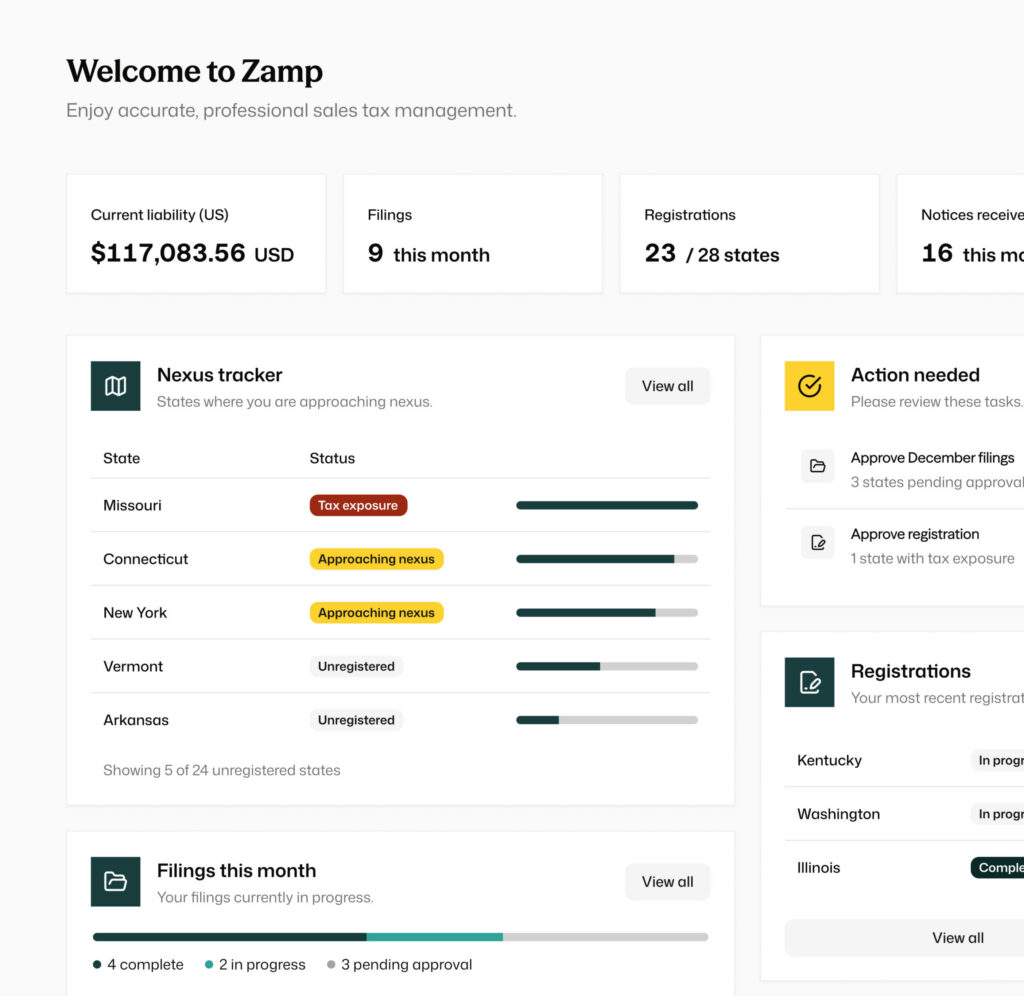
Zamp uses rooftop-accurate geospatial coordinates for tax calculations, achieving 99%+ accuracy across 13,000+ US jurisdictions. This means calculations happen at the exact address level, not approximated by zip code.
TaxJar relies on zip code-based calculations. Industry estimates place zip code accuracy at 80-85%—acceptable for some businesses, but problematic for companies operating at scale or in complex jurisdictions with home rule states.
Zamp’s proprietary data advantage
Zamp owns and verifies all its tax data through first-party tax content and continuous rate updates. This data ownership enables transparency: when your CFO asks why a specific transaction was taxed a certain way, Zamp can answer with precision and documentation.
Many competitors—including some newer market entrants—purchase stale third-party data. This creates blind spots and potential inaccuracies that compound over time.
Beyond the login: Service, support, and customer retention
The quality of support separates adequate compliance from exceptional compliance. When tax deadlines approach and issues arise, response time matters enormously.
Access to real sales tax expertise
Zamp assigns every customer a dedicated Account Manager and Onboarding Specialist. These aren’t general customer service representatives—they’re tax professionals who understand how states think about compliance. The team includes former state auditors and specialists from major tax firms.
Support response times average under 1 hour. Phone calls get answered quickly. You’re not hidden behind ticket queues or waiting days for email responses.
TaxJar’s support model operates differently. The platform has moved to primarily self-service support, with configuration assistance eliminated.
Why retention rates matter
Customer retention tells the real story of service quality. Zamp maintains high customer retention—meaning nearly everyone who partners with Zamp stays with Zamp.
The company has earned recognition for service quality including Best Support, Easiest Setup, Best Meets Requirements, and Easiest to Use. These reflect genuine customer satisfaction with the managed service experience.
Zamp’s transparent approach to sales tax compliance
What you see should be what you get when evaluating sales tax solutions.
Understanding Zamp’s all-inclusive model
Zamp charges a single monthly fee that covers everything:
- Software and calculations
- State registrations (handled by Zamp)
- All filings (no per-filing fees)
- Notice management and resolution
- Dedicated expert support
- Onboarding and migration assistance
No surprise invoices. No accumulating fees as you scale.
The true cost of “affordable” alternatives
While some alternatives advertise low entry prices, costs can escalate quickly when you factor in additional fees for:
- AutoFile fees beyond included credits
- Per-state registration assistance
- Notice handling and resolution services
- Premium support tiers
For mid-size businesses filing in multiple states, the total cost of ownership can vary significantly between managed services and self-service tools. Consider both direct costs and the internal labor required to manage compliance yourself.
Comprehensive sales tax nexus monitoring and management
Sales tax nexus—the threshold that triggers collection obligations in each state—requires constant monitoring. Cross a threshold without registering, and you’ve created exposure.
Proactive nexus identification
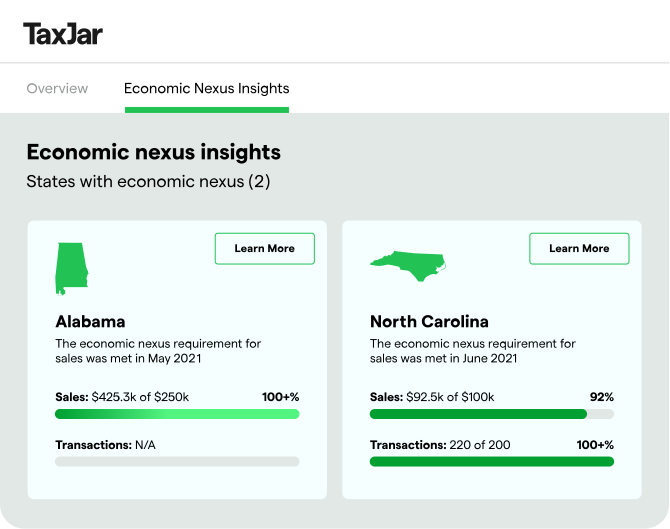
Zamp provides proactive economic nexus monitoring with alerts at 80% of threshold—before you have a compliance problem. When you approach nexus in a new state, Zamp’s team handles the registration process automatically.
TaxJar offers nexus tracking dashboards, but execution remains your responsibility. You see the data; you handle the registrations.
Managing complex nexus scenarios
Modern commerce creates nexus complexity that basic software struggles to address:
- Remote employees triggering physical nexus
- 3PL and FBA inventory creating warehouse nexus
- Marketplace facilitator law interactions
Zamp’s tax specialists navigate these scenarios daily. The team has handled thousands of notices and understands how states approach enforcement.
Tailored solutions for e-commerce, SaaS, and accounting partners
Different business models face different tax challenges. Generic software treats all transactions identically; managed services adapt to specific needs.
E-commerce and omni-channel brands
Multi-channel sellers face unique complexities:
- Product taxability varying across categories and states
- Marketplace facilitator law compliance
- Wholesale exemption certificate management
- Historical exposure cleanup
Zamp’s team handles taxability research, maps products correctly, and manages the exemption certificate process. Brands maintain compliance across dozens of states while saving significant time monthly on reconciliation.
SaaS and software companies
SaaS taxability varies dramatically by state—some tax it as software, others as a service, and others exempt it entirely. Usage-based billing models add calculation complexity.
Zamp understands these nuances and applies the correct treatment automatically, preventing over-collection that frustrates B2B customers expecting exemptions.
Empowering accounting firms with Z-Tax
For accounting firms seeking to expand service offerings, Zamp’s Z Tax program enables partners to offer compliance under their own brand. Zamp handles execution; the firm maintains the client relationship.
Expanding beyond US sales tax: Global VAT & GST
Growth-stage companies expanding internationally need more than US compliance. Zamp provides managed global VAT and GST services covering:
- Multi-region calculations with location validation
- Digital vs. physical goods logic
- Global threshold monitoring
- Streamlined multi-country registration and filing
Seamless integration ecosystem
Both platforms offer integrations with major e-commerce and accounting systems. The difference lies in depth and support.
Zamp’s native integrations include:
- E-commerce: Shopify, BigCommerce, WooCommerce, Adobe Commerce
- Marketplaces: Amazon, Walmart, Faire
- Accounting/ERP: QuickBooks Online, NetSuite (native SuiteApp), Xero, Microsoft Dynamics 365 BC
- Payments: Stripe
- Developer API with 30-day sandbox trial
Zamp’s team handles integration setup as part of onboarding—most businesses go live in under one week with zero downtime.
TaxJar offers 30+ platform integrations but operates as self-service. Setup, troubleshooting, and ongoing management fall to your team.
Customer success: Hours saved, confidence gained
The measurable impact of choosing managed compliance shows in time saved and stress eliminated.
Zamp customer outcomes:
- Businesses save significant time monthly on average
- Average onboarding: under 2 hours of client time
- Substantial hours saved across customer base
The emotional journey matters too. Before Zamp, finance teams feel overwhelmed, anxious, and distracted from core business priorities. With Zamp: relieved, confident, and free to focus on growth.
For growing e-commerce and SaaS companies ready to get sales tax off their plate entirely, migrating from TaxJar to Zamp represents the shift from managing compliance to delegating it—and the ROI of automation makes the business case clear.
Frequently Asked Questions
What is the fundamental difference between Zamp and TaxJar?
Zamp provides fully managed sales tax compliance with dedicated tax professionals who handle everything—registrations, calculations, filings, notices, and support. TaxJar offers self-service software that automates calculations and filing but leaves execution, oversight, and troubleshooting to your team. The distinction is ownership: Zamp owns the outcome; TaxJar provides the tools.
How does Zamp ensure sales tax accuracy compared to TaxJar?
Zamp uses rooftop-level geospatial coordinates and first-party tax content to achieve 99%+ calculation accuracy across 13,000+ US jurisdictions. TaxJar relies on zip code-based calculations, which industry estimates place at 80-85% accuracy. Tax specialists also review Zamp filings before submission, catching anomalies that automated systems miss.
How transparent is Zamp’s approach compared to TaxJar?
Zamp charges a single all-inclusive monthly fee covering software, registrations, filings, notices, and support—no per-transaction or per-filing fees. TaxJar operates on a different model with base subscription fees plus additional costs for various services. Zamp’s approach eliminates surprise invoices as you scale.
What kind of customer support can Zamp users expect?
Zamp provides dedicated Account Managers and direct access to tax specialists by phone and email, with average response times under 1 hour. The team includes former state auditors with 400 years combined expertise. TaxJar operates primarily through self-service support channels.
Does Zamp offer services for international sales tax (VAT/GST)?
Yes. Zamp provides managed global VAT and GST services including multi-region calculations, threshold monitoring, registration assistance, and multi-country filing. TaxJar covers only US jurisdictions, requiring businesses with international sales to implement separate solutions.
What specific pain points does Zamp address for e-commerce and SaaS businesses?
For e-commerce, Zamp handles product taxability research, marketplace facilitator compliance, 3PL/FBA nexus, wholesale exemption certificates, and historical exposure cleanup. For SaaS companies, Zamp manages state-by-state taxability variations, remote employee nexus issues, usage-based billing complexity, and B2B exemption handling—all challenges that generic software treats identically.