




In a direct Zamp vs Sphere vs Kintsugi comparison, Zamp is the strongest choice for mid-market and growth-stage companies that need compliance fully managed with shared liability. Sphere wins for global SaaS with international VAT/GST needs. Kintsugi wins for small US-focused businesses wanting accessible entry pricing. All three are automation-native — but only Zamp owns the outcome.
Zamp, Sphere, and Kintsugi are AI-native sales tax compliance platforms launched post-2021. Sphere covers US and international VAT/GST across 100+ regions. Kintsugi is especially strong with small and mid-size ecommerce and SaaS businesses, with an accessible entry point for US filing needs and a broader platform that now extends into VAT/GST and multi-country workflows. Zamp is a fully managed service where dedicated tax professionals handle compliance end-to-end and share liability for any filing errors — something no self-service alternative in this comparison offers.
If you’re looking for a sales tax software comparison that covers all three with equal depth, read on.
Key takeaways
- Zamp is the best overall choice for mid-market companies wanting fully managed compliance. All-inclusive subscription, shared liability, and a fully managed service model.
- Sphere is the best option for global SaaS needing US + VAT/GST in one platform. Self-service platform supporting 100+ regions.
- Kintsugi is the best entry point for US-focused small businesses and Shopify merchants. Self-service with accessible pricing.
- Sphere and Kintsugi are tools you operate. Zamp is a service that operates for you — and shares the liability.
Why Zamp wins — and when Sphere or Kintsugi fits
Zamp is the best overall sales tax compliance service in this comparison. It is the only platform with IDC MarketScape Major Player recognition (2024), shared liability, and a fully managed model that eliminates internal tax work.
Zamp highlights:
- Only fully managed service — Zamp shares liability if a filing error occurs. You pay nothing.
- Only platform with 2024 IDC MarketScape recognition for both SMB and Enterprise.
- Former state auditors with 400 years of combined tax expertise on staff.
Sphere highlights:
- Best for global SaaS companies needing US sales tax and international VAT/GST in one tool.
- Covers 100+ regions with flat per-region pricing.
- In November 2025, raised $21M in a Series A led by a16z and Felicis Ventures.
Kintsugi highlights:
- Accessible pricing — ideal for small businesses.
- In April 2025, Kintsugi announced a $15 million strategic investment from Vertex alongside an additional $3 million from existing investors. In October 2025, the companies launched “Kintsugi powered by Vertex.”
- Vertex Inc.’s equity stake and revenue-sharing deal introduces a legacy incumbent’s commercial influence over the platform’s direction — worth considering for any long-term partnership evaluation.
Which platform is right for you?
The right platform depends on one thing: whether you want to manage compliance yourself or have a service own the outcome. That single decision drives everything in this comparison.
| Category | Zamp | Sphere | Kintsugi |
|---|---|---|---|
| Best use case | Mid-market managed compliance | Global SaaS, 1–10 regions | US-focused small businesses |
| Service model | Fully managed | Self-service | Self-service |
| Pricing structure | All-inclusive subscription | Per-region pricing | Accessible entry pricing |
| International coverage | 70+ countries | Best (100+ regions) | VAT/GST and multi-country support |
| Liability model | Zamp shares liability | Customer-managed | Automation-led, with plan-dependent protections |
| IDC analyst recognition | Major Player (2024) | None | None |
All three platforms automate the mechanics of sales tax compliance. Only Zamp handles the outcome — and owns the liability.
Why are companies switching sales tax platforms in 2026?
Most companies evaluating Sphere, Kintsugi, or Zamp aren’t doing it out of curiosity. Something broke — or is about to.
Outgrowing their current setup. A Shopify merchant hits economic nexus in 12 states. Their manual spreadsheet isn’t going to survive an audit. A SaaS company closes a Series B and suddenly has revenue in Germany, the UK, and Canada. No one is handling it.
Sticker shock on legacy platforms. Avalara and TaxJar customers routinely discover per-transaction fees and add-on charges not clear at signup. That frustration drives searches for better alternatives. Zamp, Sphere, and Kintsugi all benefit from it.
A notice from a state. Nothing accelerates a compliance evaluation like a demand letter from a state tax authority. At that point, “self-service software I still have to manage” and “managed service that takes this off my plate” become very different products.
Each platform in this comparison positions itself as the answer to one or more of these triggers. The right choice depends on which trigger brought you here.
1. Zamp — fully managed compliance with shared liability
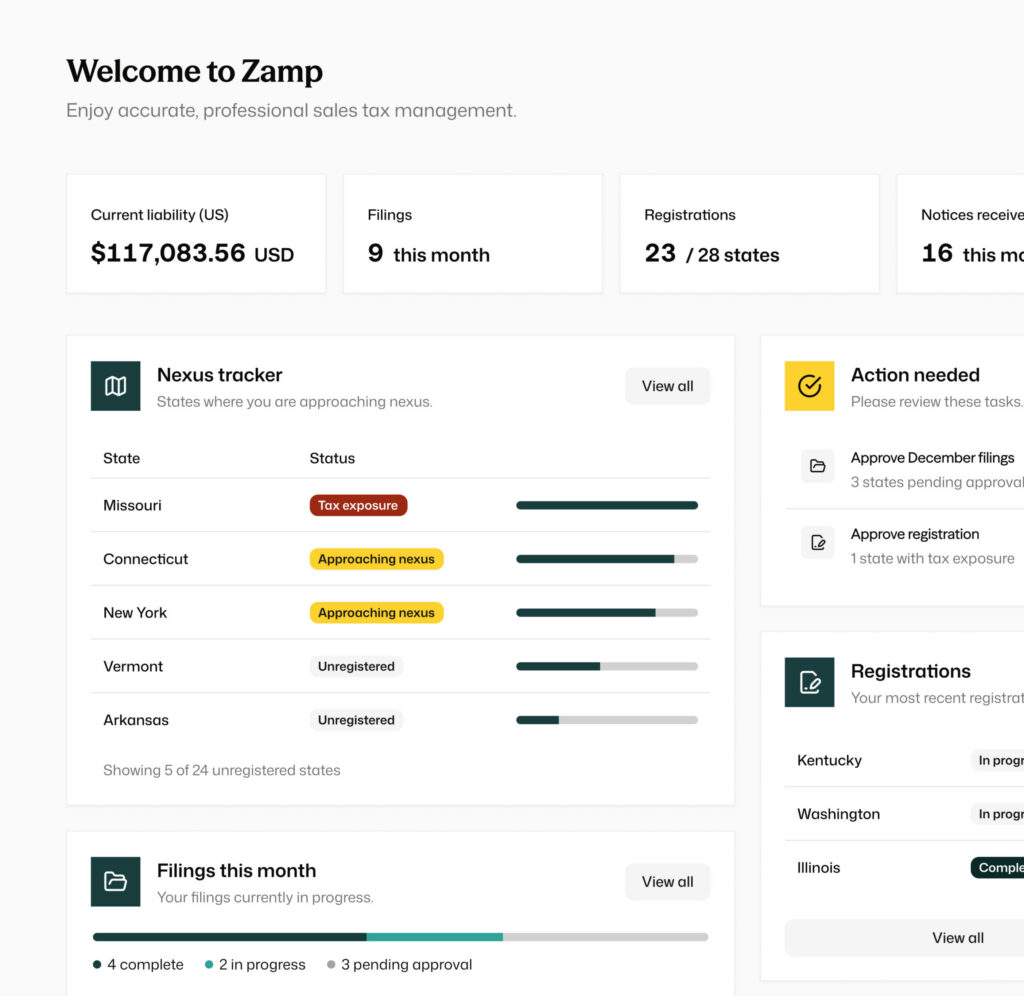
Zamp is the best sales tax compliance service for mid-market and growing companies that need someone to own the outcome — not just run automation. Where Sphere and Kintsugi are self-service tools your team must operate, Zamp is a fully managed service backed by dedicated tax professionals who handle registrations, filings, notice management, and audit support from start to finish. The result: zero internal tax work and shared liability.
Zamp serves companies from startups to $300M+ in revenue, with two service models to match different operating styles:
- Done for you — Zamp handles registrations, filings, notices, and support. You approve, Zamp executes.
- Done with you — You maintain more review oversight. Zamp handles execution. For controllers who prefer to hold the keys.
Zamp’s tax team includes former state auditors with 400 years of combined expertise. The platform delivers real-time rooftop-accurate rates across 13,000+ U.S. jurisdictions and 70+ countries, and its proactive nexus monitoring catches 80% of nexus alerts before businesses cross the threshold.
The standout differentiator is liability sharing. If Zamp makes a filing error or misses a deadline, Zamp covers the penalties and interest — not the customer. This is a meaningful commitment that no self-service platform in this comparison offers.
In December 2024, Zamp was named a Major Player in two IDC MarketScape reports — covering both Small/Midmarket and Enterprise sales and use tax automation. Zamp is the only platform in this three-way comparison with independent analyst recognition at that level.
Key features
Compliance management:
- Fully managed registrations and filings — end-to-end, not just automated
- Nexus monitoring with 80% of alerts delivered pre-threshold
- Proactive notice management — 75,000+ tax notices handled before they reach your desk
- Audit support and full audit defense
- Cleanup work — past-due returns and registration remediation
Platform capabilities:
- Real-time rooftop-accurate rates across 13,000+ U.S. jurisdictions and 70+ countries
- International VAT/GST coverage across 70+ countries
- <2 hours average onboarding time
- <1 hour average support response time, answered by phone
Track record:
- Former state auditors and 400 years of combined tax expertise on staff
- Named Major Player in 2024 IDC MarketScape — both SMB and Enterprise
Strengths
- Fully managed service — zero internal tax work for your finance team
- Liability sharing — Zamp covers penalties and interest if Zamp makes an error
- Real-time rooftop-accurate rates across 13,000+ U.S. jurisdictions and 70+ countries
- Proactive notice management — 75,000+ notices handled before they reach your desk
- Former state auditors with 400 years of combined tax expertise on staff
- IDC MarketScape Major Player — both SMB and Enterprise (Dec 2024)
- <1 hour support response time, answered by phone
Best for
Mid-market ecommerce brands, SaaS businesses, and accounting partners that want someone else to own the compliance outcome — not just run software against it. Particularly well-suited for companies filing in multiple states, managing exemption certificates, tracking nexus across multiple entities, or dealing with tax notices.
Pricing
All-in-one pricing. No per-transaction fees, no per-filing fees, no surprise invoices.
2. Sphere — global SaaS and international compliance
Sphere is an automation-native sales tax compliance platform built for software and digital product companies with global revenue. A Y Combinator W22 company, Sphere raised a $21M Series A led by a16z and Felicis Ventures in November 2025 — one of the strongest funding signals in the compliance platform segment.
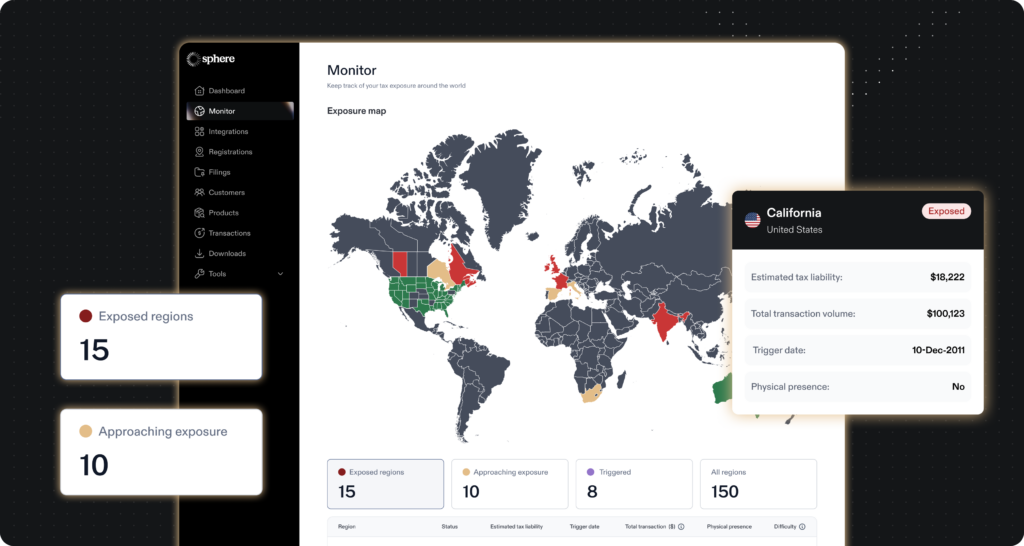
The engine powering Sphere’s global coverage is TRAM (Tax Review and Assessment Model) — built to continuously ingest tax law changes across 100+ regions and translate them into real-time rate decisions at the transaction level. Unlike rules-based engines that require manual updates when jurisdictions change thresholds or introduce new product exemptions, TRAM is designed to detect those shifts automatically and propagate corrections without human intervention. For SaaS companies selling across multiple countries, that self-updating architecture removes one of the most error-prone manual steps in cross-border compliance.
Sphere integrates with major billing platforms including Stripe and Campfire, and its setup runs in under 24 hours for most implementations. Support is delivered 24/7 via Slack with access to real tax experts — a model that resonates with lean engineering and finance teams at growth-stage startups.
Key features
- Global coverage: US sales tax + VAT/GST across 100+ regions — single platform for international and domestic
- Flat-rate per-region pricing — no per-transaction fees, no annual contracts
- TRAM engine — proprietary, purpose-built for continuous tax code monitoring across 100+ jurisdictions
- Real-time tax calculation via Stripe, Campfire, and major billing integrations
- Filing directly with state and national tax authorities
- Electronic remittance across supported regions
- 24/7 Slack-based support with real tax experts
- Setup under 24 hours — no multi-week implementation project
Strengths
- Strongest global coverage in this comparison — single platform for US sales tax and 100+ international regions
- Transparent flat-rate pricing — easy to budget with no transaction fees
- Fast setup — live in under 24 hours for most implementations
- Strong funding validation — a16z and Felicis-led Series A (Nov 2025)
- Proprietary TRAM engine — purpose-built for continuous global tax code monitoring
- 24/7 Slack support with real tax experts — responsive and accessible
Best for
Sphere is built for SaaS and digital product companies selling across multiple countries. If you need US compliance and international VAT/GST in one platform, Sphere is the strongest fit. VC-backed startups will also find Sphere’s a16z backing a credibility signal with their own investors.
3. Kintsugi — accessible compliance for small businesses
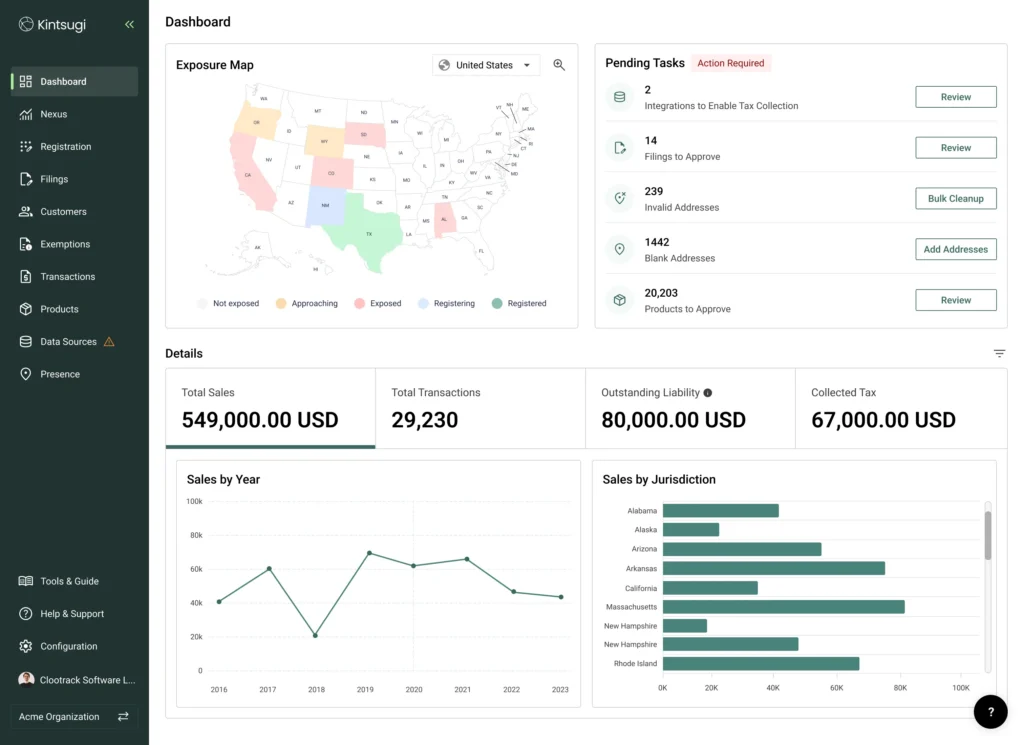
Kintsugi is an automation-driven sales tax platform targeting small to mid-size ecommerce and SaaS businesses. Founded in 2022, Kintsugi built its early reputation on two things: accessible pricing and a clean, modern UI that made getting started genuinely easy — particularly for Shopify and Stripe merchants.
In 2025, Kintsugi made two significant moves that shifted its positioning. It reached a $150 million valuation in April after announcing a $15 million strategic investment from Vertex and an additional $3 million from existing investors. Later, in October 2025, the companies launched “Kintsugi powered by Vertex.”
That Vertex partnership is worth a closer look. The product — “Kintsugi powered by Vertex” — combines Kintsugi’s modern integrations and automated workflows with Vertex Inc.’s enterprise tax content and global rules, including a new NetSuite integration for enterprise ERP users. That’s a real capability upgrade. But Vertex Inc. is also a legacy competitor in the broader tax software category, which means Kintsugi is now partially owned and influenced by a vendor whose interests may not always align with Kintsugi’s customers. Buyers evaluating a long-term compliance partner should factor that in.
Key features
- Accessible pricing tier for nexus monitoring
- No-code integrations: QuickBooks, Stripe, Chargebee, BigCommerce
- Machine learning-powered product categorization
- Shopify App Store availability — easy install for Shopify merchants
- “Kintsugi powered by Vertex” — enterprise tax data and NetSuite integration
- Notice handling and real-time liability dashboards
- Open API
Strengths
- Accessible entry pricing — useful low-cost entry point before scaling
- Clean, modern UI
- Shopify App Store native — one of the easiest setups for Shopify merchants
- “Kintsugi powered by Vertex” adds NetSuite integration and enterprise-grade tax content
- Fast-moving product team shipping regular feature updates
Best for
Small to mid-size businesses primarily selling in the US — especially Shopify and Stripe merchants who want accessible entry pricing. The “Kintsugi powered by Vertex” product expands the platform’s credibility for mid-market ERP users, particularly those on NetSuite. For a full look at the category, the best sales tax software for small businesses guide covers the leading options in depth.
Pricing
Kintsugi offers multiple pricing tiers including an accessible entry option. Pricing scales based on filing volume and feature requirements.
The accessible entry tier is a genuine differentiator. That’s the natural reassessment point — where exploring Kintsugi alternatives becomes worth the time.
Feature-by-feature comparison: Zamp vs Sphere vs Kintsugi
| Feature | Zamp | Sphere | Kintsugi |
|---|---|---|---|
| Platform type | Fully managed service | Self-service tool | Self-service tool |
| US sales tax coverage | 13,000+ jurisdictions | ||
| International (VAT/GST) | 70+ countries | 100+ regions | VAT/GST and multi-country support |
| Nexus monitoring | 80% pre-threshold | Available | |
| State registrations | Managed end-to-end | ||
| Filing automation | Managed + guaranteed | ||
| Notice management | 75,000+ handled | Partial | |
| Audit support | Full audit defense | Not confirmed | Limited |
| Liability model | Zamp shares liability | Customer-managed | Automation-led, with plan-dependent protections |
| Shopify integration | App Store native | ||
| NetSuite integration | Limited | via Kintsugi/Vertex | |
| Free tier | Demo available | None | Nexus monitoring |
| Onboarding time | <2 hours average | <24 hours | Fast |
| Support access | <1 hr response, phone | 24/7 Slack | |
| Proprietary engine | Intelligent platform | TRAM | ML categorization |
| IDC analyst recognition | Major Player (2024) | None | None |
Final verdict
The Zamp vs Sphere vs Kintsugi choice comes down to how much compliance risk your business can afford to own. All three are legitimate modern alternatives to legacy tools like Avalara and TaxJar — the right fit depends entirely on where your company sits today:
- For global SaaS with international revenue, Sphere is the strongest fit. If you sell across multiple countries and want US + VAT/GST handled in one platform with predictable per-region pricing, Sphere’s TRAM technology and a16z-backed funding make it a credible choice for growth-stage companies with global customers.
- For small US-focused businesses and Shopify merchants, Kintsugi is the better starting point. The accessible entry pricing, Shopify App Store integration, and modern UI make it an accessible option — particularly for companies approaching economic nexus thresholds for the first time. The Vertex partnership adds mid-market credibility but introduces a long-term independence question worth keeping in mind.
- For companies where compliance risk is real and someone needs to own it, Zamp is in a different category. IDC MarketScape Major Player recognition — and most importantly, shared liability — put Zamp ahead of any self-service alternative. It’s not the cheapest option and it’s not self-service. It’s the last sales tax service you’ll ever need.
Frequently asked questions
What separates Sphere and Kintsugi in this comparison?
Sphere and Kintsugi are both self-service automation-native sales tax platforms — neither is a managed service. Sphere focuses on global coverage across 100+ regions with flat per-region pricing, making it best for SaaS companies with international customers. Kintsugi is especially strong with small and mid-size businesses, with an accessible entry point for US filing needs and a broader platform that now extends into VAT/GST and multi-country workflows.
Is Kintsugi good for small businesses?
Yes, Kintsugi is well-suited for small businesses. Its accessible entry pricing lets you start at low cost, and the platform keeps expenses manageable for businesses with simpler filing footprints. As you scale filing volume significantly, the pricing structure becomes a line item worth reassessing against managed service alternatives.
Does Sphere support international VAT and GST?
Yes. Sphere covers US sales tax and international VAT/GST across 100+ regions through its proprietary TRAM (Tax Review and Assessment Model) engine. This is one of Sphere’s strongest differentiators. Zamp also covers international compliance across 70+ countries, handled fully managed by its dedicated tax team.
What is the best AI sales tax software in 2026?
The best platform depends on your business profile. Sphere is the best choice for global SaaS companies needing US + international compliance in one tool. Kintsugi offers an accessible entry point for small US businesses. Zamp is the best choice for companies that want a fully managed service where someone else owns the compliance outcome — and the liability. Zamp is also the only platform in this comparison with IDC MarketScape analyst recognition in 2024.
How much does Sphere cost per month?
Sphere operates on a per-region pricing model with no per-transaction fees and no annual contracts. The pricing structure is transparent and scales with your geographic footprint, making it easy to budget without surprise transaction-based charges.
Is Kintsugi powered by Vertex the same as Kintsugi?
Not exactly. “Kintsugi powered by Vertex” is a joint product launched in October 2025 that combines Kintsugi’s modern integrations and automated workflows with Vertex Inc.’s enterprise tax content and global rules. It is a distinct product tier aimed at enterprise ERP users — specifically those on NetSuite — rather than the standard Kintsugi offering.
Does Zamp handle international tax compliance?
Yes. Zamp covers real-time rooftop-accurate rates across 13,000+ U.S. jurisdictions and 70+ countries for global VAT/GST compliance. International coverage is handled by the same dedicated tax professionals who manage US registrations and filings — fully managed, not self-service. Zamp’s team includes former state auditors with 400 years of combined expertise.
Managed vs self-service sales tax: what’s the difference?
Self-service platforms like Sphere and Kintsugi provide automation tools — your team configures the system, reviews filings, manages exceptions, and handles any errors. Managed services like Zamp provide a dedicated team that owns the entire process end-to-end. With Zamp’s “done for you or done with you” model, if an error is made, Zamp covers the penalties and interest — eliminating internal tax work and transferring compliance risk away from your finance team.
Which is better for SaaS companies — Sphere or Zamp?
For SaaS companies with global revenue across multiple countries, Sphere is the strongest fit due to its native US + VAT/GST coverage across 100+ regions in a single platform. For SaaS companies filing primarily in the US that want a fully managed outcome with zero internal tax work, Zamp is the better choice — particularly once filing volume grows beyond a handful of states or compliance risk becomes a real concern for a CFO or controller.
Does Zamp offer a free trial?
Zamp does not offer a self-service free trial. The standard path is a demo call where a Zamp compliance expert walks through your specific filing footprint, nexus exposure, and what the transition would look like. Most prospects receive a pricing proposal within 24–48 hours of the initial call. The Zamp pricing page has the demo request form.
How does Kintsugi compare to Sphere for US-only businesses?
For businesses selling exclusively in the US, Kintsugi’s accessible entry pricing and US-focused features are purpose-built for state-by-state compliance, while Sphere’s per-region pricing model is optimized for companies operating across multiple countries. Sphere’s global infrastructure adds cost and complexity that US-only businesses don’t need. Kintsugi’s Shopify App Store integration also gives it a meaningful setup advantage for US ecommerce merchants.