
Alex Steele
Writer




When growing e-commerce and SaaS companies evaluate sales tax compliance solutions, the choice between managed service providers carries significant weight. Two options—Zamp and HOST (Hands Off Sales Tax)—represent different eras in the compliance space. While HOST has operated as a boutique service provider since 1999, Zamp combines an intelligent platform with dedicated tax professionals to handle compliance end-to-end. This comparison shows why Zamp’s integrated approach delivers superior value for companies seeking modern, transparent, and fully managed sales tax compliance.
Zamp positions itself as the last sales tax service you’ll ever need—combining proprietary software with expert-led compliance management in a single solution. Based in Miami, Zamp has built its reputation serving 1,200+ finance teams with a team possessing 400 years of combined sales tax expertise. The company takes full ownership of outcomes, not just tools—handling everything from nexus monitoring to registrations, filings, and notice resolution.
HOST (Hands Off Sales Tax) operates as a traditional service provider, positioning itself as a “customer-obsessed sales tax support firm” that has been solving sales tax compliance for 25 years. Rather than offering proprietary software, HOST partners with existing tax tools like TaxJar and Avalara to provide a managed service layer on top of client-chosen platforms.
The fundamental difference: Zamp owns the entire solution stack, while HOST adds service capabilities to third-party software.
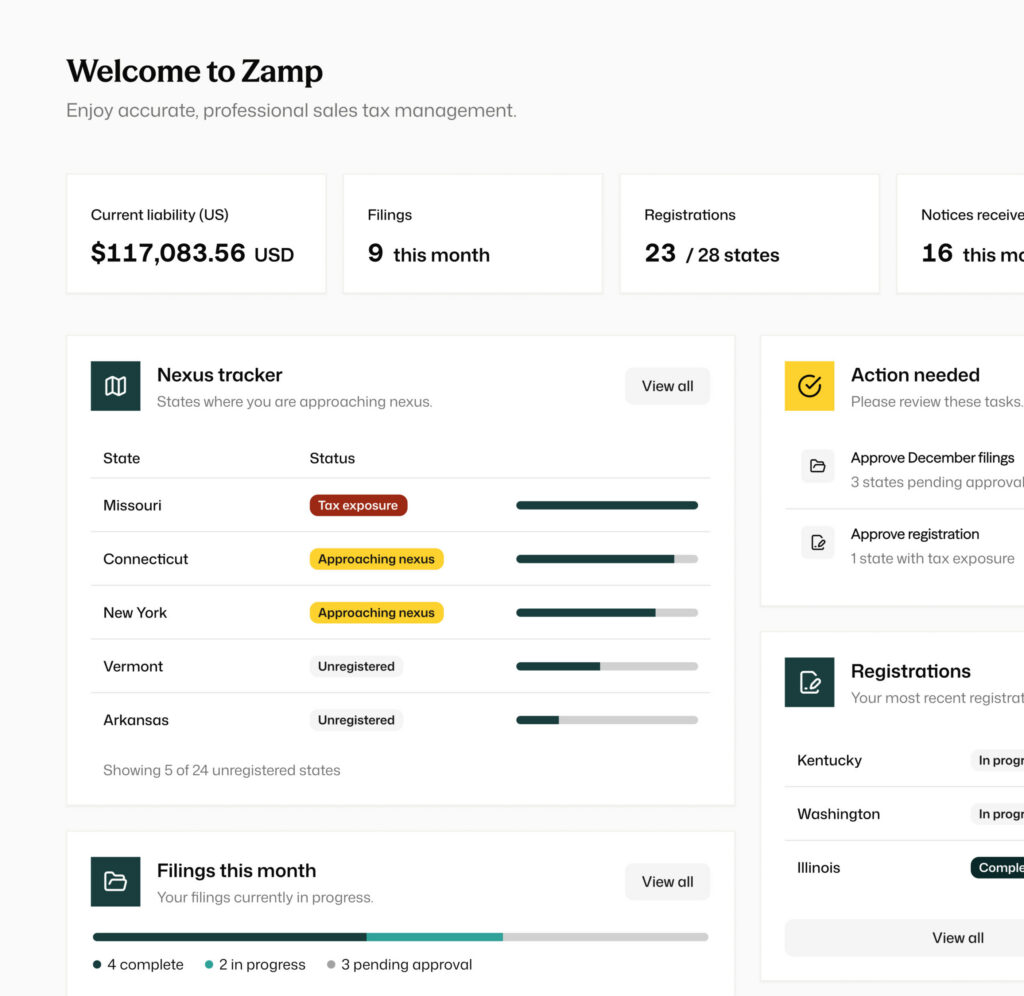
Zamp’s service portfolio delivers comprehensive, integrated compliance:
HOST’s service model relies on external software partnerships:
The critical distinction lies in execution speed and integration depth. Zamp delivers complete onboarding in under 2 hours with white-glove setup, while HOST’s timeline remains unspecified. For companies seeking SaaS sales tax or multi-channel e-commerce support, Zamp’s native platform eliminates the complexity of coordinating separate software and service relationships.
Zamp primarily serves three distinct customer profiles:
Notable Zamp clients include companies like David (sunglasses), Glamnetic (beauty), Puzzle (SaaS), and Tushy—spanning verticals from consumer goods to technology.
HOST primarily serves companies already using established tax software like TaxJar or Avalara who want managed service support added on top. Their boutique model appeals to businesses preferring personalized attention from a smaller firm.
For growing companies seeking a single partner to handle everything—without managing multiple vendor relationships—Zamp’s integrated model proves more efficient.
Both companies claim strong results, but the depth of verifiable data differs significantly.
Zamp’s quantified performance:
HOST’s claimed performance:
For finance leaders needing confidence in provider selection, verifiable metrics provide crucial reassurance.
Zamp’s methodology centers on full ownership and proactive service:
HOST’s methodology emphasizes personalized service:
For companies already using TaxJar or Avalara who want to add managed services, HOST provides continuity. However, for those seeking to consolidate vendors and eliminate software dependency, Zamp’s integrated approach delivers more efficiency.
Modern compliance requires seamless data flow. The integration capabilities between these providers differ substantially.
Zamp’s native integrations include:
HOST’s integration approach:
Zamp’s 15+ direct integrations enable real-time, bidirectional data sync. HOST’s export-based model requires manual data transfers—adding time and potential for errors.
For companies using Shopify, NetSuite, or Stripe, Zamp’s native connections eliminate middleware complexity entirely.
Accuracy in sales tax compliance directly impacts audit risk and customer relationships.
Zamp’s accuracy approach:
HOST’s accuracy approach:
The data ownership distinction matters significantly. Zamp maintains and verifies all tax data internally, enabling full transparency and audit-defensible records. Companies using third-party data sources inherit whatever limitations those sources carry.
For e-commerce and SaaS companies seeking sales tax compliance, Zamp offers clear advantages across every dimension that matters.
Speed and efficiency:
Solution completeness:
Technology depth:
Global capability:
Risk protection:
HOST’s 25-year track record demonstrates business stability—a fair point to acknowledge. For companies specifically wanting to keep existing TaxJar or Avalara setups while adding managed services, HOST offers that continuity.
But for companies seeking a single partner to own sales tax completely—with modern integrations, international capability, and quantified performance—Zamp represents the evolved standard in compliance.
Ready to see the difference? Companies switching from other providers can follow Zamp’s migration guide from Avalara or migration guide from TaxJar to get started.
Zamp provides a fully integrated platform combining proprietary tax calculations with managed compliance services—all from one provider. HOST operates as a managed service layer that works with third-party software like TaxJar or Avalara. This means Zamp clients work with a single vendor that owns the entire outcome, while HOST clients must maintain separate software relationships. Zamp’s integrated approach eliminates coordination complexity and ensures data consistency throughout the compliance process.
Zamp uses rooftop-accurate calculations based on geospatial coordinates, covering 13,000+ U.S. jurisdictions with first-party tax content maintained internally. This approach achieves high filing accuracy standards and enables Zamp to explain exactly why any transaction was taxed a specific way. HOST relies on third-party software (TaxJar or Avalara) for calculations, which means accuracy depends on the partner platform’s data quality rather than being controlled directly.
Yes. Zamp provides VAT and GST compliance across 70+ countries, including multi-region calculations, location validation, threshold monitoring, and unified multi-country filing. HOST focuses exclusively on U.S. sales tax compliance. For companies selling internationally or planning global expansion, Zamp offers a single platform for both domestic and international indirect tax obligations—eliminating the need for separate providers.
Zamp delivers sub-1-hour support response times with dedicated Account Managers and direct phone access. Every client receives white-glove onboarding completed in under 2 hours on average. HOST provides responsive support according to customer testimonials, with a personalized boutique approach from their smaller team. The support speed difference matters significantly during urgent compliance situations like state notices or audit inquiries.
Zamp specifically serves e-commerce and SaaS companies with $1M-$200M in revenue facing complex compliance challenges—including product taxability variations, marketplace facilitator laws, remote employee nexus, and usage-based billing. The platform includes 15+ native integrations with Shopify, Amazon, NetSuite, Stripe, and other major platforms. With customers saving 20 hours monthly on average, Zamp demonstrates strong fit for high-growth companies needing scalable compliance without adding internal headcount.
.png)
%20(1).png)