
Alex Steele
Writer



When scaling businesses need to get sales tax compliance right, choosing between providers becomes a critical decision. Two options—Zamp and Anrok—represent fundamentally different approaches to solving the same problem. While Anrok operates as a self-service software platform requiring your team to manage compliance, Zamp combines an intelligent platform with dedicated tax professionals who handle everything from registration to filing to notice resolution. This comparison shows why Zamp’s fully managed approach delivers superior results for companies that want compliance owned, not just enabled.
Zamp positions itself as “the last sales tax service you’ll ever need”—a fully managed solution that owns the outcome, not just the software. Founded after the 2018 Wayfair decision, Zamp has built its reputation on combining technology with 400 years of combined tax expertise across its team. The company serves 1,200+ finance teams and has completed 100K+ on-time filings while handling 75K+ notices.
Anrok takes a different approach. Founded by experienced operators and valued at $525 million, Anrok built a self-service platform primarily for SaaS companies. The platform automates calculations and filing workflows, but customers remain responsible for managing their own compliance. While Anrok has raised $110 million in funding and earned recognition as G2’s fastest-growing Sales Tax & VAT product, their model still places the compliance burden on internal teams.
The fundamental difference: Anrok gives you tools to manage sales tax yourself. Zamp takes care of everything so you don’t have to.
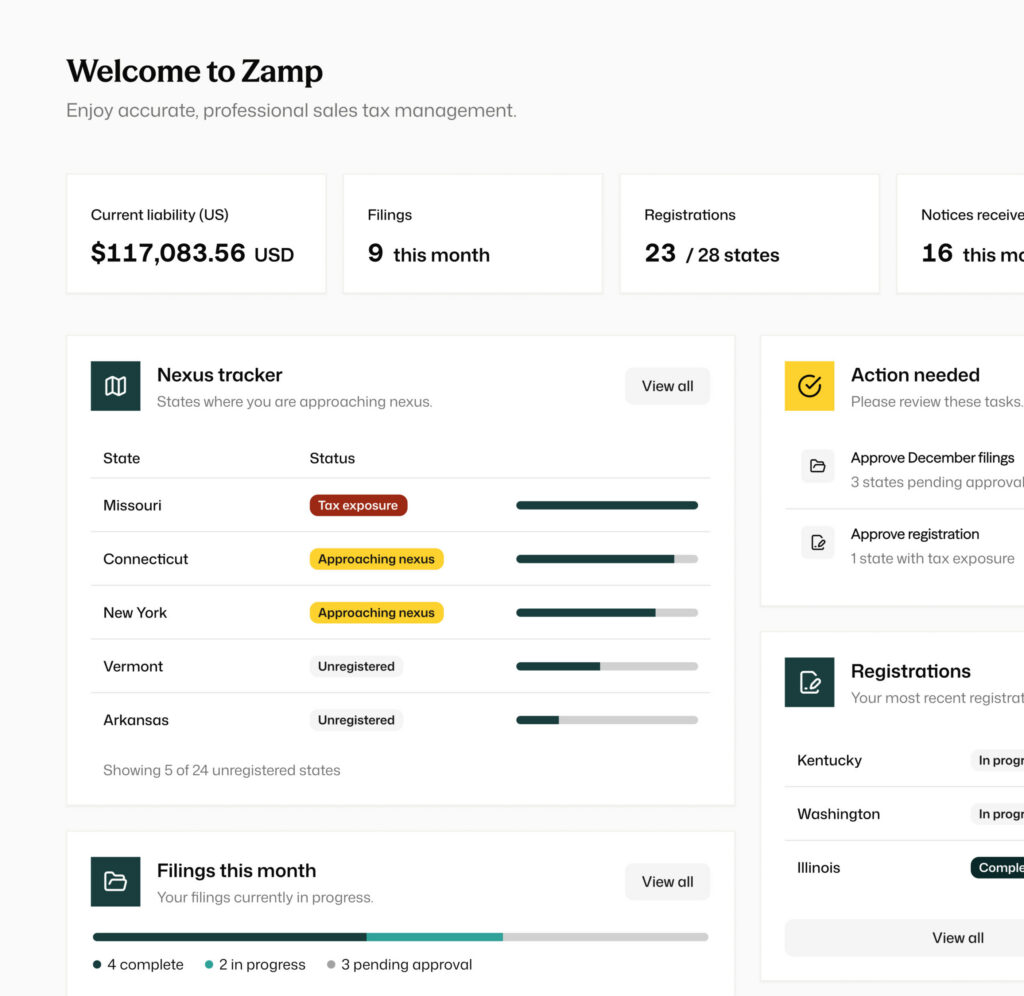
Zamp’s “Done-for-You” approach includes:
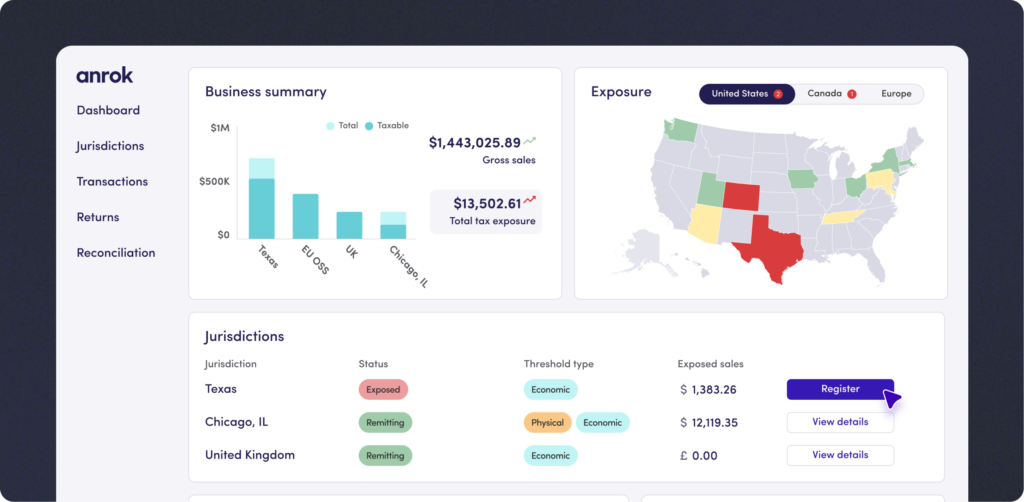
Anrok’s self-service model provides:
The service model difference matters significantly. With Anrok, your finance team must configure integrations, monitor thresholds, approve filings, and handle state correspondence. With Zamp, your team simply reviews and approves—or delegates entirely. When your CFO asks “why was this taxed this way?” Zamp can answer directly. With self-service platforms, you’re on your own.
Zamp primarily serves:
Anrok primarily serves:
This distinction matters. If your business has product taxability complexity across multiple categories, marketplace facilitator law questions, or 3PL/FBA nexus concerns, Zamp’s expert team handles that research for you. With Anrok, you’re researching and configuring those rules yourself.
Both companies publish impressive metrics, but the service experience tells a more complete story.
Zamp’s verified performance:
Anrok’s performance metrics:
Both platforms offer extensive integration ecosystems, but with different emphases.
Zamp integrates with:
Anrok integrates with:
Anrok’s HR integration represents a genuine differentiator—tracking employee-triggered nexus automatically for distributed teams. However, Zamp’s tax experts manually monitor all nexus triggers as part of the managed service, delivering proactive alerts without requiring integration setup.
The setup experience also differs. Zamp’s white-glove onboarding means specialists extract and migrate your historical data while you simply review. With Anrok, customers manage their own data migration with ticket-based support.
Fair assessment requires acknowledging where Anrok excels:
However, once companies reach meaningful revenue and want compliance truly handled, Zamp’s managed service delivers better outcomes at lower total cost.
Companies seeking sales tax compliance face a fundamental choice: manage it yourself with software, or let experts handle everything.
Zamp wins for these reasons:
For e-commerce brands managing product taxability across categories, SaaS companies dealing with state-by-state rules, and accounting firms seeking white-label solutions, Zamp represents the evolved approach to sales tax compliance. The combination of expert service, predictable costs, and genuine partnership creates value that software-only platforms cannot match.
Sales tax is complex. Paying for it—and managing it—shouldn’t be. Get started with Zamp and see the difference a managed service makes.
Zamp provides fully managed sales tax compliance where dedicated tax professionals handle everything—registrations, calculations, filings, and notice resolution. Anrok offers self-service software where your team configures and manages compliance using their platform. With Zamp, you simply review and approve. With Anrok, you’re responsible for setup, monitoring, and execution. This fundamental difference affects time investment, accuracy, and peace of mind.
Zamp uses rooftop-accurate calculations based on geospatial coordinates rather than ZIP codes, ensuring precise tax rates down to the exact address. The company owns and verifies all tax data internally, while competitors often buy stale third-party data. When questions arise about why something was taxed a certain way, Zamp’s experts can provide definitive answers because they control the entire data chain.
Yes. Zamp serves both e-commerce brands managing multi-channel sales and SaaS companies dealing with complex taxability rules. E-commerce customers benefit from expertise in product taxability, marketplace facilitator laws, and 3PL nexus. SaaS customers get guidance on state-by-state software taxability, remote employee nexus, and usage-based billing complexity. The managed service model adapts to each company’s specific needs.
Zamp charges all-inclusive monthly fees based on state coverage—everything from software to service to filings included. This predictable model means costs remain consistent regardless of revenue growth. Anrok charges a base subscription plus a percentage of taxable revenue, which creates variable costs that increase as your business scales. For growing businesses, Zamp’s predictable model provides better cost certainty and typically proves more economical at scale.
Zamp provides global VAT and GST managed services covering 70+ countries, including multi-region calculations, threshold monitoring, registration support, and unified filing. While Anrok covers more jurisdictions (100+), Zamp’s managed approach means experts handle international complexity rather than your team configuring rules themselves. For most US-based businesses expanding internationally, Zamp’s coverage combined with expert handling delivers superior outcomes.
.png)
%20(1).png)