


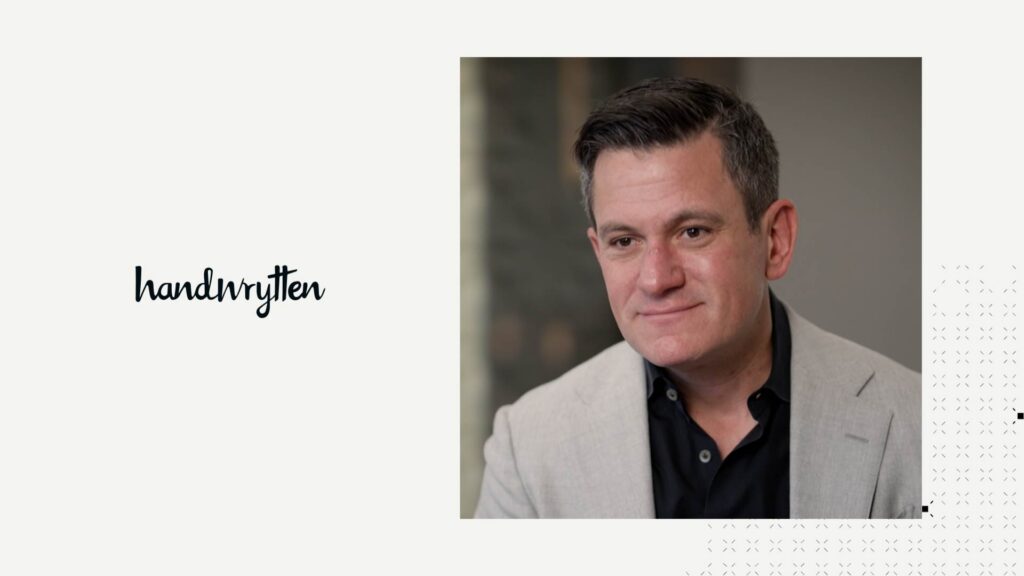
David Wachs has spent his career thinking about communication at scale.
First it was text messaging. His company grew to the point where they were sending a million texts a day for a single retailer. Eventually, he sold it. And when it came time to thank the people who helped build it, he sat down to write handwritten notes.
Hand cramped, out of ink, and running out of postage. “There had to be a better way,” he thought. So he built one.
Today, Handwrytten operates a fleet of robots that hold real pens and write out handwritten notes on behalf of 50,000+ businesses worldwide. On a given day, they process 30,000 to 50,000 card and envelope pairs. The notes go to veterinary patients, nonprofit donors, car buyers, piano tuning customers, and thousands of other recipients who open the envelope not knowing a robot was behind it.
“You did something different to stand out in the clutter of sameness,” David says. “Even if they know it was written by a robot.”
It’s easily one of the most counterintuitive ideas in business: slow, personal, handwritten — delivered at enterprise scale. As one of the Handwrytten team members put it, “the most old-school concept, run by the most futuristic technology.”
Sales Tax Wasn’t Part of the Vision
Running a 24/7 robot operation means David’s team is always on. The robots don’t stop. The orders don’t stop. And for a while, the sales tax headaches didn’t stop either.
Post-South Dakota v. Wayfair, economic nexus rules spread across the country fast. Suddenly, a business shipping cards and envelopes to customers in 50 states had compliance obligations in states it had never touched operationally. Each state handled it a little differently. The rules kept changing. So David and his team sought help from one of the most well known providers in the industry, and despite the price tag, they just weren’t much help.
“They were the most customer-hating company in the world,” David says. “You’d call them and have no opportunity to speak to anybody. If you needed genuine help, they’d just throw the book at you.”
The 10,000-page wiki wasn’t cutting it. Getting someone on the phone was a battle. Certainty, which David calls critical, was low. His bookkeeper was spending two-plus hours every week just on sales tax. As a percentage of what a small business pushing cards and envelopes should be worrying about, the math didn’t add up.
“The amount we were spending on monthly compliance reporting was simply too much. Especially since all they did was hand it back to us.”
Finding a Different Kind of Partner
When David started looking for an alternative, he interviewed two or three companies. His conversation with Matt and the team at Zamp stood out immediately.
“He really seemed to understand what we needed and how to improve the situation for us.”
The platform was fully built out. The migration was supported end-to-end. And critically, there were real people David could talk to. No guessing. No wikis. No hoping someone in the United States picks up.
He also got substantially better pricing than he was paying before.
“Between the hand holding, which was critical, and the better pricing, it seemed like an obvious decision.”
What Changed
The results weren’t abstract.
Handwrytten’s bookkeeper went from spending two-plus hours per week on sales tax to about two hours per month. That’s a 75% reduction in time spent on compliance. The data flows correctly. New states get onboarded faster and more cleanly than before.
And the people who need to be reachable actually are.
“They understand we are working 24 hours a day, literally, with robots running 24/7. But they are there as well.”
David specifically calls out Chris on Zamp’s IT team for responding on weekends and nights. Not because it’s expected, but because Zamp seems to get what it means to run a business that never stops.
“We know that if we do have an issue where something needs to happen, we can count on them to understand us and support us.”
That kind of certainty matters. For a founder who spent years second-guessing his old vendor’s answers, knowing the data is right and help is a call away isn’t a small thing.
The Bigger Picture
David sees real stakes ahead for businesses like his.
AI is flooding inboxes. Personalized emails, perfectly written, sent by tools nobody admits to using. Recipients are already conditioned to wonder: is this real? Was this actually written by a person? Even the most sincere digital message carries that ambient doubt now.
Handwrytten sits on the other side of that problem. A physical note in an envelope, written in pen, addressed by hand. When it lands on a doormat, it carries weight that a notification never can.
“You, as a person, are going to discount that email and feel maybe this was written by a robot. But they don’t realize that handwritten notes can be automated too. And because of that, it creates a much stronger bond.”
David points to one of his favorite customer stories: a piano tuner in Pennsylvania who sets up a note to go out automatically one year after each visit. When he shows up to retune the piano, the card is often still displayed on top of it. Not filed away. Not thrown out. On display, alongside graduation announcements and wedding photos.
“You cannot buy that real estate as a marketer or a brand.”
The robots write the notes. Zamp handles the tax. And David Wachs focuses on building a business that helps people feel something.
That’s the model.

Brandon Roth