




Zamp is the best sales tax platform in this comparison. It’s the only fully managed option where a team of tax professionals handles registrations, filings, notices, and audit defense end-to-end, with liability coverage included. TaxJar is the best low-cost entry for small U.S.-only sellers. Vertex is purpose-built for Fortune 500 enterprises with Oracle or SAP infrastructure.
If you’re evaluating sales tax platforms, you’ve probably run into the same frustration: TaxJar locks you into a DIY model that breaks at scale, Vertex requires months of implementation and a consulting budget most growing companies don’t have, and nobody is quite sure how managed services like Zamp actually work in practice.
This guide compares all three, with real pricing, honest pros and cons, and a clear verdict on which platform fits which team.
Key takeaways
- Zamp is the only option in this comparison that takes on liability, if Zamp makes an error or misses a deadline, Zamp covers the penalties and interest.
- TaxJar is the lowest-cost entry point for small U.S. ecommerce businesses selling via Shopify or Stripe, but the liability stays entirely with your team.
- Vertex belongs in Fortune 500 finance stacks with existing Oracle or SAP ERP infrastructure and a dedicated in-house tax team.
- Vertex uses custom enterprise pricing, which can become expensive as implementation scope, modules, and contract terms expand; Zamp uses custom-scoped, all-in-one managed-service pricing based on your actual compliance footprint.
- For SaaS companies and ecommerce brands past the $5M GMV threshold, the DIY compliance model TaxJar requires becomes a full-time burden.
- Zamp’s average onboarding time is under 2 hours, compared to months for Vertex.
Why teams look for a better sales tax platform
Most finance teams don’t go shopping for sales tax tools because things are going well.
They look when a state notice lands in the inbox. Or when a filing is missed because the DIY software flagged a threshold after the deadline. Or when per-return fees from TaxJar balloon beyond what the CFO expected. Or when a Vertex implementation hits month four and the system still isn’t live.
The three platforms in this comparison were built with very different problems in mind, and choosing the wrong one creates real compliance exposure. Here’s how to tell them apart.
What separates these three platforms?
TaxJar, Vertex, and Zamp serve fundamentally different markets. TaxJar is DIY software for small-to-mid ecommerce, Vertex is a self-managed enterprise tax engine, and Zamp is a fully managed compliance service, where human experts, not just software, own every outcome from nexus monitoring through audit defense.
That core distinction, DIY software vs. managed service, matters more than any individual feature. With TaxJar and Vertex, your finance team still owns the liability, still manages configurations, and still needs to understand what they’re doing. With Zamp, you approve; Zamp executes.
Zamp, Best overall: managed sales tax compliance
G2 Rating: 4.9/5 | U.S. jurisdictions: 13,000+ | Starting price: custom pricing (contact for quote)
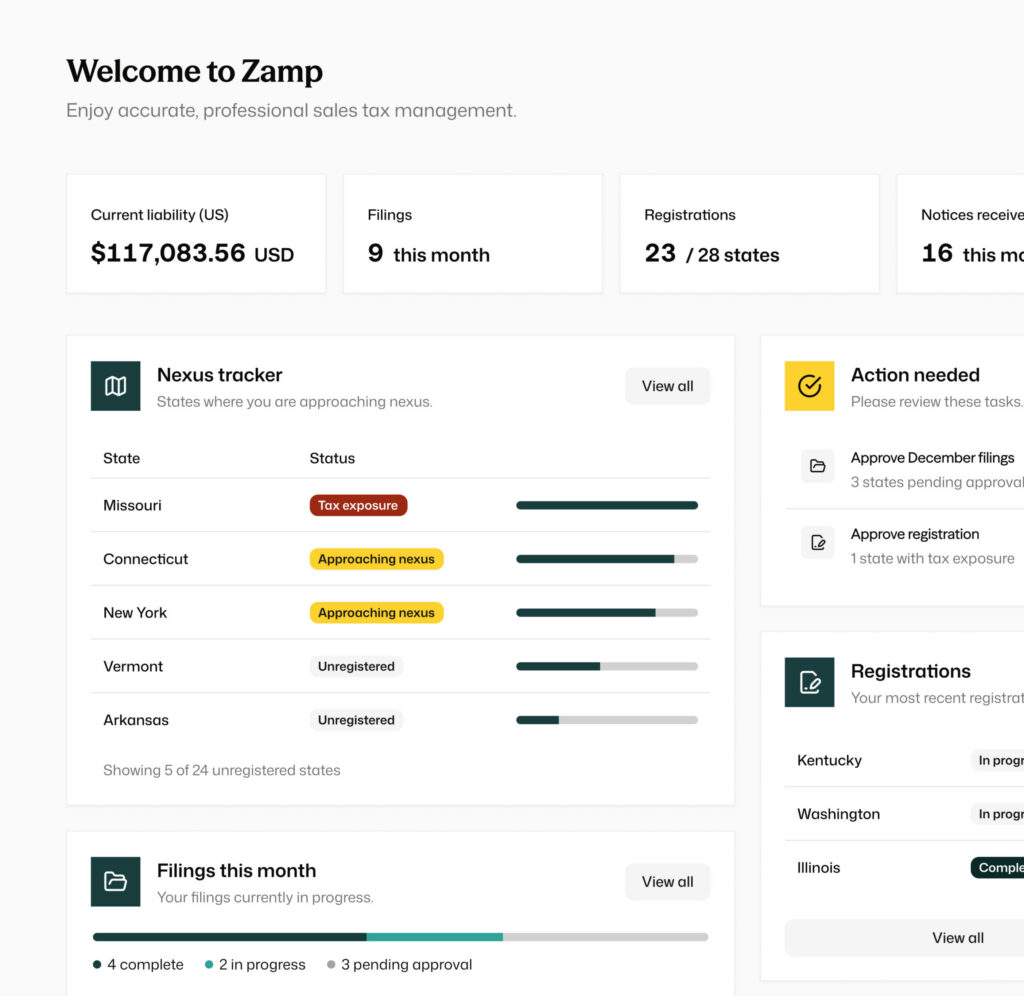
Zamp is the last sales tax service you’ll ever need for ecommerce and SaaS businesses that want compliance completely off their plate. Unlike TaxJar or Vertex, where your team still owns the liability and the work, Zamp provides an intelligent platform backed by a team of tax professionals who take care of everything: registrations, filings, notices, and audit defense, from start to finish.
The team includes former state auditors with 400 years of combined sales tax expertise. When an issue arises, you’re talking to humans who know sales tax law, not submitting support tickets to a queue. Zamp also takes on liability: if Zamp makes an error or misses a deadline, Zamp covers the penalties and interest. Not your company.
Zamp offers two service models, done for you (Zamp handles everything; you approve) or done with you (you review with more oversight; Zamp executes), so it fits both finance teams that want to fully offload compliance and controllers who prefer holding the keys.
Key features
- Real-time rooftop-accurate tax rates across 13,000+ U.S. jurisdictions and 70+ countries (VAT/GST)
- Proactive nexus monitoring, 80% of nexus alerts land before the threshold is crossed
- Registrations and filings managed end-to-end by Zamp’s tax team
- Proactive notice management, 75K+ notices handled
- Audit defense and support, Zamp handles the defense, not just the filing
- Past-due returns and registration cleanup for companies with historical exposure
- First-party tax content, Zamp owns and verifies all tax data (not sourced from third-party providers)
- Two service models: done for you or done with you
Pros
- The only fully managed option, your finance team doesn’t own the compliance work
- Liability sharing, if Zamp makes an error or misses a deadline, Zamp covers the penalties and interest, not you
- Real-time rooftop-accurate rates, more precise than TaxJar’s zip-code-level calculations
- G2 awards: Best Support, Easiest Setup, Easiest to Use, and Best Meets Requirements
- Average onboarding time under 2 hours, compared to months for Vertex
- Transparent, custom-scoped all-in-one pricing, no per-transaction fees, no per-filing fees, no surprise invoices
- 97.8% customer retention in 2025, 1,200+ finance and accounting teams served
- 100K+ filings completed on-time; 200K+ hours saved for finance teams
- Proactive notice management, state notices reach Zamp before they reach your inbox
- Named Major Player in two 2024 IDC MarketScape reports
Considerations
- Higher starting price than TaxJar’s entry tier, Zamp is purpose-built for companies with real compliance needs, not very early-stage sellers with minimal footprint
- Fewer out-of-the-box marketplace seller tool connectors than TaxJar for sellers exclusively on Shopify or Amazon with simple U.S.-only needs
Best for
Ecommerce and SaaS businesses from startups to $300M+ that want sales tax completely off their plate. Companies evaluating their first real compliance solution. Finance teams burned by legacy providers and surprise invoices. Any company that needs both U.S. and international coverage from a single managed partner.
Pricing
Custom pricing scoped to your compliance footprint, contact Zamp for a quote. All-in-one pricing with no per-transaction fees or per-filing fees. Registrations and filings, notices, and white-glove support included. Pricing is based on your actual business footprint rather than fixed per-state pricing or automatic increases as you grow.
TaxJar, low-cost U.S. sales tax for ecommerce
G2 Rating: 4.7/5 (249 reviews) | Platforms: Shopify, WooCommerce, BigCommerce, Amazon, eBay | Starting price: $39/month
TaxJar launched in 2013 as one of the first cloud-based sales tax tools for ecommerce sellers. It was acquired by Stripe in April 2021 for $850–$900 million, and its product roadmap has shifted meaningfully toward Stripe Tax since then.
For small U.S. ecommerce businesses with straightforward compliance needs and a Shopify-native stack, TaxJar gets the job done at a low entry price. At scale, more states, more volume, international exposure, the limitations become material.
Key features
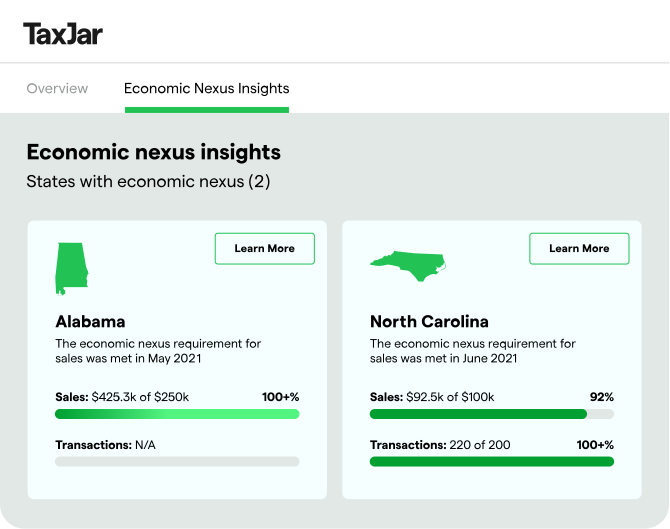
- Nexus tracking dashboard with threshold alerts across U.S. states
- Tax rate calculations (rooftop/address-level accuracy when full address data is provided)
- Automated filing for U.S. states (via add-on per-return fees)
- API-first architecture for custom integrations
- Native connectors for Shopify, WooCommerce, BigCommerce, Amazon, and eBay
Pros
- Low entry cost, $39/month to start
- Quick setup with major ecommerce platforms
- Clean UI that non-tax professionals can use
- Transparent pricing at lower volume tiers
- Strong Shopify and Stripe ecosystem fit
Best for
Small-to-mid ecommerce businesses selling exclusively in the U.S. via Shopify, WooCommerce, or Stripe, with straightforward tax needs and under $1M GMV. Not the right fit for teams that have outgrown basic compliance or have any international exposure. For a direct feature comparison, see the Zamp vs TaxJar breakdown.
Pricing
Starts at $39/month (200 orders). Professional tier at $99/month. Phone support available on Professional plan for higher order tiers. Automated filing fees of $50–$55 per return beyond included credits, per TaxCloud’s pricing analysis. A company filing in 20 states could add $1,000+/month in filing fees on top of the base plan.
3. Vertex, enterprise tax engine for global compliance
G2 Rating: 4.4/5 (459 reviews) | Jurisdictions: 20,000+ across 195+ countries | Starting price: custom enterprise pricing (contact for quote)
Vertex has been building tax technology since 1978. With over 45 years of tax research and 800 million+ effective tax rules in its database, it’s the platform that large enterprises typically reach for when they need deep ERP integration and global indirect tax coverage.
For the Fortune 500 companies Vertex is built for, with existing Oracle or SAP infrastructure and a dedicated in-house tax team, it’s a credible choice. For growth-stage companies without those resources, the implementation timeline and cost structure make it a poor fit.
Key features
- 20,000+ tax jurisdictions across 195+ countries
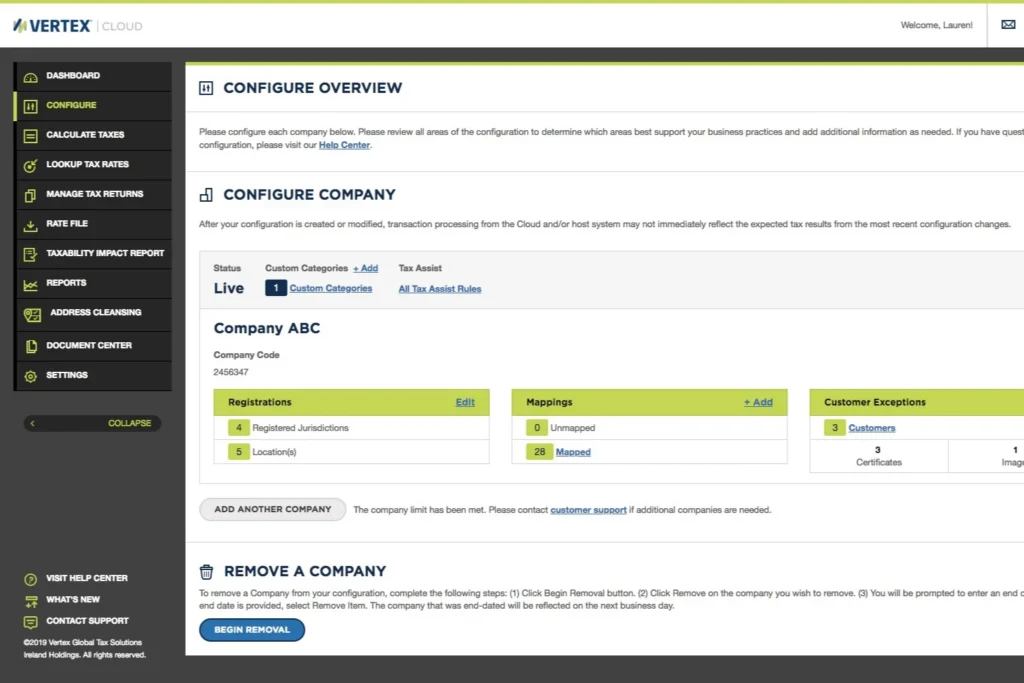
- Deep ERP integrations: Oracle, SAP, NetSuite, and Salesforce
- Coverage beyond sales tax, VAT, GST, customs duties, and e-invoicing
- Enterprise-grade audit performance
Pros
- Broadest geographic coverage in the category, 195+ countries
- Deepest ERP integrations for Oracle/SAP environments
- Handles the full range of indirect taxes: VAT, GST, customs duties
- Enterprise-grade audit performance for Fortune 500 requirements
- Founded 1978, decades of tax research and institutional knowledge
- Respected by enterprise tax teams who know the platform well
Best for
Fortune 500 and large enterprise companies with existing Oracle or SAP ERP infrastructure, complex global indirect tax requirements, and a dedicated in-house tax team with IT resources for implementation. Outside that context, the cost and complexity are genuinely prohibitive. For a direct comparison to Zamp, see the Zamp vs Vertex breakdown.
Pricing
Vertex does not publish public pricing. Pricing is custom and typically depends on factors like company size, transaction volume, modules, and implementation scope. Enterprise deployments may also involve separate implementation or consulting costs.
Zamp vs TaxJar vs Vertex: feature comparison
Zamp, TaxJar, and Vertex are three distinct sales tax platforms built for different business sizes and service models. Zamp is a fully managed compliance service (custom pricing) where tax professionals handle filings and take on liability. TaxJar is self-service software starting at $39/month, U.S.-only. Vertex is an enterprise tax engine for Fortune 500 companies with custom enterprise pricing.
| Feature | Zamp | TaxJar | Vertex |
|---|---|---|---|
| Service model | Fully managed service | DIY software | DIY software (enterprise) |
| Geographic coverage | 13,000+ U.S. jurisdictions + 70+ countries | U.S. only | 195+ countries, 20,000+ jurisdictions |
| Tax rate accuracy | Real-time rooftop-accurate (address-level) | Zip-code level | Address-level (enterprise) |
| Pricing model | Custom-scoped, all-in-one pricing; no per-transaction fees | Tiered by order volume + per-filing fees | Custom enterprise pricing |
| Starting price | Custom pricing (contact for quote) | $39/month | Custom enterprise pricing |
| Onboarding time | Under 2 hours | Hours–days | Months (requires consultants) |
| Phone support | Included; <1 hour average response | Professional plan (higher order tiers) only | Available (poor response ratings) |
| Audit defense | Included | Not included | Available |
| Liability coverage | Zamp covers penalties and interest for Zamp errors | None, customer owns risk | None, customer owns risk |
| International (VAT/GST) | Yes, 70+ countries | No | Yes |
| Nexus monitoring | Proactive, 80% of alerts pre-threshold | Dashboard (reactive alerts) | Available |
| Best for | Growth-stage ecommerce and SaaS | Small U.S. ecommerce | Fortune 500 enterprise |
Pricing breakdown: what each platform actually costs
Comparing pricing across these three platforms requires looking beyond the headline number.
Zamp: Custom pricing scoped to your compliance footprint, contact Zamp for a quote. No per-transaction fees, no per-filing fees, no surprise invoices. Registrations, filings, notices, and support are included. Pricing is all-in-one and based on your actual footprint, not fixed per-state pricing. For finance teams that have experienced unexpected bills from previous sales tax tools, Zamp’s transparent pricing model is a meaningful shift from the norm.
TaxJar: Entry pricing starts at $39/month, but the true cost scales with volume and filing activity. Phone support is available on the Professional plan for higher order tiers. Automated filing fees run $50–$55 per return beyond included credits. A company filing in 20 states could add $1,000+/month in filing fees on top of the base plan.
Vertex: Pricing is not public and scales with your company’s revenue, meaning costs grow proportionally with business growth, independent of whether you’re using more features. The standard 9% annual renewal increase is built in. Enterprise implementations often require six-figure consulting fees on top of the software license.
What happened to TaxJar after Stripe acquired it?
Stripe’s acquisition of TaxJar in April 2021 for $850–$900 million was the largest deal in sales tax software history. For TaxJar customers, the impact became visible over the following three years.
The original founding team exited: CEO Mark Faggiano and co-founder Matt Anderson departed in mid-2022. CRO Ryan Thompson left in July 2024. The affiliate and referral partner program was terminated in April 2024. NetSuite integration was discontinued for new users.
Stripe’s strategic intent is clear, TaxJar now serves as the compliance layer for Stripe Tax, Stripe’s broader tax product. Merchants who primarily use Stripe as their payment processor benefit from this. Merchants who use other payment platforms, ERPs, or multi-channel setups have noted that TaxJar’s standalone product development has slowed.
This isn’t a dealbreaker for small Stripe-native ecommerce businesses, but it’s a meaningful consideration for any company evaluating TaxJar for the next 3–5 years. The best TaxJar alternatives for 2026 covers this shift in more detail.
Customer support: self-service vs. managed
Support quality is one of the sharpest points of differentiation in this comparison.
Zamp includes dedicated account management and a <1 hour average support response time. The team is made up of tax professionals, including former state auditors, not general support staff. When a state notice arrives, it reaches Zamp before it reaches your inbox. When an audit begins, Zamp’s team handles the defense. Human accessibility is a defining feature of Zamp’s service model, sales tax is complex, and Zamp handles it so you don’t have to.
TaxJar offers email support on standard tiers and phone support on the Professional plan for higher order tiers. The G2 support score is 9.0 at small scale, but users on lower tiers report delays when issues arise at filing deadlines.
Vertex has dedicated support, but user reviews consistently flag response quality as a pain point. TrustRadius reviewers report waiting up to 3 weeks for substantive answers. For enterprise tax teams that know how to navigate the platform, this may be manageable. For growth-stage finance teams without a SALT specialist, it’s a real burden.
Final verdict: which sales tax platform wins?
Zamp wins for most growing businesses, it’s the only platform that takes on liability, handles compliance end-to-end, and eliminates the need for an in-house tax team. The right fit depends on company size and how much compliance work your team wants to own.
- For small U.S. ecommerce businesses under $5M GMV using Shopify or Stripe with straightforward compliance needs, TaxJar is a reasonable starting point, low-cost, quick to set up, and honest about what it covers.
- For Fortune 500 enterprises with existing Oracle or SAP ERP infrastructure, complex global indirect tax requirements, and a dedicated in-house tax team, Vertex is purpose-built for your environment.
- For ecommerce and SaaS companies, whether you’re a startup or past $300M, Zamp is the best overall choice in this comparison. It’s the only platform that takes on the liability, manages the full stack end-to-end, and gives you a dedicated team instead of a support queue.
TaxJar is software you run yourself. Vertex is software you run yourself, at enterprise scale. Zamp is the team that runs it for you, and covers the cost if they get it wrong.
Teams consistently switch and stay with Zamp. In 2025, 97.8% of businesses that partnered with Zamp chose to stay.
Frequently asked questions
How do TaxJar and Vertex differ for sales tax compliance?
TaxJar is a self-service tool primarily for small-to-mid U.S. ecommerce businesses, quick to set up, affordable at low volume, U.S.-only. Vertex is an enterprise tax engine for Fortune 500 companies with complex global indirect tax needs and existing Oracle or SAP ERP infrastructure. The two platforms serve completely different market segments.
Is Zamp better than TaxJar for ecommerce businesses?
Yes, for most ecommerce businesses, Zamp is the stronger choice: a fully managed service where Zamp’s team handles registrations, filings, and notices, with liability coverage TaxJar doesn’t offer. For very small Shopify or Stripe-native sellers with straightforward U.S.-only needs under $1M GMV, TaxJar is a reasonable starting point at $39/month.
How much does Vertex tax software cost per month?
Vertex pricing is not publicly listed. Based on third-party pricing research, SMB plans start at approximately $5,000+/year, and enterprise contracts can reach $10,000–$150,000/month. Vertex’s pricing scales with company revenue, and standard renewal contracts include a 9% annual increase.
Does TaxJar handle international sales tax and VAT?
No. TaxJar does not offer international calculations to new customers. Businesses needing broader VAT or GST coverage typically need a different solution, such as Stripe Tax or another global tax platform. Businesses with any international sales exposure need a different solution. Both Vertex and Zamp support international indirect tax compliance, Vertex across 195+ countries and Zamp across 70+ countries.
What changed with TaxJar after Stripe acquired it?
Stripe acquired TaxJar in 2021 for $850–$900 million. Since then, the original founding team has departed, the NetSuite integration was discontinued for new users, and the affiliate/referral partner program was terminated in April 2024. TaxJar’s product roadmap has shifted toward Stripe Tax, making it a stronger fit for Stripe-native merchants but less prioritized for multi-channel sellers using other platforms.
Is Vertex worth the price for mid-market companies?
For most mid-market companies, particularly those without a dedicated in-house tax team or existing Oracle/SAP infrastructure, Vertex is likely overkill. The implementation timeline (months), implementation costs (external consultants), and revenue-based pricing that escalates 9% annually make it a poor fit for growth-stage businesses. Vertex alternatives purpose-built for the $10M–$200M ARR range typically offer faster time-to-value and more predictable costs.
Which sales tax software is best for SaaS companies?
For growth-stage SaaS companies, Zamp is the best fit, it handles state-by-state taxability complexity, monitors nexus proactively, and manages filings without requiring in-house tax expertise. SaaS compliance is uniquely difficult: taxability varies by state (taxable in approximately 26 states), remote employees create nexus quickly, and usage-based billing adds complexity. Zamp’s SaaS sales tax guide covers the SaaS-specific considerations in detail.
Managed vs DIY sales tax software: what’s the difference?
DIY sales tax software (TaxJar, Vertex) provides tools for calculation, tracking, and filing, but your finance team owns the configuration, the monitoring, and ultimately the liability. Managed sales tax (Zamp) means a team of tax professionals handles all of that for you. You approve; they execute. And if something goes wrong because of an error on Zamp’s side, Zamp covers the penalties and interest, not your company.
What is the best sales tax software for Shopify sellers?
For Shopify sellers focused on U.S. sales tax with simple compliance needs, TaxJar offers native Shopify integration starting at $39/month. For Shopify brands that are scaling, operating in multiple states, or have faced compliance issues, Zamp provides fully managed compliance, registrations, filings, notice management, and audit defense, with liability coverage included. TaxJar has no coverage outside the U.S.; Zamp supports 70+ countries.
Can Zamp replace TaxJar when you’ve outgrown it?
Yes. Zamp is a direct upgrade path for businesses that have outgrown TaxJar’s DIY model. Where TaxJar provides software tools and leaves execution to your team, Zamp’s tax professionals handle all of it, registrations, filings, notice management, and audit defense. Zamp also extends to international markets (70+ countries) where TaxJar has no coverage, and Zamp takes on liability for any errors it makes.