
Alex Steele
Writer




When finance teams evaluate sales tax compliance solutions, they often seek providers that match their specific operational needs and growth trajectory. Sovos has built a strong reputation serving enterprise organizations with global e-invoicing and regulatory reporting. For growing businesses seeking a different approach—whether that’s more hands-on service, transparent pricing, or a solution sized for their current needs—these seven alternatives offer distinct paths to sales tax compliance.
Rather than providing software for your team to operate, Zamp’s tax professionals handle calculations, registrations, filings, and notices—either doing it entirely for you or working alongside your team depending on your preference.
Zamp takes a fundamentally different approach to sales tax compliance: rather than providing software for your team to operate, Zamp’s tax professionals handle calculations, registrations, filings, and notices—either doing it entirely for you or working alongside your team depending on your preference.
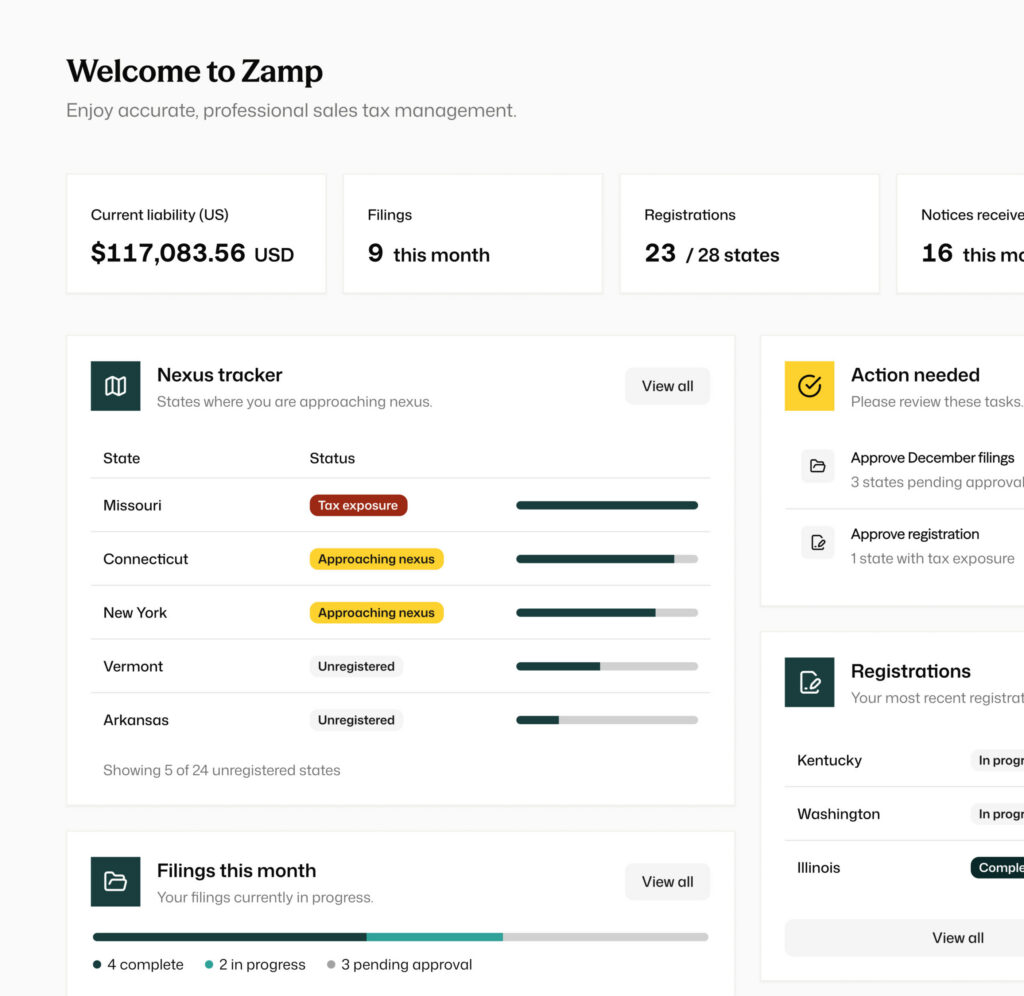
Startups to $300M+ companies wanting sales tax handled rather than just enabled. Particularly well-suited for e-commerce brands, SaaS companies, and accounting firms seeking to extend compliance services to their clients.
Zamp serves 1,200+ finance teams with a 97.8% customer retention rate. The average customer saves 20 hours per month on sales tax work, with onboarding typically completed in under two hours.
All-inclusive monthly pricing that covers software, service, registrations, filings, support, and dedicated account management. No per-transaction fees, no per-filing fees, no surprise invoices.
Get a free nexus assessment to understand your current exposure and see how Zamp works.
Avalara is an indirect tax management software offering comprehensive tax automation for organizations with established accounting departments. The platform provides extensive calculation capabilities with deep integration into enterprise systems, serving 43,000+ customers across 75+ countries.
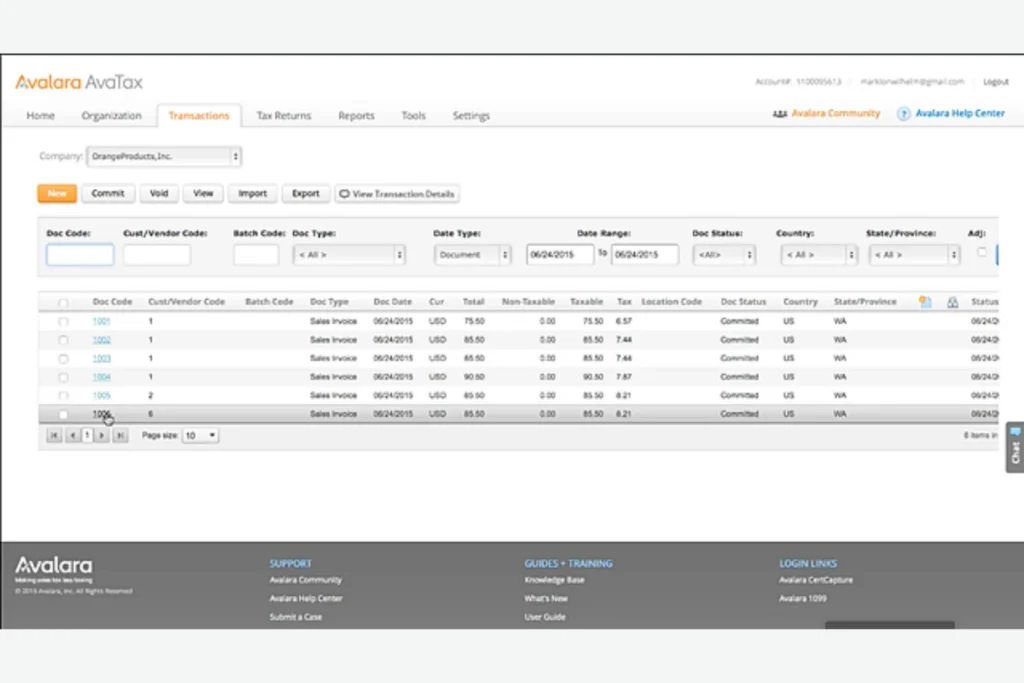
Large enterprises with in-house tax teams who need comprehensive global tax coverage and extensive ERP integrations. Ideal for organizations with dedicated IT resources for implementation and ongoing management.
Custom pricing based on transaction volume and feature requirements. For teams considering a switch, Zamp offers a migration guide from Avalara.
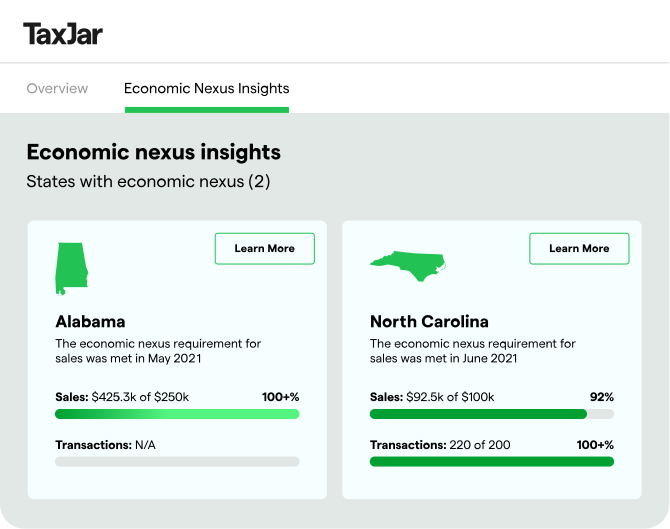
TaxJar provides straightforward US sales tax automation with an emphasis on simplicity and affordability, serving over 20,000 businesses. The platform was acquired by Stripe in 2021, integrating sales tax capabilities into Stripe’s payment ecosystem.
Small to mid-sized e-commerce businesses with US-only operations seeking an accessible entry point to automated sales tax compliance.
Vertex brings 40+ years of experience in tax automation to enterprise organizations, with deep integrations into major ERP systems and comprehensive global indirect tax capabilities.
Large enterprises with complex ERP environments (SAP, Oracle, Microsoft Dynamics) requiring certified tax integrations and global indirect tax capabilities.
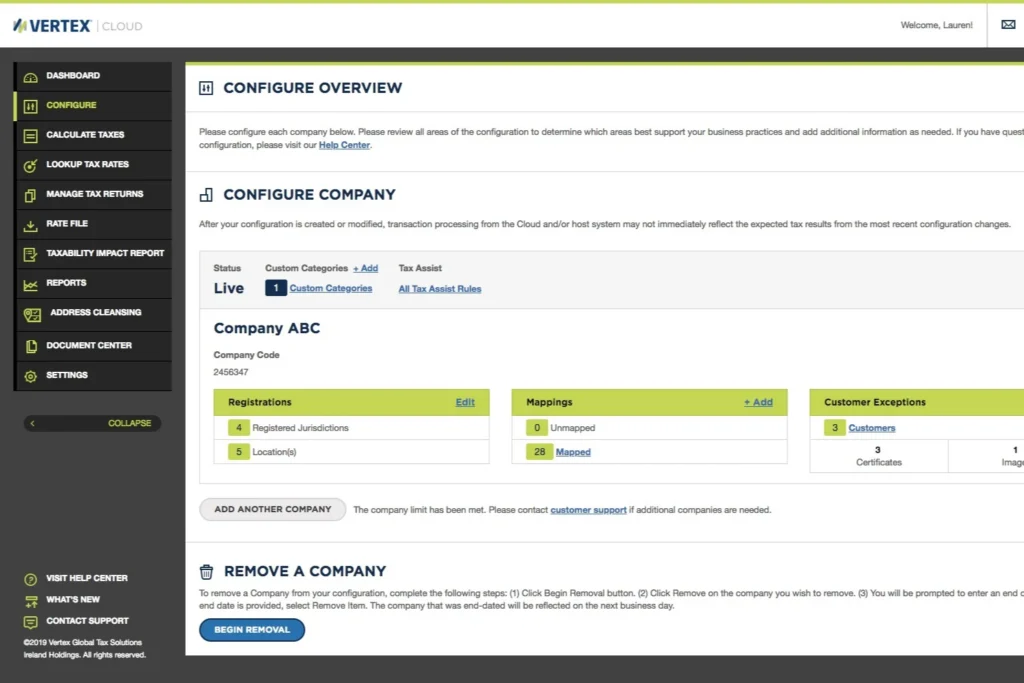
Custom pricing upon request.
Anrok focuses specifically on SaaS and subscription-based businesses, offering a modern platform designed around the complexities of recurring billing and software taxability.
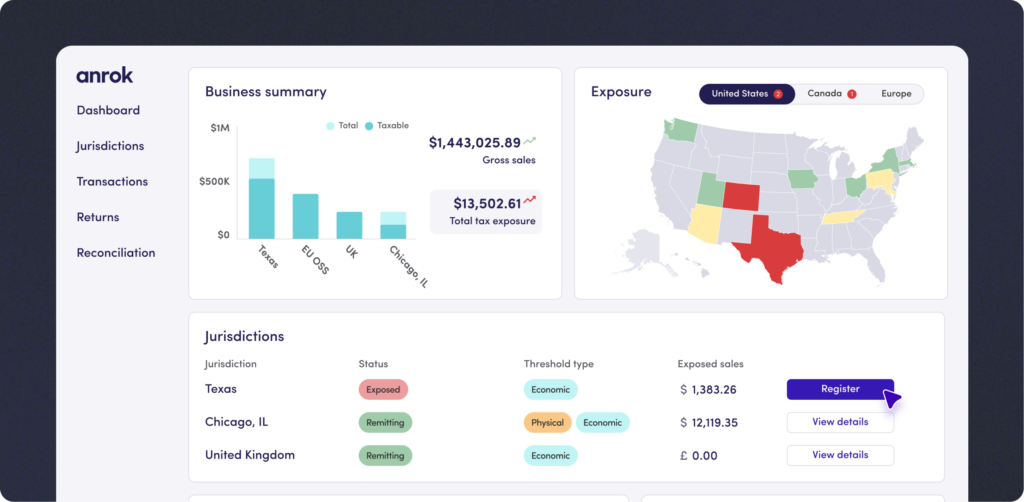
SaaS companies, subscription businesses, and software startups with recurring billing models who want a platform built specifically for their use case.
Custom pricing based on company size and requirements.
Kintsugi is a newer entrant in the sales tax space with automation-focused capabilities and mid-market positioning.
Mid-market businesses seeking a technology-forward approach to US sales tax compliance.
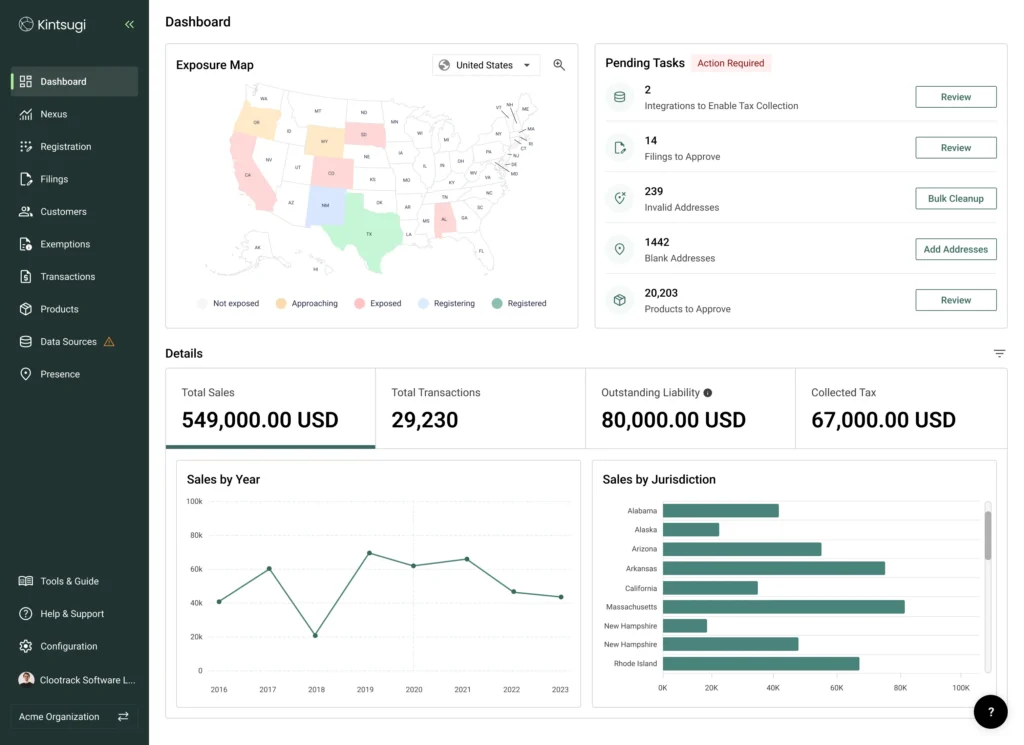
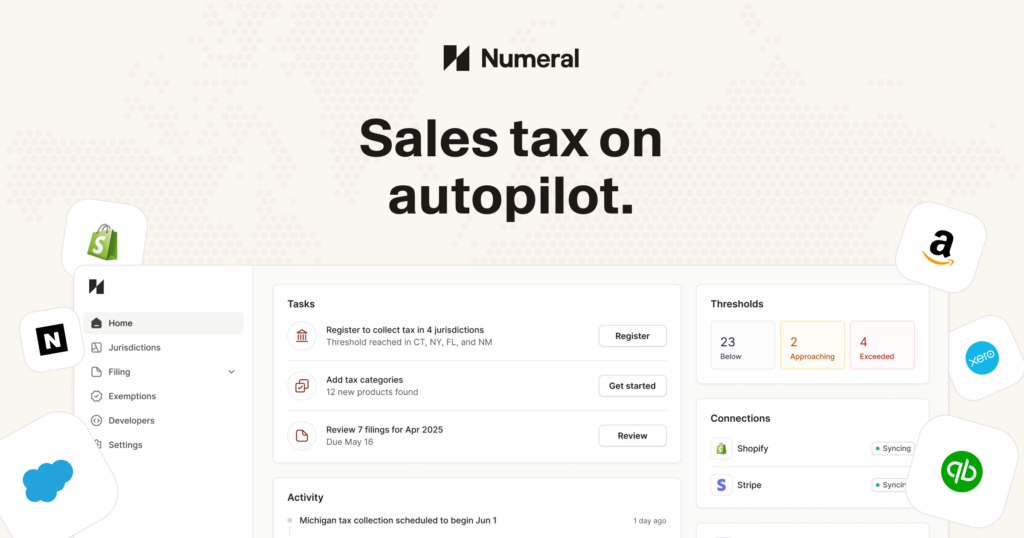
Numeral offers a modern approach to global tax compliance, covering both US sales tax and international VAT/GST with an emphasis on clean design and straightforward implementation.
Growing companies needing both US and international tax coverage with a modern platform experience.
Focus on five key areas: service model (managed vs. self-service), pricing structure (per-transaction, flat-rate, or percentage-based), integration compatibility with your existing tech stack, support access (dedicated manager vs. ticket queue), and liability coverage for errors. Request a clear breakdown of total costs including implementation, and ask specifically who bears responsibility if the platform causes compliance issues.
Migration timelines vary by platform and complexity. Self-service platforms like Avalara or TaxJar typically require several weeks for setup and configuration. Managed service providers like Zamp handle migration with white-glove support, often completing onboarding in days rather than weeks. The key factors are your current state count, integration complexity, and whether you need historical data cleanup.
Yes, many companies run parallel systems during migration to ensure continuity. This is particularly common when switching from a self-service platform to a managed service, allowing validation that calculations match before fully transitioning. Discuss transition planning with your new provider—they should have established processes for seamless handoffs.
Your state registrations remain valid regardless of which compliance platform you use—registrations are with the states, not the software provider. Your new provider will need your existing registration details to continue filing on your behalf. Some platforms assist with registration consolidation or cleanup if you have gaps in your current compliance.
Consider your growth trajectory. SaaS-specific platforms like Anrok work well if you’re confident you’ll remain a pure software business. All-in-one platforms provide flexibility if you might expand into physical products, international markets, or complex B2B scenarios. Managed services like Zamp adapt to your business model changes since human experts—rather than rigid software configurations—handle the nuances.
.png)
%20(1).png)