
Ari Goldstein
Head of Growth, Zamp


%20(1).png)

A lot of comparison guides treat ecommerce sales tax software the same as general sales tax software, but in reality, these are two distinct categories. Your needs as an ecommerce seller aren’t necessarily the same as every other seller, and the moment you sell through more than one channel (e.g., your own Shopify store plus Amazon, or a wholesale account alongside a BigCommerce storefront), your tax calculations get even more complex. (That’s because economic nexus doesn’t reset per channel, and a tool built around a single cart can miss a threshold that’s actually being triggered somewhere else.)
With all of that in mind, this guide walks through eight of the leading sales tax software options for ecommerce, ranging from lightweight self-serve calculators to fully managed services. But unlike other guides out there, we’ve organized this resource around one important question: do you want software you run yourself, or a team that runs it for you?
Before we dive into comparing tools, let’s quickly talk about what ecommerce sales tax compliance actually requires when more than one sales channel is in play.
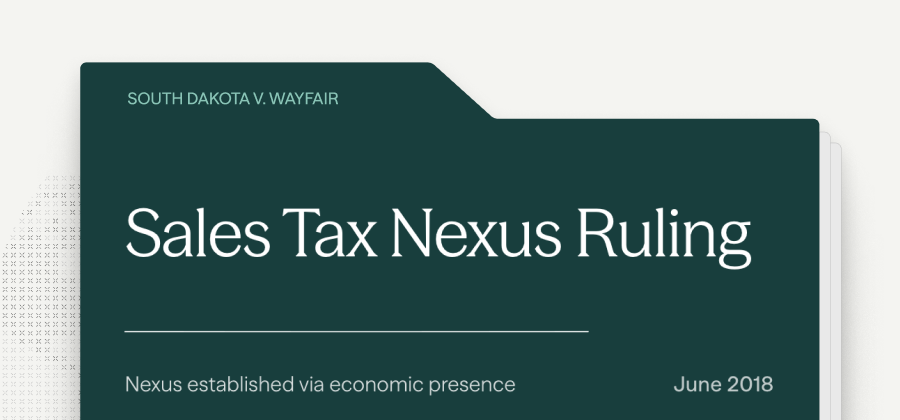
Before 2018, a state generally couldn’t require a business to collect sales tax unless that business had a physical presence inside state lines (e.g., an office, warehouse, or employee). The Supreme Court’s ruling in South Dakota v. Wayfair changed that. A state can now require tax collection once a seller crosses a state-determined sales or transaction threshold, commonly $100,000 in revenue or 200 transactions a year, regardless of physical presence. Check out Oyez’s case summary for a clear, nonpartisan breakdown of this landmark decision if you’d like to learn more.
Marketplace facilitator laws are layered on top of economic nexus rules. Most states now require platforms like Amazon and Walmart to collect and remit sales tax on a seller’s behalf for transactions made through the marketplace. Georgia’s Department of Revenue has crafted a simple explanation of how this works in that particular state, but the process is similar across other states that have adopted it.
What often trips people up with marketplace facilitator laws is that just because a marketplace has collected tax, it doesn’t mean you, as the seller, are totally off the hook. You still need to track those marketplace sales toward your nexus thresholds, and you still owe tax on anything sold through a channel the marketplace doesn’t cover (e.g., your Shopify store). Messing up these calculations could lead to double-remitting tax that was already collected, or worse: inadvertently failing to remit tax because you didn’t know you’d crossed a threshold.
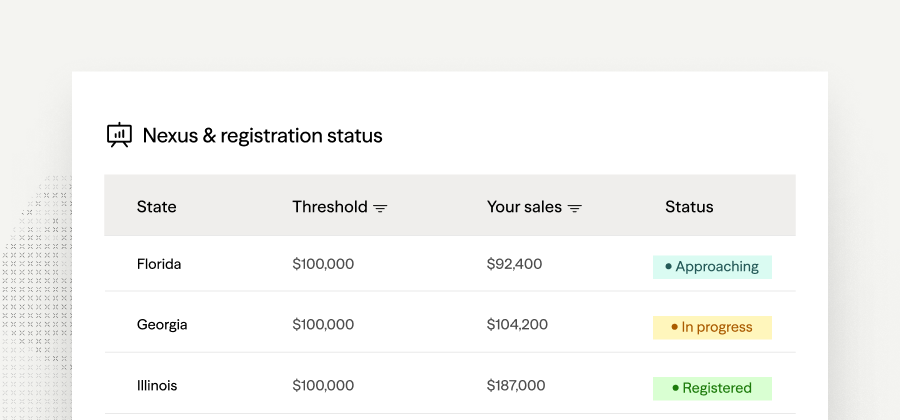
Economic nexus thresholds are calculated on a seller’s total sales in a state, combined across every channel. In other words, thresholds are not measured separately for each channel (e.g., Shopify, Amazon, and wholesale). This crucial detail is precisely why single-cart tools aren’t viable solutions for multi-channel ecommerce sellers. A brand doing $60,000 on Shopify and $50,000 through Amazon FBA in the same state has crossed a $100,000 threshold even though neither channel reached the threshold on its own. And even outside of sales and transactions thresholds, inventory sitting in an FBA warehouse or a third-party logistics center can also create good old-fashioned physical nexus in a given state. So, if you use an automated sales tax tool that only keeps tabs on one sales channel, you put your brand in jeopardy of missing both of these triggers. (FYI, Zamp’s nexus tracker is built for this exact purpose, monitoring thresholds across every channel combined rather than one at a time.)
Okay, now that you’re up to speed on the logistics, let’s dig into what actually separates a good-fit solution from one that’ll probably be a pain in the you-know-what six months in:
Whether you’re comparing full sales tax automation platforms or lighter calculation-only tools, answering these five questions will give you a more realistic idea of your day-to-day experience with a vendor than any feature on a spec sheet.
The chart below provides a quick side-by-side overview of key attributes of the best sales tax software for ecommerce.
The table below breaks down the core product capabilities of all eight platforms, so you can quickly identify functional gaps before you commit to any one solution.
Notes on starred (*) cells:
A blank cell means the capability wasn’t confirmed in our research, or that the capability is not clearly indicated in a platform’s publicly available product information. Confirm actual features and functionality directly with any vendors you are seriously considering.
Here’s a closer look at each vendor, including customer feedback drawn from real G2 and Capterra reviews.
.png)
For ecommerce brands looking to take the stress of sales tax completely off their team’s shoulders, Zamp is the obvious winner among the other platforms on this list. Pairing its intuitive software with a dedicated team that includes former state auditors, Zamp is built specifically for ecommerce and SaaS companies that want compliance handled end-to-end rather than managed in-house. Zamp connects natively across Shopify, Amazon, BigCommerce, Adobe Commerce, NetSuite, and QuickBooks, making it an excellent fit for multichannel sellers that must track nexus in aggregate across all platforms, not just one. (See all available Zamp integrations here.)
Zamp’s pricing is designed to support, rather than penalize, business growth. Options include a free assessment tier as well as custom-quoted U.S. and U.S.-plus-Canada plans scoped to a business’s unique footprint. This approach distinguishes Zamp from many other sales tax solutions whose per-transaction or per-filing pricing scales unpredictably as order volume increases. That makes Zamp an especially great option for scaling ecommerce brands like Yumwoof, an Austin-based pet food company that uses Zamp to manage compliance across 17 states and counting.
On G2, Zamp holds an impressive average rating of 4.7 out of 5 across 47 reviews, with reviewers specifically highlighting the depth of the platform’s multichannel integration as well as its proactive nexus monitoring, the exact two capabilities a growing multichannel seller needs. G2 has also recognized Zamp with a wide array of badges, including Best Support, Easiest Setup, Easiest to Use, and Best Meets Requirements, offering further objective evidence of Zamp’s unique combination of technical depth and hands-on support. The tradeoff is that there’s no self-serve signup option, and Capterra currently shows no published reviews for Zamp, so third-party validation is concentrated on one platform.
Backed by $30M in funding from investors like Thomson Reuters Ventures and Acrew Capital and reporting 99.97% filing accuracy across more than 100,000 filings, Zamp is a top contender for teams that want total peace of mind, not just a platform.
.png)
With ecommerce integrations that include Shopify, Magento, and BigCommerce, layered on top of deep ERP integrations with SAP, NetSuite, and Salesforce, Avalara is a mainstay for larger, multi-system sellers. It’s probably more infrastructure and complexity than a smaller, single-platform DTC brand needs. But for a seller with a bigger back-office tech stack that’s running ecommerce alongside wholesale, Avalara is a solid fit.
Pricing is quote-only for the core product (based on volume and transactions), though registration runs a flat $403 per location. On Capterra, Avalara sits at an average rating of 4.0 out of 5 across 355 reviews, and G2 shows the same 4.0 average across 825 reviews. Integration depth and calculation reliability draw consistent praise; customer service is by far the most common complaint, with reviewers describing slow response times and billing that continued after cancellation. (See Zamp vs. Avalara for a more detailed comparison of these two platforms, specifically.)
.png)
TaxJar, now part of Stripe Tax, is a natural fit for sellers already running Stripe for payments, as well as Shopify and Amazon merchants looking for a lighter, self-serve tool. Stripe Tax splits its offerings into two tiers: Tax Basic handles calculation and collection only, billed per transaction where you’re registered (with a small number of free calculation API calls before a per-call charge kicks in), while Tax Complete adds registration and filing on a tiered monthly subscription basis.
TaxJar’s legacy pricing runs $39 to $99 a month depending on tier, with a capped number of AutoFile credits included and additional filings billed separately, so filing isn’t unlimited by default. On Capterra, TaxJar holds an average rating of 4.4 out of 5 across 76 reviews, and G2 shows a strong average rating of 4.7 across 252 reviews, though several reviewers note a decline in support quality after the Stripe acquisition. (Get a more detailed comparison of Zamp vs. TaxJar here.)
.png)
Vertex’s enterprise reputation sometimes overshadows its ecommerce capabilities, but it actually has a well-rounded ecommerce setup, including a Shopify partnership. It also connects to Adobe Commerce, BigCommerce, and Mirakl-powered marketplaces, making it perhaps the strongest fit for sellers running ecommerce as one piece of a larger, multi-entity, multi-country operation already built on a major ERP.
Pricing is enterprise and custom quote-based (rates are not published). Capterra ratings for Vertex average 4.3 out of 5 across 75 reviews, and G2 ratings average 4.4 out of 5 across 466 reviews, with reviewer feedback consistently calling out Vertex’s responsive support alongside its strong calculation accuracy. Tradeoffs include a dated interface and a longer, more involved implementation than a smaller ecommerce brand may want to take on.
.png)
Anrok is built for SaaS and digital-goods companies, and this focus shows up in both its customer list (which includes Anthropic, Notion, Vanta, and Mercury) and its ecommerce fit: it connects well to Stripe and other billing platforms, but unlike many of the other solutions on this list, it isn’t built for physical-goods, multichannel selling. Filing and remittance are included in the core product rather than sold as add-ons, differentiating the platform from many other tools here that charge extra for it.
Pricing starts at $100 per market per month on the Starter tier, with a custom tier for businesses in 10 or more markets. On G2, Anrok holds a strong average rating of 4.5 out of 5 across 299 reviews, with particular strength among SaaS and subscription businesses. If most of your revenue comes from physical goods sold across Shopify, Amazon, and wholesale, then you should keep Anrok on your radar, but it’s probably not the right fit in its current state.
.png)
Numeral specifically targets Shopify-first DTC brands, as evidenced by its pricing: rather than a flat monthly subscription, the Standard tier charges per state filing and per state registration, which often works in favor of sellers with a handful of nexus states. But, costs can quickly add up for those with nexus in a lot of states.
Reviews are fairly split, so if you’re seriously considering Numeral, we’d recommend diving deeper into published customer feedback. On G2, Numeral has an average rating of 3.6 out of 5 across 19 reviews, with several reviewers who switched from TaxJar specifically praising the support team. Others report duplicated filings, overpayment, and slow resolution on more complex cases. Trustpilot reviews tell a similar story: generally positive on ease of use and onboarding speed, with a recurring complaint about slow support response when something goes wrong. Overall, while it might be a fit for simpler, single-channel situations, it appears that problems tend to arise once things get more complicated.
.png)
TaxCloud leans into being the budget-conscious sales tax software for online retailers. Its Streamlined Sales Tax (SST) certification means calculation is free in the 24 SST member states, no matter which plan you’re on. It connects to Shopify, WooCommerce, BigCommerce, and Magento, covering the most common small-to-mid-size ecommerce stacks.
Pricing combines order-volume tiers starting at $19 a month with a separate filing subscription starting at $39 a month, plus a 7% surcharge on credit-card payments. Ratings diverge more than usual for TaxCloud: Capterra shows an average rating of 3.5 out of 5 across 73 reviews, while G2 shows an average of 4.5 out of 5 across 43 reviews, with low cost cited as a recurring plus and support responsiveness as a recurring complaint across both review platforms. Overall, it’s a solid sales tax software for small business option for sellers watching every dollar.
.png)
Kintsugi is the newest name on this list, and despite having the smallest review sample, it’s also currently the highest-rated: 4.8 out of 5 on Capterra across 16 reviews, and 4.6 out of 5 on G2 across 45 reviews. The caveat, though, is that this is a smaller review base than some of the more established names on this list. Kintsugi connects through the Shopify App Store and integrates with the usual ecommerce and billing platforms, and multiple reviewers describe switching over from Avalara or TaxJar specifically based on cost and service quality.
On the pricing front, a free tier covers nexus monitoring and address validation; the paid Starter tier adds filing, automatic registration, and exemption certificate management, priced per filing or registration rather than as a flat subscription. One reviewer on Capterra explicitly weighed Kintsugi against Zamp before choosing Kintsugi due to price and team confidence. (See this Zamp vs. Kintsugi page for a closer look at how these two solutions stack up.)
A single-channel seller (say, a lone Shopify store with a handful of nexus states and someone in-house who is comfortable reviewing filings) can usually run just fine on a self-serve tool. The tradeoff is time and attention, not necessarily risk (as long as someone is actually paying attention to it every month).
Once an ecommerce seller adds a second or third channel, has Amazon FBA inventory sitting in new states, or has a wholesale account alongside DTC, the aggregation problem we talked about earlier in this guide starts becoming very real. This is where a fully managed service swoops in for the win: someone else is reconciling nexus across every channel and handling responses to state notices in a timely fashion. (If you want a closer look at multichannel-specific patterns like FBA inventory nexus, Zamp’s broader ecommerce platform comparison goes deeper on that specific topic.)
Here’s a short framework to sort through all of this, based on how your business sells:
Whatever your needs are, we recommend aligning them as honestly as you can to the ecommerce sales tax solutions above, rather than defaulting to certain names just because they are familiar or widely known.
It’s software that calculates sales tax at checkout, tracks where your combined sales across channels have created economic nexus, and in many cases, handles your registration and filing. Coverage varies a lot depending on the vendor; some stop at calculation, while others own the full process end to end.
Yes, usually. Amazon and Walmart collect and remit tax on marketplace transactions under marketplace facilitator laws, but you’re still on the hook for tracking those sales toward your own nexus thresholds and handling any direct channels, like your own Shopify store, correctly.
It’s a sales or transaction threshold that, once crossed in an individual state, creates a tax obligation there even without a physical presence. This standard was set nationally by South Dakota v. Wayfair. For multichannel sellers specifically, that threshold is based on combined sales across every channel, not any one channel in isolation.
With self-serve software, you are responsible for configuring rules, watching for nexus alerts, and initiating registration or filing yourself. With a fully managed service, a team of experts does all of that on your behalf, and in some cases responds directly to state notices as well.
It depends on the model. Some vendors offer set subscription tiers based on order volume, some price on a per-filing or per-registration basis, some charge a percentage of taxable revenue, and some provide custom-quoted pricing. Check out the table above, and be sure to confirm current numbers directly with each vendor before committing.
Most modern platforms connect to more than one cart or marketplace, but the depth of those integrations varies. Be sure to confirm real-time multi-channel sync, exemption certificate handling, and whether nexus is tracked in aggregate across everything you sell on (not just calculated separately for each channel).
With most self-serve tools, responding to that notice, and often initiating any new registration it requires, is still on you. A fully managed service, on the other hand, typically handles that response for you.
Generally, no, not by itself. Built-in cart or marketplace calculators handle that one channel well, but they don’t monitor nexus across your other channels, register you in new states when necessary, or file returns for you.
There’s no single best sales tax software for ecommerce, only the one that best matches how many channels you’re actually selling on and how much of the reconciliation work you want to own. A single-channel seller with in-house bandwidth might do fine with a self-serve ecommerce sales tax software like Anrok, TaxJar, or Kintsugi. But for a multichannel brand juggling nexus tracking and notices across Shopify, Amazon, and wholesale, a fully managed service like Zamp’s probably makes the most sense.
If that’s the kind of solution you’re leaning toward, explore Zamp’s ecommerce and retail solutions here, or talk to Zamp’s team directly about what end-to-end sales tax support would look like for your specific channel mix.
.png)