


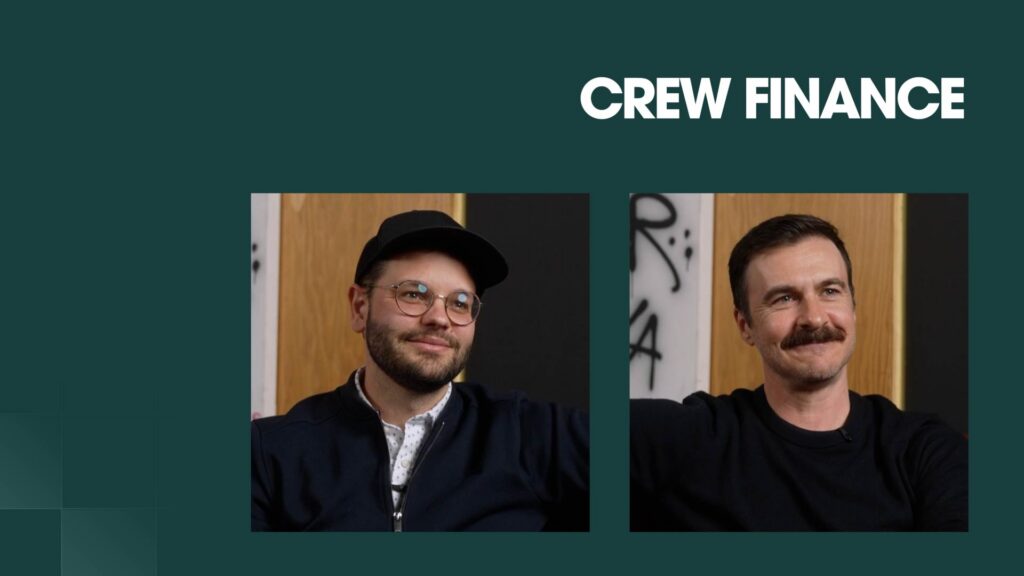
David Whitcroft has spent his career inside consumer goods brands. He’s seen what happens when the financial infrastructure doesn’t keep up with growth — the compliance gaps, the accounting debt, the liabilities nobody noticed until someone opened the books and found them.
So when he co-founded Crew Finance in 2023, the mission was clear: build the finance and accounting backbone that lets founders focus on building, not firefighting.
“We want to make sure we’re providing infrastructure that allows these companies to grow,” David said. “Whether that’s working capital, compliance, or financial modeling — we want to be there.”
In just three years, Crew has grown to support more than 300 clients spanning FP&A, CFO advisory, accounting, and HR. They specialize in high-growth, venture-backed consumer goods startups — DTC, wholesale, omnichannel, brick-and-mortar. Their clients range from pre-revenue all the way to nine-figure exits. Two of them sold for over a billion dollars last year.
And through every stage of that growth, getting sales tax right wasn’t optional. It was table stakes.
What Founders Bring Through the Door
No two Crew clients arrive in the same shape. Some have never thought about sales tax. Others come in carrying years of accounting debt from DIY tools and disconnected systems they cobbled together while focused on growth.
What they all share is an expectation: once they hand their finances to Crew, they don’t want to think about them anymore.
That expectation is exactly what Stefanos Metaxas, SVP of Strategy and Operations, holds the firm to.
“No longer worrying about their finances is table stakes,” Stefanos said. “They don’t just want to know what happened this month. They want expertise. And that expertise needs a very well-functioning system underneath.”
Before Zamp, sales tax was a gap in that system. Clients came in with whatever solution they’d been using — sometimes a DIY tool, sometimes a non-specialist firm that wasn’t fully across nexus requirements. Either way, someone still had to log in, check if nexus had been triggered, and manage the filings themselves.
“It was less streamlined, more risky, and a drag on scaling the business,” David said.
For a firm staking its reputation on certainty, that drag wasn’t acceptable.
The Standard Every Partner Has to Meet
Crew is a referral-based business. Every partner they put in front of a client carries the Crew name. The bar is deliberate.
When evaluating any partnership, David runs through a short checklist: Do they provide true white-glove service? Can they pick up the phone and actually answer the question? Is the pricing competitive? Can they scale with clients over time?
Within the first few months of starting Crew, David began referring clients to Zamp.
“Finding the right partner for every type of service is a really important piece of our ability to grow,” he said. “It allows us to introduce a trusted, supportive partner to our clients so that we know their needs are taken care of. But it also reduces the workload and pressure on our team.”
Stefanos put the distinction bluntly: working with Zamp isn’t like adding another software tool to the stack. It’s the difference between handing a client a piece of software and handing them a department.
Clear ownership was a big part of the appeal. Before Zamp, there was always ambiguity around who was responsible when a nexus trigger occurred. Was it Crew? The client? The tool? That ambiguity has a cost.
“Ambiguity can really ruin a relationship in the long term,” Stefanos said. “Working with Zamp, from beginning to end there’s ownership and clear structure. We know what we own, we know what they own, and we can keep going from there.”
Zero Complaints
The result that matters most to Stefanos is the simplest one to measure.
Crew has introduced nearly all of its clients to Zamp. In that entire time, they haven’t received a single sales tax complaint.
“I know that sounds a little silly — that shouldn’t be the number one reason to work with someone,” Stefanos said. “But given that I oversee client experience, that is very important. And it reflects very positively on us.”
No complaints means no surprise bills. No ambiguous filings. No client wondering why their nexus triggered three months ago and nothing happened. It means sales tax fades into the background — exactly where it belongs for a founder trying to build something.
“Zamp thinks quickly about what’s around the corner and how to ensure that there are no errors for our clients,” Stefanos said. “It’s incredibly nimble. And that’s incredibly important.”
David points to something else that stood out after attending Zamp’s offsite and meeting the broader team: the size is intentional.
“You don’t want to think about there being one guy in a room doing all your sales tax compliance. That has dangers. And likewise, a company that is massive and publicly traded — you get lost in the weeds,” he said. “Zamp has in-house tech, in-house product, and sales tax experts. But they’re not so big that you can’t reach the CEO or talk to the product team.”
Built to Grow Together
Three years in, Crew isn’t slowing down. More clients, more channels, more complexity. And as their clients scale, the demands on every part of the infrastructure — including sales tax — scale with them.
“Zamp has been critical for our ability to scale and grow with our clients,” David said. “Making sure we can always rely on a sales tax department to be there puts our minds at ease and ensures our clients are getting the support they need.”
The partnership works because both companies are wired the same way. White-glove service, clear ownership, no surprises, and people on the other end who actually pick up the phone.
“Having a sales tax partner you can trust allows you to sleep better at night,” David said. “Knowing your clients are being looked after.”
300 clients, two unicorn exits, and zero complaints. That’s not luck. That’s what the right infrastructure looks like.
Sales tax problems don’t have to scale with your practice. Zamp handles it end-to-end so you don’t have to.

Brandon Roth