




Anrok has built a strong reputation among SaaS companies looking to automate sales tax compliance, with 40%+ of Forbes AI 50 companies using its platform. But the right sales tax solution depends on your business model, team structure, and how much ownership you want over day-to-day compliance. Whether you’re looking for a managed service that handles everything, an enterprise platform with deep ERP integrations, or a budget-friendly option for basic automation, this guide breaks down seven alternatives worth evaluating.
Key takeaways
- Managed service vs. self-service software: Some platforms give you tools to manage compliance yourself, while others (like Zamp) handle registrations, filing, and notices on your behalf—choose based on whether you want to own the work or own the outcome
- Pricing model impacts total cost: Transaction-based fees scale with growth, while all-inclusive pricing keeps costs predictable—model your expected costs at current and projected revenue levels
- Data ownership affects accuracy and defensibility: Platforms that own and maintain their own tax content can answer “why was this taxed this way?” with certainty, which matters during audits and CFO reviews
- Support structure determines your experience: Dedicated account managers provide different value than ticket-based support queues—consider how much hands-on guidance your team needs
- Integration depth varies by platform: Some solutions offer native connections to specific ecosystems (SaaS billing tools, e-commerce platforms, enterprise ERPs), so match the platform to your existing tech stack
- Liability coverage is a meaningful differentiator: Evaluate whether the platform covers penalties and interest from their errors, or whether your company bears all compliance risk
1. Zamp: managed sales tax compliance done for you or with you
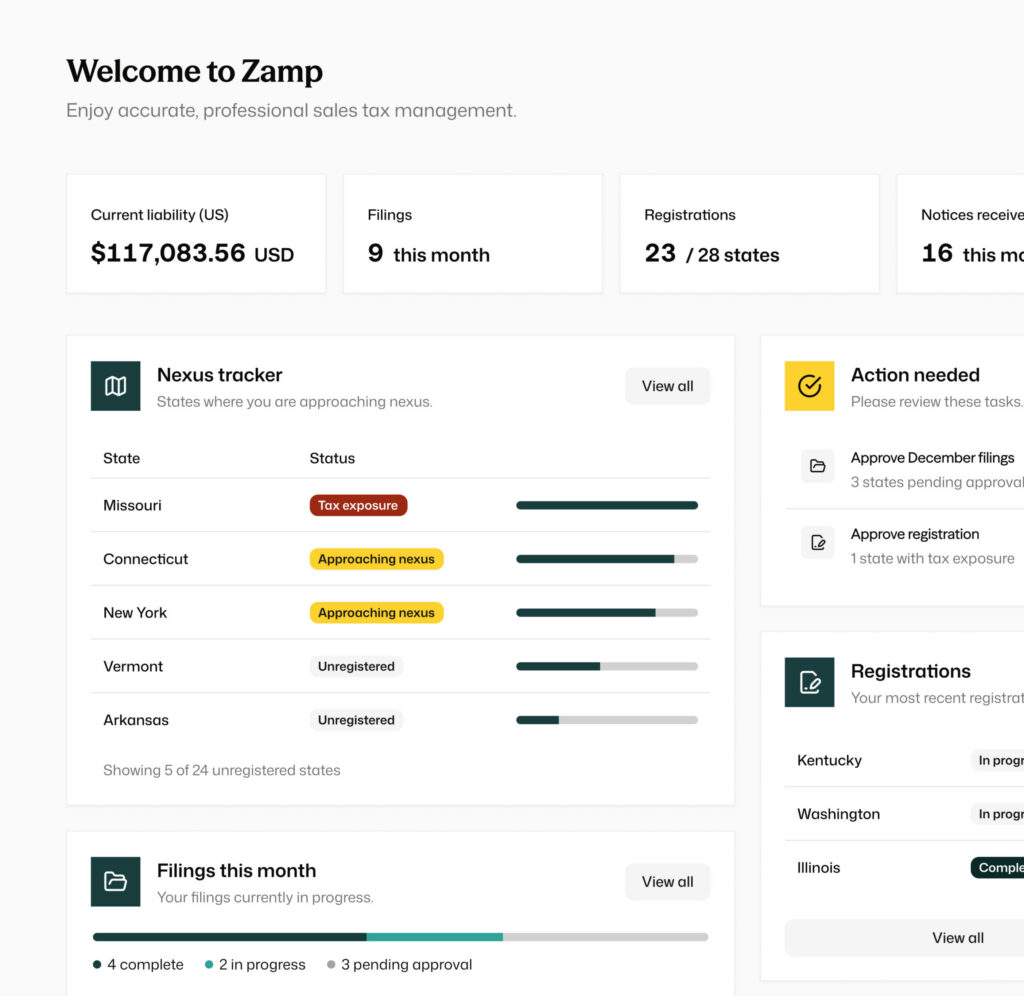
Zamp takes a fundamentally different approach to sales tax. Rather than providing software for your team to operate, Zamp combines an intelligent platform with dedicated tax professionals who handle compliance end-to-end—or work alongside your team if you prefer more oversight. This “do it for you or do it with you” model serves companies from startups to $300M+ in revenue who want sales tax handled without becoming tax experts themselves.
Best for
E-commerce brands, SaaS companies, and accounting firms seeking a partner that owns the compliance outcome—not just the tools. Particularly valuable for growing companies where finance teams are already stretched thin.
Key capabilities
- Real-time rooftop-accurate rates across 13,000+ U.S. jurisdictions and 70+ countries
- Proactive nexus monitoring with alerts at 80% of threshold, plus automated registration management
- Automated filing and remittance with discount capture across all registered states
- End-to-end notice management—Zamp resolves notices before they reach your inbox
- Audit support and cleanup work for past-due returns and historical exposure
- Liability sharing—the Zamp Commitment covers penalties and interest from Zamp’s errors
- Dedicated account manager for every customer, with average support response under 1 hour
Pricing approach
All-inclusive monthly pricing that covers software, service, registrations, filings, support, and dedicated account management. No per-transaction fees, no per-filing fees, no surprise invoices.
Get a free nexus assessment to understand your current exposure and see how Zamp works.
2. TaxJar
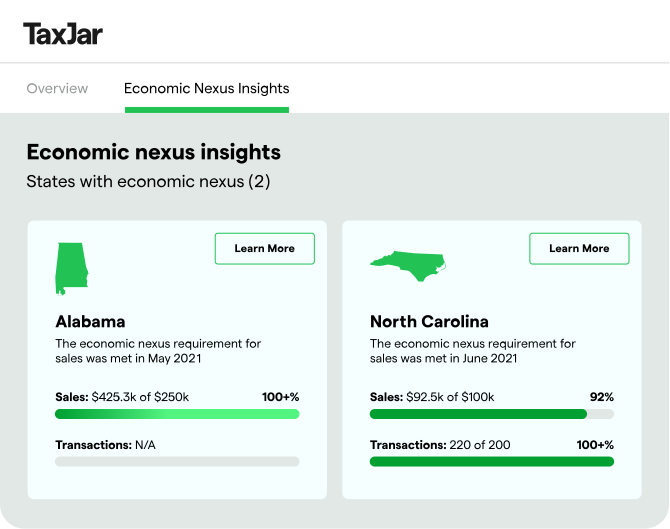
TaxJar, now owned by Stripe, provides sales tax automation with a focus on e-commerce businesses. The platform offers calculation, nexus tracking, and automated filing capabilities through a self-service model.
Best for
Small to mid-sized e-commerce businesses seeking transparent, tiered pricing and strong integrations with platforms like Shopify, Amazon, and WooCommerce.
Key capabilities
- Real-time sales tax calculations across U.S. jurisdictions
- Nexus insights dashboard tracking economic nexus thresholds
- Automated filing functionality (limited filings included per plan)
- Native integrations with major platforms
- API access for custom implementations
Pricing model
- Pricing varies based on order volume
- Starter: Starts at $19/month
- Professional: Starts at $99/month
3. Avalara
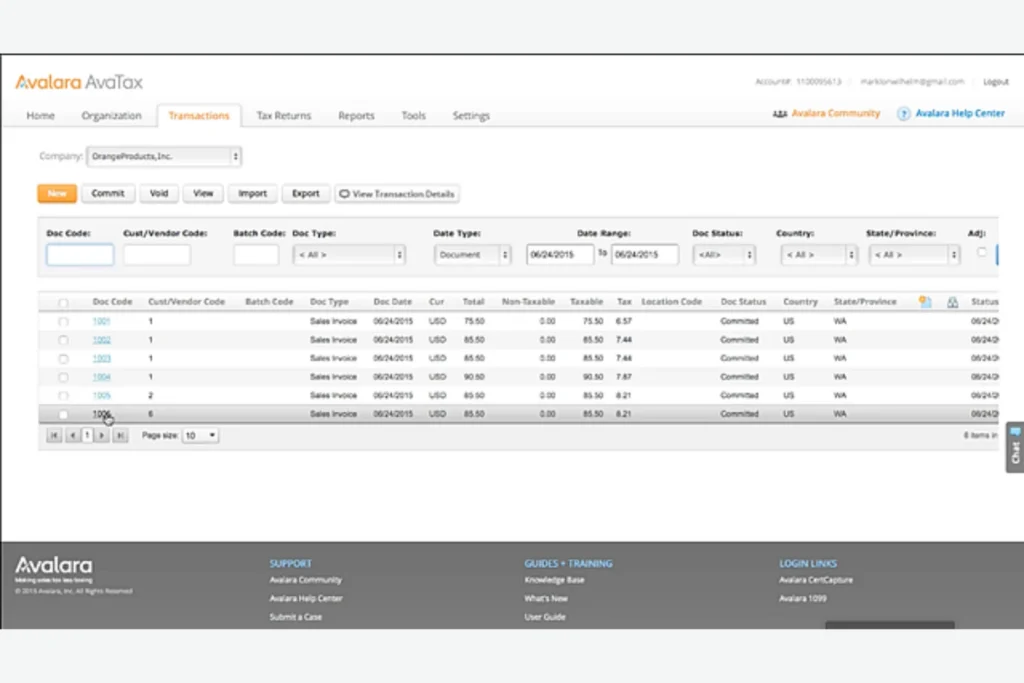
Avalara is an indirect tax management software offering comprehensive tax automation for organizations with established accounting departments. The platform provides extensive calculation capabilities with deep integration into enterprise systems.
Best for
Large enterprises with in-house tax teams who need comprehensive global tax coverage and extensive ERP integrations. Ideal for organizations with dedicated IT resources for implementation and ongoing management.
Key capabilities
- Advanced tax calculation engine covering US sales tax plus international VAT and GST
- 1,400+ certified integrations including native SAP, Oracle, and NetSuite connections
- Industry-specific configurations for manufacturing, hospitality, and specialized verticals
- Exemption certificate management and validation
- Returns preparation and filing automation
Pricing model
Custom pricing based on transaction volume and feature requirements. For teams considering a switch, Zamp offers a migration guide from Avalara.
4. Vertex
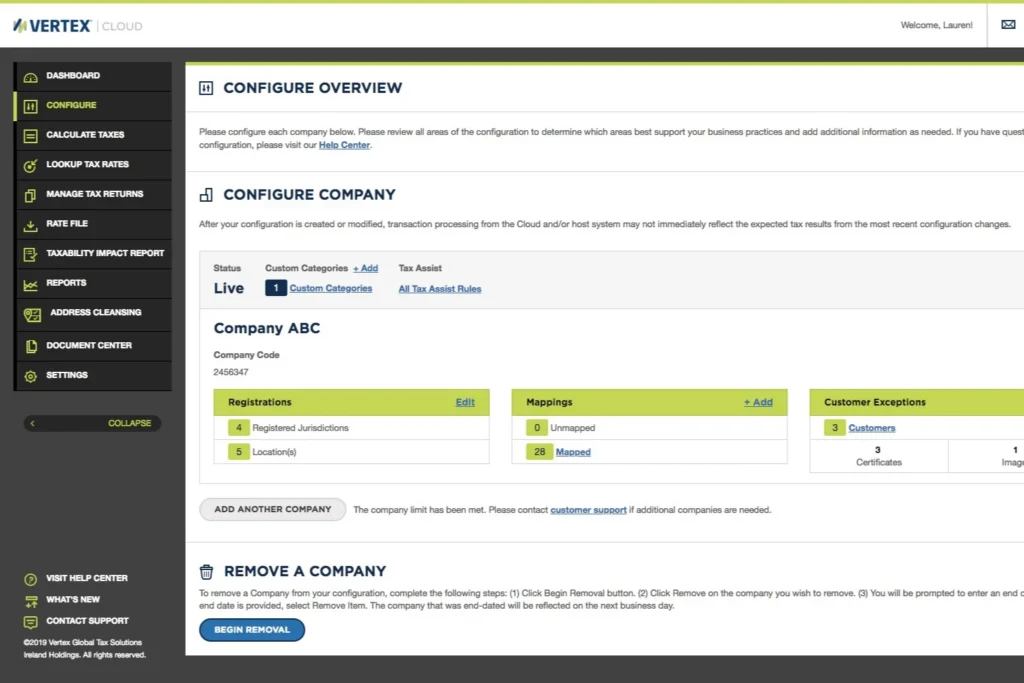
Vertex serves large enterprises with comprehensive indirect tax capabilities across multiple tax types. The platform is designed for organizations with established accounting departments managing complex global tax obligations.
Best for
Fortune 500 companies and large multinationals with sophisticated tax departments requiring deep customization and broad indirect tax coverage.
Key capabilities
- Comprehensive tax determination engine
- Multi-tax-type coverage (sales, use, VAT, communications)
- Deep ERP integrations for SAP and Oracle environments
- Advanced reporting and analytics
- Global tax content and compliance support
Pricing model
Custom pricing upon request.
5. Numeral
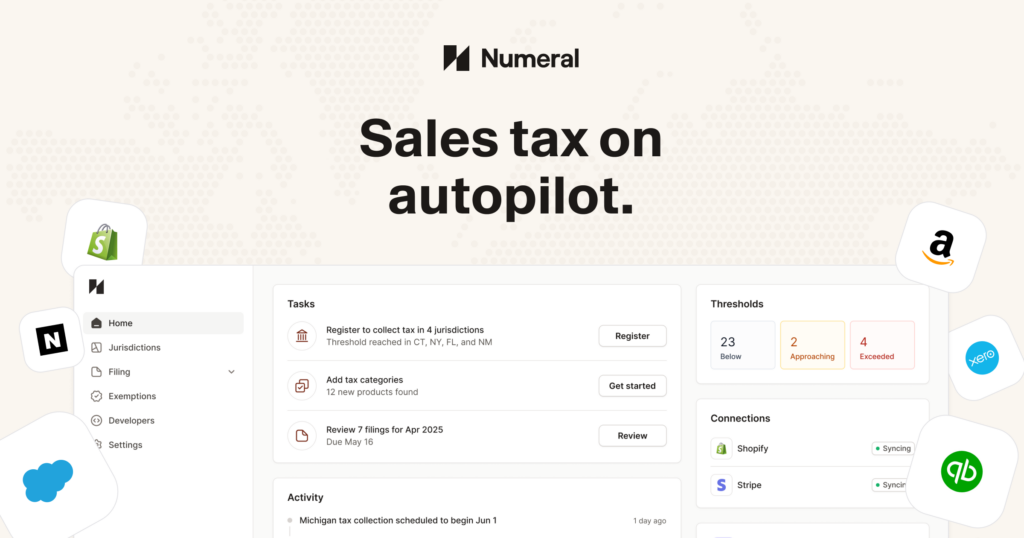
Numeral positions itself as a flat-fee alternative to transaction-based pricing models. The platform offers managed service elements alongside its automation capabilities.
Best for
SaaS and e-commerce companies seeking predictable monthly costs and an alternative to revenue-percentage pricing.
Key capabilities
- Sales tax calculation and nexus monitoring
- Filing and remittance services
- Flat monthly pricing structure
- Integrations with billing and e-commerce platforms
Pricing model
- Monitoring: Free
- Standard: $75 per filing and $150 per registration
- Pro: Custom pricing
6. Kintsugi
Kintsugi is a newer entrant in the sales tax automation space, focusing on streamlined automation for e-commerce businesses.
Best for
E-commerce companies exploring newer platforms with automation-focused approaches to sales tax compliance.
Key capabilities
- Sales tax calculations and compliance automation
- Nexus tracking and threshold monitoring
- Filing support across U.S. states
- E-commerce platform integrations
Pricing model
- Free tier available
- Starter: Starts at $75 per filing or registration
- Premium: Custom pricing
7. Sovos
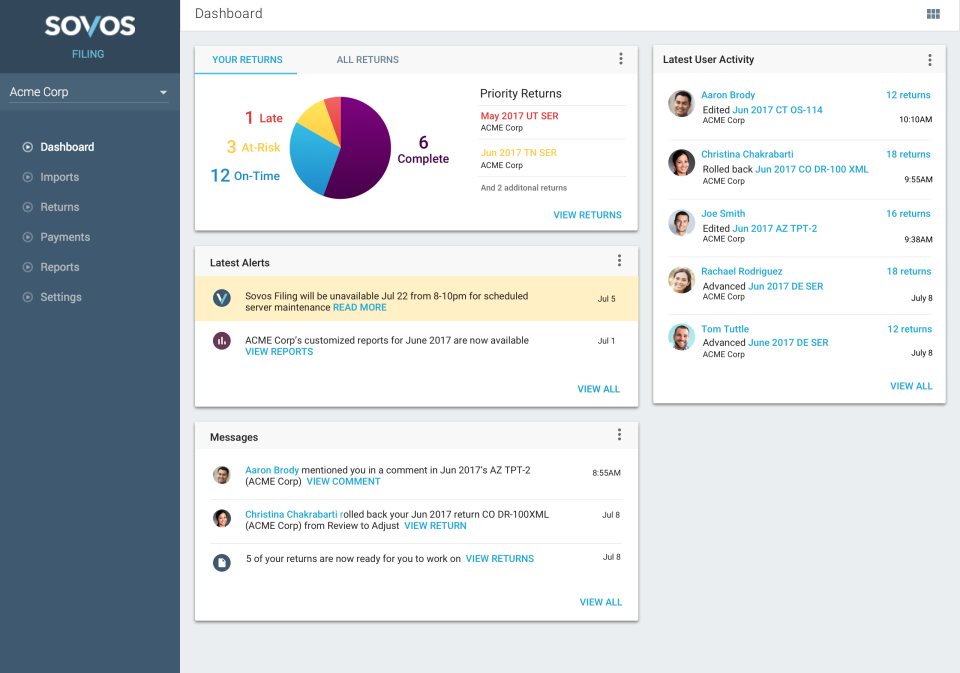
Sovos provides enterprise tax compliance and regulatory reporting across multiple tax types. The platform serves large multinational organizations with broad indirect tax and regulatory obligations.
Best for
Large enterprises requiring compliance across multiple regulatory frameworks, including tax, e-invoicing, and regulatory reporting.
Key capabilities
- Broad indirect tax coverage across tax types
- E-invoicing and regulatory reporting
- Global compliance capabilities
- Enterprise integrations and implementation services
Pricing model
Custom enterprise pricing.
Frequently asked questions
How do I evaluate whether I need managed service or self-service software?
Consider your team’s capacity and expertise. Self-service platforms work well when you have someone who can dedicate time to learning tax rules, monitoring nexus thresholds, managing registrations, and handling notices. Managed services like Zamp make sense when you’d rather have experts own those responsibilities while your team focuses on core business operations. Many growing companies find that the time saved—20+ hours monthly on average with Zamp—justifies the managed approach.
What should I expect when switching from Anrok to another provider?
Switching sales tax providers is more straightforward than many expect. With Zamp, the transition includes white-glove onboarding where the team handles integration setup, historical data review, and nexus assessment—typically completed in under 2 hours. There’s no compliance gap during the transition. Companies currently under contract with other providers can discuss buyout options. The key is ensuring continuous coverage so no filing deadlines are missed.
How do pricing models differ between transaction-based and all-inclusive approaches?
Transaction-based pricing scales with your growth—as revenue increases, so do costs. All-inclusive models (like Zamp’s) provide predictable monthly costs regardless of transaction volume, with registrations, filing, and notice management included. For a company with $5M in revenue, the difference can be substantial over a year. Model your costs at both current and projected revenue levels to understand the true comparison.
What happens if the platform makes a calculation or filing error?
This varies significantly by provider. The Zamp Commitment covers penalties and interest resulting from Zamp’s errors—a meaningful liability protection. Most self-service platforms place compliance responsibility entirely on the business, meaning errors are your problem to resolve and pay for. When evaluating alternatives, ask specifically about error liability and audit support to understand where responsibility falls.
Can I transition from Anrok while maintaining my existing integrations?
Yes. Most sales tax platforms integrate with the same core e-commerce, billing, and accounting systems. Zamp offers native integrations with Shopify, NetSuite, QuickBooks, and other major platforms. During onboarding, the Zamp team handles integration configuration to ensure your existing tech stack connects properly. Companies currently using TaxJar can reference the TaxJar migration guide for transition details.